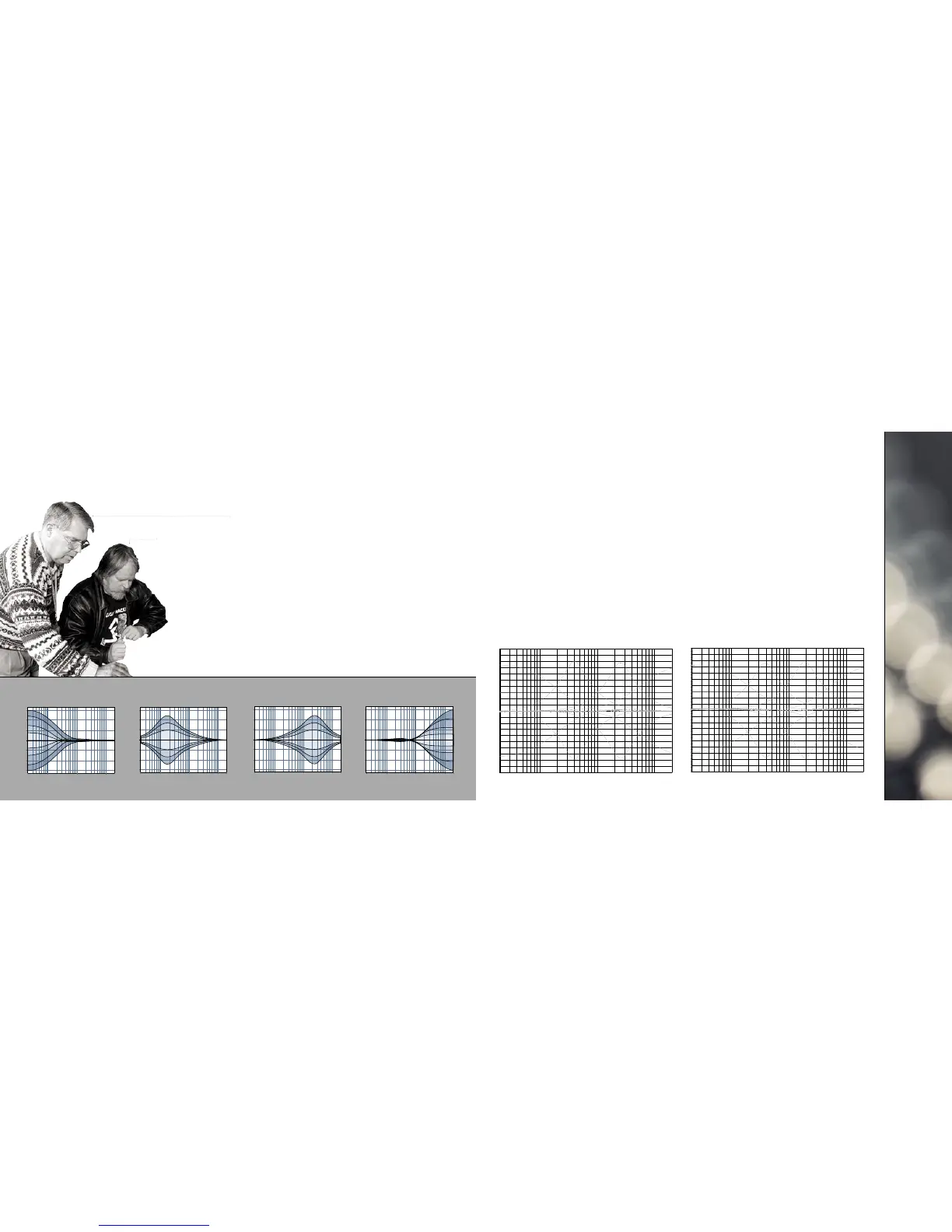
STER EO EQ
Before we tell you about the Perkins EQ section, we should probably
introduce you to its designer—the legendary Cal Perkins. Along with
Greg Mackie, Cal was the driving force behind Mackie
innovations like XDR mic preamps, HR Series monitors
and more... not to mention his 30-plus years of
experience designing classic audio gear for other
big names in the business.
To create his all-new Perkins EQ, Cal started
with the Wien Bridge circuit topology
—a very musical design inspired by the
hallowed “British” desks of the 60s and 70s. This design essentially trades
boost/cut capability for a wider, highly musical Q filter. But Cal, being the
cool dude he is, decided that you deserve a better bargain.
To get past the tradeoffs of the Wien Bridge, he wrote a mind-numbing 20
pages of equations describing this seemingly simple circuit in complete
detail. After solving the equations with overclocked brain power, Cal
was able to specify capacitor and resistor values that would give Onyx
mixers an extra 6dB of control (±15 dB) without excessively narrowing
the “Q” or bandwidth of the filters.
Next, Cal employed combining filters for minimum phase shift,
making the entire EQ section as musical as possible. Finally, he added
an individual hardware bypass on every channel that completely removes
the EQ circuitry from the signal path. On the seventh day, he rested. The
end result is a sweet, very musical analog EQ section that sounds great
when it’s “in” and is completely invisible when it’s “out.”
As important as great mic preamps and musical EQ sections are, they are
only part of the reason we can confidently call the Onyx 80 Series a “premium
analog mixer.” Equally as important, though admittedly less sexy, are the Onyx
mixers’ proprietary negative-gain architecture and minimized signal path.
For those of us who don’t speak electrical engineer, negative-gain
architecture means that by running at internal levels of -6dB, Onyx mixers
can handle up to four times the number of hot signals of regular mixers
before clipping. Minimized signal path, on the other hand, is the reason the
Onyx mixers’ EQ section is above the Aux assignments—creating a linear
signal path from the mic preamp to the EQ, through the Aux sends and on
to the channel faders—resulting in a 50% shorter path (and less noise) than
many of our competitors’ mixers.
Extraordinary EQ, from extraordinary engineers.
Cal and Greg cancelled their hip-hop album to design Onyx.
16


 To Next Page
 Loading...