Need help?
Do you have a question about the Mackworth TA180 and is the answer not in the manual?
Provides an overview and safety caution for using the transfer aid.
Details conditions or situations where the transfer aid should not be used.
Explains the primary purpose and design of the transfer aid.
Guides users on the general operation and setup of the transfer aid.
Procedure for adjusting the width of the transfer aid's legs for optimal positioning.
Instructions on how to correctly position the footplate for user engagement and stability.
Lists essential safety measures and warnings to prevent injury and damage during operation.
Outlines the essential checks to perform daily before operating the transfer aid.
Provides instructions for cleaning the transfer aid, including general and disinfecting methods.
Diagrams showing the physical dimensions and weight of the transfer aid.
Detailed product specifications including weight capacity, dimensions, and overall weight.
Defines the maximum safe working load capacity of the transfer aid.
Lists the standards and regulations the device complies with.
Details the specific checks recommended for daily execution before use.
Highlights critical warnings concerning stability on slopes and operational risks.
Offers solutions for common operational issues and guidance on maintenance.
Specifies requirements for servicing and maintenance in accordance with standards.
Contains the test certificate details and the manufacturer's guarantee terms.
Section to record initial purchase details and contact information for service.
Forms for logging details of each service, repair, or maintenance performed on the aid.
The Mackworth TA180 Transfer Aid is a mechanical mobile device designed to assist healthcare professionals in transferring mobility-impaired individuals. Its primary function is to facilitate patient transfers with minimal strain or risk to the caregiver, while ensuring the client's safety, dignity, and comfort. The aid allows an individual to be held in an upright position while being moved from one location to another, provided the patient has the ability to hold onto the aid during motion. Operation of the device is intended for use by an attending carer who has undergone appropriate training in lifting and handling procedures.
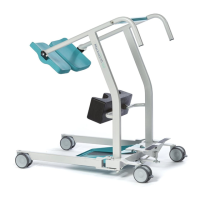
The TA180 Transfer Aid is delivered pre-installed and ready for use. Users should familiarize themselves with its components and operating procedures before use. Key components include a grip bar, seat pads, knee pad, leg lever, braked rear castors, and a foot plate.
To prepare the aid for a transfer, the seat pads can be swiveled outwards, allowing the aid to get as close as possible to the client. Once positioned, the rear castor brakes should be applied. The client can then step onto the foot plate. It is crucial to ensure the client has a firm hold of the grip bar before rotating the seat pads back to their operating position. Once the seat pads are in place and the client is comfortably seated, the carer can release the rear castor brakes, and the transfer aid is ready to move the client to the desired area.
The leg width of the base unit can be adjusted using the leg lever pedal. Pressing "open" widens the legs, while pressing "close" narrows them. The transfer aid can be maneuvered with the legs in any position. The foot plate is secured onto the base by locating it onto two pegs on either side of the central leg lever bracket.
Before any transfer operation, a risk assessment should always be conducted. Daily checks are mandatory before using the transfer aid, including verifying that castors move freely, braked castors operate correctly, and seat pads move freely and are not loose. Users must read the manual thoroughly to familiarize themselves with operating controls and safety features. It is essential to confirm that the patient's weight is within the safe working load (SWL) of the transfer aid. The aid should always be pushed by its handles, and brakes must be applied when parking.
Never push a loaded transfer aid at speeds exceeding a slow walking pace, or over uneven/rough ground. Avoid attempting to push or pull a loaded aid over floor obstructions that castors cannot easily clear. Bumping the transfer aid down steps, whether loaded or unloaded, can damage the castors. Negotiating a loaded transfer aid on a slope is not recommended, and a 5-degree slope is the maximum permitted, to be handled with extreme care. The maximum load of the transfer aid must never be exceeded. The TA180 is strictly for patient transfer and should not be used for any other purpose. All operators should read and understand the warning section, as transfer aids are less stable on sloping surfaces and can be dangerous if used recklessly or pushed at speed.
The TA180 Transfer Aid requires regular cleaning and maintenance to ensure its longevity and safe operation.
General Cleaning: The exterior of the device can be cleaned with a damp, soapy cloth. It is important to ensure the cloth is damp, not wet, and that the exterior is thoroughly dried with a clean, dry cloth after cleaning. Care must be taken when cleaning around electrical components.
Disinfecting: For a more thorough clean, the use of Actichlor disinfectant tablets is recommended. Users must follow the manufacturer's safety instructions for the cleaning product to ensure safe use for both operator and patient. The cleaning cloth should be damp, not wet, especially when cleaning near electrical systems, to prevent water ingress. Although the device is IP rated, it is not completely watertight. The disinfectant solution, prepared by diluting Actichlor tablets in water, should be applied with a clean, damp cloth.
Recommended dilutions for effective cleaning include 1 tablet (1.7g) per 1 liter of water for a virucidal solution (1000 ppm available chlorine), suitable for cleaning "dirty" devices or as a precaution against viruses, bacteria, spores, yeasts, and molds. The contact time for the solution on the outer components should be at least 5 minutes to prevent virucidal infections without degrading the device's functionality. For blood spills, an increased concentration of the solution may be required, referring to the manufacturer's product labeling.
Fault Finding: If the transfer aid does not operate, check if movement is compromised by excessive force due to debris fouling the castors (clean out and test). Also, inspect for a damaged footplate catching on the floor level; if damaged, remove it and contact an agent for a replacement. If these checks are unsuccessful, contact the service department of an approved agent.
Service and Guarantee: Any work performed on the TA180 must comply with the specifications detailed in BS 10535:2006. Regular servicing, potentially every six months where LOLER (Lifting Operations and Lifting Equipment Regulations 1998) applies, is recommended. The device comes with a twelve-month guarantee against material or workmanship defects from the date of purchase. This guarantee is void if the equipment is not serviced by Prism Medical UK or its authorized agents, or if unauthorized persons carry out work on it. It does not cover normal wear and tear, damage from natural forces, user neglect, misuse, or deliberate destruction. A service record history section is provided in the manual to document all completed services and repairs.
 General
| Frame Material | Steel |
|---|---|
| Foldable | Yes |
| Armrests | Fixed |
| Type | Transit Wheelchair |
| Seat Width | 45 cm (18 inches) |
| Wheel Size | 20cm (8") |
| Seat Depth | 41cm (16") |
| Backrest Height | 41cm (16") |

 To Next Page