S.T.E.A.M Master
Guide Book
6
Educational Effects of
Magformers According to Age
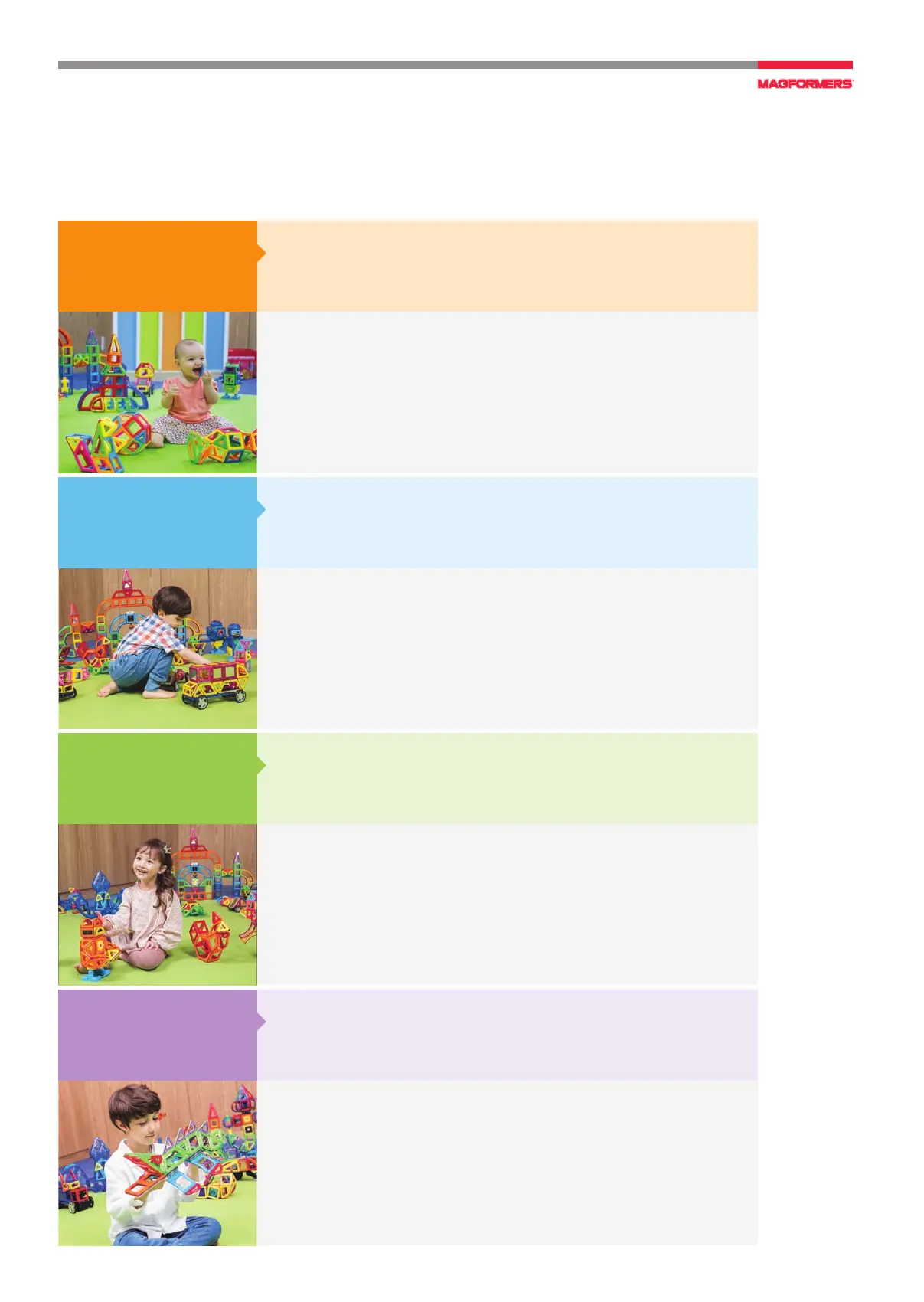
A critical period that forms 80% of brain development. Through various
sensory stimulation activities and nger movements, the brain and ner-
vous system are developed.
Educational Effects
●
Visual stimuli with the rich colors and shapes of Magformers
●
Auditory stimuli with the clear sound of shapes attaching and detaching
●
Developing recognition of colored shapes and distinction of different colored shapes
●
Fostering coordination of eyes and hands while holding, attaching and detaching
Magformers
●
Developing gross and ne motor skills while moving arms, hands and ngers
A period when self-reliance and independence is developed, which caus-
es behavior based on accomplishment. The ability to think and express
themselves is developed, and creative and unique play is possible.
Educational Effects
●
Learning the basis of mathematics such as parts and wholes, response and patterns while
combining Magformers and making models
●
Conception of geometric relationships and space by understanding shape and size com
parison, direction and location of right, left, top and bottom
●
Fostering creativity, problem solving skills, self-reliance and a sense of accomplishment
while planning and creating on their own
●
Developing verbal expression while expressing planned and nished models
A period to passionately explore objects. While operating surrounding
objects, curiosity increases. Symbolic thinking is developed, and imagi-
native and virtual play forms are displayed overall.
Educational Effects
●
Improving ability to operate objects by developing hand control
●
Fostering divergent thinking, imagination and creativity while making desired
shapes
●
Developing modeling capability while creating a form or shape, and understanding
symmetry, conguration, area and lines
A period that enables concrete thinking about objects and specic re-
production regarding the surrounding world that they experience. In this
process, observation and analytical skills relating to objects, and logical
thinking are developed.
Educational Effects
●
Developing observation, analytical and thinking skills while reproducing various surrounding
objects
●
Developing spatial perception skills while shaping buildings or making 3D models
●
Developing reasoning, logic and thinking skills while predicting and representing invisible form
●
Developing creative problem solving skills while making and combining complex objects
●
Forming geometric concepts, acquiring mathematical knowledge and approaching science
with the principle of magnets
Sensitive 1-3 year-old
Sensorimotor Stage
Stubborn 5-7 year-old
Concrete
Operational Stage
Curious 3-5 year-old
Preoperational Stage
Expressive 7 year-old and older
Formal
Operational Stage



 To Next Page