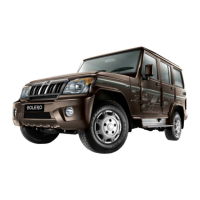
The provided document is a diagnostic manual for the Mahindra Bolero m2DiCR, specifically focusing on the Controller Area Network (CAN) system. It outlines procedures for troubleshooting complaints related to the CAN SUPPORT system in these vehicles.
Function Description:
This manual serves as a comprehensive guide for diagnosing issues within the CAN communication network of the Mahindra Bolero m2DiCR. The CAN system is crucial for inter-module communication, allowing various Electronic Control Units (ECUs) such as the Engine Management System (EMS) ECU, Immobilizer Control Unit (ICU), and Instrument Cluster (IC) to exchange data. The manual details how to identify, analyze, and correct faults that disrupt this communication. It covers retrieving Diagnostic Trouble Codes (DTCs) from the EMS ECU and the Instrument Cluster, interpreting these codes, and performing corrective actions. The diagnostic process emphasizes a structured approach, starting with understanding customer complaints, searching for quick solutions, and then proceeding with DTC-based diagnosis.
Important Technical Specifications:
The manual highlights key components of the CAN network and their interconnections:
- EMS ECU: Contains an inbuilt 120 Ohm terminating resistor. Connected to the CAN network via pins 19 (CAN High) and 18 (CAN Low).
- Immobilizer C.U. (ICU): Connected to the CAN network via pins 5 (CAN Low) and 1 (CAN High).
- Cluster (Instrument Cluster): Contains an inbuilt 120 Ohm terminating resistor. Connected to the CAN network via pins 13 (CAN High) and 14 (CAN Low).
- Diagnostic Connector (OBD Connector): Provides access to the CAN network for diagnostic tools. Pins 6 (CAN_H), 14 (CAN_L), 4 & 5 (GND), and 16 (+ve) are specified for resistance checks.
- CAN Network Resistance: The manual specifies expected resistance values across various points in the CAN wiring for diagnostic purposes. For instance, with both EMS and IC present, the resistance between CAN_H and CAN_L should be 60 Ohms. If either EMS or IC is not present, this value changes to 120 Ohms.
- Voltage Thresholds: For CAN Overvoltage (B0120), the battery voltage exceeding 15.5V for 500ms is a trigger. For CAN Undervoltage (B0121), battery voltage below 9.5V for 500ms is a trigger.
Usage Features:
- DTC-Based Troubleshooting: The manual is structured around DTCs. Users can look up specific error codes to find their descriptions, the nodes where they are present, probable causes, cluster display effects, and corrective actions.
- Hyperlinked Content: DTCs are hyperlinked to their respective troubleshooting charts/pages for quick navigation.
- Wiring Manual Integration: Users are advised to use this diagnostic manual in conjunction with the vehicle's wiring manual (MAN-00140).
- Diagnostic Tester Capability: The diagnostic tester can test certain actuators, aiding in the troubleshooting process.
- Immobilizer Error Analysis: For immobilizer-related errors, DTCs from both the EMS and Immobilizer ECU (ICU) need to be analyzed together, with a reference to the dedicated Immobilizer Diagnostic Manual (MAN-00142).
- Resistance Check Procedure: A detailed "Steps For Resistance Check in CAN Wiring" section provides instructions on how to measure resistance across the OBD connector pins, including disconnecting the battery, ensuring all ECUs are connected, and using a multimeter. It lists expected resistance values for various scenarios (e.g., EMS & IC present, either absent, short circuits).
- Warning Lamps Overview: A visual guide to the warning lamps on the instrument cluster, including Battery Charging, Low Engine Oil Pressure, Parking Brake, High Coolant Temp, Seat Belt, Immobilizer, OBD Check, Low Fuel, Water in Fuel Filter, Headlamp High Beam, Turn Indicators, and Micro Hybrid Stop-Start Lamp.
- Driver Information System (DIS) Overview: A visual guide to the DIS display, showing Day, Time, Date, Door Ajar Lamp, Distance Traveled, Average Fuel Efficiency, Distance To Empty, Gear Indicator, Set Button, and Mode Button.
Maintenance Features:
- "DO's and Don'ts in CAN Diagnosis": This section provides critical guidelines for safe and effective troubleshooting:
- Battery Disconnection: Always disconnect the battery before checking resistance.
- ECU Connection: All ECUs should be connected when checking resistance.
- Tool Usage: Use a multimeter for resistance and continuity checks; do not use the lamp method.
- Connector Handling: Unlock connector locks before pulling, hold connectors firmly when connecting until they lock securely.
- Wiring Integrity: Do not hamper twisted CAN wires. Do not pull the wiring harness when disconnecting inter-connectors.
- Wiring Replacement: Follow CAN standard wiring harnesses. Change complete wiring if necessary; do not replace only CAN wiring.
- Wiring Installation: Fix wiring harnesses with clamps; do not leave loose/hanging wires.
- Post-Repair Checks: Check continuity and resistance after replacing components or repairing wiring before reconnecting the battery.
- Bypass Wiring: Do not connect CAN terminals using bypass wires, as this can introduce electrical noise.
- Corrective Actions: Each DTC description includes specific corrective actions, such as checking ECU connections, measuring CAN wiring resistance, repairing/replacing wiring harnesses, checking sensors (vehicle speed, CAM/Crank shaft), and replacing ECUs (IC, EMS, ICU).
- Technical Assistance: In cases where published solutions or DTC-based diagnosis are insufficient, the manual advises contacting TEKliner with a Technical Assistance Request (TAR).
The manual is intended for restricted internal circulation within Mahindra & Mahindra (M&M) authorized dealer service centers, emphasizing that all information is up-to-date at the time of publication but subject to change without notice. Reproduction or translation of the document is prohibited without prior written consent from Mahindra & Mahindra Ltd.

 Need help?
 General


 To Next Page