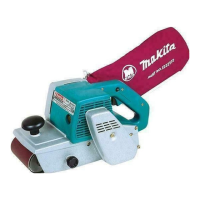
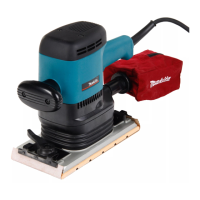
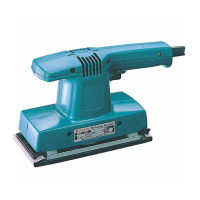
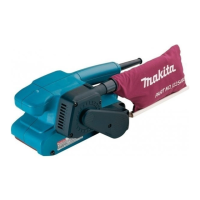
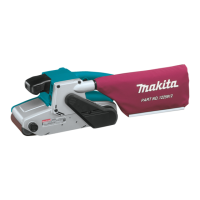
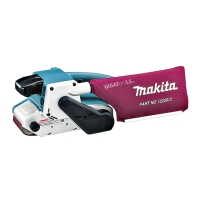
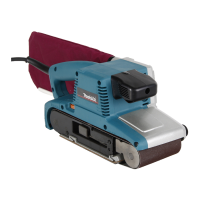
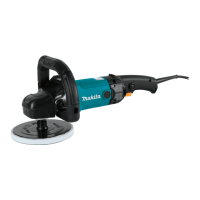
The Makita Sander Model 9000BL is a robust electric power tool designed for sanding and grinding applications. It is a double-insulated device, emphasizing user safety during operation.
Function Description:
The primary function of the Makita Sander Model 9000BL is to perform sanding and grinding tasks. When configured as a sander, it uses abrasive discs mounted on a rubber pad to smooth surfaces. When configured as a grinder, it utilizes depressed center wheels for material removal and shaping. The tool is designed for hand-held operation, providing control and maneuverability for various tasks.
Important Technical Specifications:
- No load speed (RPM): 6,000 RPM. This high speed allows for efficient material removal in both sanding and grinding modes.
- Overall length: 450 mm (17-3/4"). This length contributes to the tool's balance and handling.
- Net weight: 5.5 kg (12.1 lbs). The weight is substantial enough to apply adequate pressure during operation without excessive user force, which is important for safety and performance.
- Spindle thread: 5/8-11 UNC. This is a standard thread size for attaching various accessories.
- Double Insulation: This safety feature provides an extra layer of protection against electric shock, eliminating the need for a grounded outlet.
Usage Features:
- Side Grip (Auxiliary Handle): The tool includes a side grip that can be installed on either side, offering enhanced control and comfort for both left and right-handed users. This is crucial for maintaining a firm grip during high-speed operations.
- Switch Action: The tool features a trigger switch for activation. For continuous operation, the trigger can be pulled and then locked into position using a lock button. To stop from the locked position, the trigger is pulled fully and then released. A safety caution emphasizes checking the trigger switch's proper actuation and return to the "OFF" position before plugging in.
- Sanding Operation: When sanding, the abrasive disc should be applied to the workpiece at an angle of approximately 15° to the surface. Only slight pressure should be applied, as excessive pressure can lead to poor performance and premature wear of the abrasive disc.
- Grinding Operation: When grinding, the wheel or disc should also be applied at an angle of about 15° to the workpiece surface. During the break-in period with a new wheel, it's advised not to work the grinder in the "B" direction (which would cause it to cut into the workpiece) until the edge of the wheel has been rounded off. After this, the wheel can be worked in both "A" and "B" directions.
- Safety Precautions (General): The manual outlines extensive safety instructions applicable to all tools, including keeping the work area clean and well-lit, keeping children away, storing idle tools securely, not forcing the tool, using the right tool for the job, dressing properly, wearing safety glasses and masks, not abusing the cord, securing the workpiece, avoiding overreach, maintaining tools with care, and disconnecting tools when not in use or during servicing.
- Safety Precautions (Sander Specific): Users must check the backing pad for cracks or damage before operation and replace it if necessary. The tool should be held firmly, hands kept away from rotating parts, and the abrasive disc should not contact the workpiece before the switch is turned on. The tool should not be left running, and the workpiece should not be touched immediately after operation due to extreme heat.
- Safety Precautions (Grinder Specific): Guards must be kept in place. Only wheels with a maximum operating speed at least as high as the tool's "No Load RPM" should be used, and depressed center wheels must be fiberglass-reinforced. Wheels must be checked for cracks or damage and replaced immediately if found. Only specified flanges should be used. Care must be taken not to damage the spindle, flange, or lock nut, as this could lead to wheel breakage. The tool must be held firmly, hands kept away from rotating parts, and the wheel should not contact the workpiece before the switch is turned on. Before use on a workpiece, the tool should be run for a while to check for vibration or wobbling. The specified surface of the wheel should be used for grinding. Users should watch out for flying sparks and direct them away from themselves and flammable materials. The tool should not be left running, and the workpiece should not be touched immediately after operation due to extreme heat.
- Voltage Warning: Before connecting the tool, users must ensure the power source voltage matches the tool's nameplate specification to prevent serious injury or tool damage.
- Accessory Installation: For both sanding discs and grinding wheels, installation involves mounting the appropriate pad or inner flange onto the spindle, fitting the disc/wheel, and then screwing on the lock nut. The shaft lock is pressed to prevent spindle rotation while tightening the lock nut with a lock nut wrench. Removal is the reverse procedure.
- Warning on Forcing the Tool (Grinder): It is explicitly stated that forcing the tool is unnecessary, as its weight provides adequate pressure. Forcing and excessive pressure can cause dangerous wheel breakage.
- Warning on Worn Wheels (Grinder): Continued use of a worn-out wheel can lead to wheel explosion and serious personal injury. Depressed center wheels should not be used after they have worn down to 115 mm (4-1/2") in diameter and should be removed from service and intentionally destroyed.
Maintenance Features:
- General Caution: Before any inspection or maintenance, the tool must always be switched off and unplugged.
- Replacing Carbon Brushes: Carbon brushes should be regularly removed and checked. They must be replaced when they wear down to the limit mark. Both carbon brushes should be replaced simultaneously with identical carbon brushes. The process involves removing brush holder caps with a screwdriver, taking out worn brushes, inserting new ones, and securing the caps.
- Product Safety and Reliability: All repairs, maintenance, and adjustments should be performed by Makita Authorized or Factory Service Centers, using only genuine Makita replacement parts, to maintain product safety and reliability.
The manual also lists various accessories available for purchase separately, including different types of abrasive discs, depressed center wheels, wire cup brushes, flexible grinding wheels, and associated flanges, lock nuts, and guards, emphasizing that only specified accessories should be used in the proper and intended manner.

 Need help?

 To Next Page
 General