Need help?
Do you have a question about the Makita XRJ04T and is the answer not in the manual?
Guidelines for maintaining a safe, clean, and well-lit work area.
Precautions for safe electrical connection and usage of power tools.
Advice on staying alert, using protective equipment, and safe operating practices.
Steps and cautions for fitting and removing the battery pack from the tool.
Procedure and safety precautions for inserting and removing the saw blade.
Guide for inspecting and replacing worn carbon brushes.
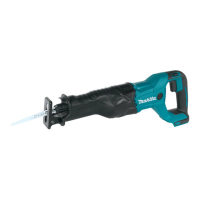
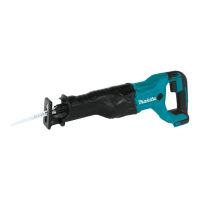
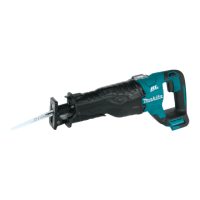
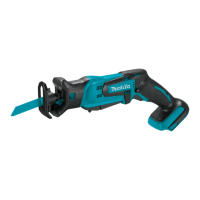
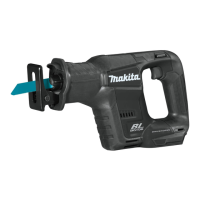
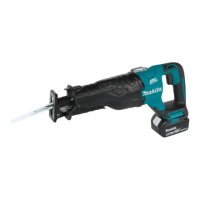
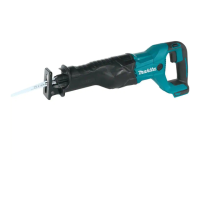
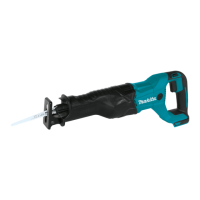
The Makita Cordless Recipro Saw Sierra XRJ04 is a powerful and versatile battery-operated power tool designed for various cutting applications. This instruction manual provides essential safety warnings, operational guidelines, and maintenance procedures to ensure safe and effective use of the tool.
The XRJ04 is a cordless recipro saw, also known as a reciprocating saw, which uses a back-and-forth motion to cut through materials like pipe and wood. It is powered by a D.C. 18V lithium-ion battery cartridge, offering portability and freedom from power cords. The tool is equipped with a switch trigger that controls the speed, allowing for variable speed operation depending on the pressure applied. A lock-off button is provided to prevent accidental starting, enhancing user safety. The tool also features an electric brake, which quickly stops the blade's movement upon release of the switch trigger, further reducing the risk of injury.
Before any operation, it is crucial to ensure the battery cartridge is properly installed and the lock-off button is engaged in the "OFF" position. To start the tool, the lock-off button must be depressed from the B side, and then the switch trigger pulled. Releasing the switch trigger stops the tool. After use, the lock-off button should always be pressed in from the A side to lock the switch trigger in the "OFF" position.
Installing and removing the recipro saw blade requires careful attention to safety. Users must ensure the tool is switched off and the battery cartridge is removed before performing any work on the tool. The blade clamp lever, part of the blade clamp sleeve, must be in the released position before inserting the recipro saw blade. The blade should be inserted as far as it will go, and the blade clamp sleeve will rotate to fix it in place. It is critical to ensure the blade cannot be extracted by pulling it, as insufficient insertion can lead to the blade being ejected unexpectedly during operation, posing a serious danger. To remove the blade, the blade clamp lever is rotated fully in the direction of the arrow until it is fixed in the released position. It is also important to clean out any chips or foreign matter adhering to the blade and around the blade clamp, as this can cause insufficient tightening and potential injury.
During operation, the shoe of the saw must be pressed firmly against the workpiece. Removing or holding the shoe away from the workpiece can cause strong vibration and twisting, leading to the blade snapping. When cutting metal, it is essential to wear gloves to protect hands from hot flying chips and to use a suitable coolant (cutting oil) to prevent premature blade wear. For cutting, a pilot groove should be made using a slower speed, followed by a faster speed to continue cutting. The tool should not be operated at no-load unnecessarily.
The XRJ04 is designed with a battery protection system, particularly for lithium-ion batteries with a star marking. This system automatically cuts off power to the tool under certain conditions to extend battery life. If the tool is overloaded, it will stop. In this case, the user should turn the tool off, stop the application that caused the overload, and then restart. If the tool does not start, the battery may be overheated and needs to cool down. If the battery voltage is too low, the tool will not operate, and the battery needs to be recharged. The remaining battery capacity can be checked by pressing the check button on the battery cartridge, which illuminates indicator lamps for a few seconds.
Regular maintenance is crucial for the safety and reliability of the XRJ04. Before any inspection or maintenance, the tool must be switched off, and the battery cartridge removed. Users should never use gasoline, benzine, thinner, alcohol, or similar substances, as these can cause discoloration, deformation, or cracks.
The carbon brushes, which are essential components for the motor's operation, should be checked regularly. They need to be replaced when they wear down to the limit mark. Both carbon brushes should be replaced simultaneously with identical carbon brushes. To replace them, the brush holder caps are removed using a screwdriver, the worn brushes taken out, and new ones inserted, securing the caps. After replacing the brushes, the battery cartridge should be inserted, and the tool run with no load for about one minute to break in the new brushes. The electric brake operation should also be checked when releasing the switch trigger. If the electric brake is not functioning correctly, the tool should be serviced at a Makita service center.
For all repairs, maintenance, or adjustments, it is recommended to use Makita Authorized or Factory Service Centers and genuine Makita replacement parts to ensure product safety and reliability. Keeping the handles dry, clean, and free from oil and grease is also important for maintaining a secure grip and preventing accidents. Following the instructions for lubricating and changing accessories is also part of proper maintenance.
 General
| Type | Reciprocating Saw |
|---|---|
| Power Source | Cordless |
| Voltage | 18V |
| Battery Type | Lithium-Ion |
| Stroke Length | 1-1/4" |
| Strokes Per Minute (SPM) | 0-3, 000 SPM |
| Blade Change | Tool-less |
| LED Light | Yes |
| Battery | BL1850B |
| No Load Speed | 0-3, 000 SPM |

 To Next Page