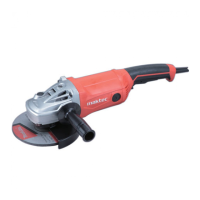
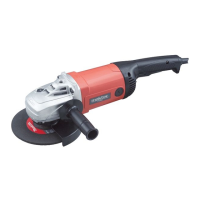
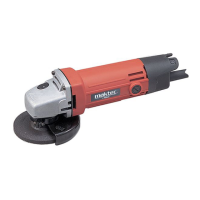
This document is an instruction manual for the Maktec Angle Grinder models MT900 and MT901. It provides specifications, safety warnings, and operational and maintenance instructions for the device.
Function Description
The Maktec Angle Grinder is a power tool designed for grinding, sanding, and cutting of metal and stone materials without the use of water. It can also be used with wire brushes for cleaning and surface preparation. The tool operates on a single-phase AC supply and is double-insulated for safety.
Important Technical Specifications
The manual provides detailed specifications for both models:
| Model |
MT900 |
MT901 |
| Depressed center wheel diameter |
180 mm |
230 mm |
| Spindle thread |
M14 |
M14 |
| Rated speed (n)/No load speed (no) |
8,500 min⁻¹ |
6,600 min⁻¹ |
| Overall length |
468 mm |
468 mm |
| Net weight |
5.5 kg |
5.8 kg |
| Safety class |
/II |
/II |
Noise levels for the typical A-weighted noise level determined according to EN60745 are:
- Sound pressure level (LPA): 90 dB(A)
- Sound power level (LWA): 101 dB(A)
- Uncertainty (K): 3 dB(A)
Vibration total value (tri-axial vector sum) determined according to EN60745 for surface grinding:
- Vibration emission (ah,AG): 5.0 m/s²
- Uncertainty (K): 1.5 m/s²
The tool is designed for public low-voltage distribution systems of between 220 V and 250 V. The mains socket used for this device must be protected with a fuse or protective circuit breaker having slow tripping characteristics. Use of a Residual Current Device (RCD) with a rated residual current of 30mA or less is always recommended, especially if operating in a damp location.
Usage Features
The angle grinder features a shaft lock mechanism to prevent spindle rotation, which is essential for installing or removing accessories. It comes with different switch actions depending on the model:
- Lock-on switch: To start, pull the switch trigger. For continuous operation, pull the switch trigger and then push in the lock lever. To stop from the locked position, pull the switch trigger fully, then release it.
- Lock-off switch: To start, push in the lock lever and then pull the switch trigger. Release the switch trigger to stop.
- Lock-on and lock-off switch: To start, push in the lock lever and then pull the switch trigger. For continuous operation, push in the lock lever, pull the switch trigger, and then push the lock lever further in. To stop from the locked position, pull the switch trigger fully, then release it.
The tool requires a side grip (handle) to be securely installed before operation. Different wheel guards are available depending on the accessory being used:
- For depressed center grinding wheels, multi-discs, flex wheels, or wire wheel brushes, the wheel guard must be fitted so that the closed side points towards the operator.
- For abrasive cut-off or diamond wheels, a special wheel guard designed for cut-off wheels must be used.
Installation of accessories:
- Depressed center grinding wheel/Multi-disc: Mount the inner flange onto the spindle, fit the wheel/disc, and screw the lock nut onto the spindle. For thicker wheels (>7mm), overturn the lock nut.
- Abrasive disc: Mount the rubber pad onto the spindle, fit the disc, and screw the lock nut onto the spindle.
- Wire cup brush: Mount the wire cup brush onto the spindle and tighten with the supplied wrench.
- Wire wheel brush: Thread the wire wheel brush onto the spindle and tighten with wrenches.
- Abrasive cut-off / diamond wheel: Mount the inner flange onto the spindle, fit the wheel/disc, and screw the lock nut onto the spindle. For thicker wheels (>7mm), mount the lock nut with its pilot circular part facing the wheel.
During grinding and sanding operations, the tool should be held firmly with both hands (one on the rear handle, one on the side handle). The edge of the wheel or disc should generally be kept at an angle of about 15 degrees to the workpiece surface. When using a new wheel, avoid working in the "B" direction initially to prevent cutting into the workpiece. Once the wheel edge is rounded, it can be worked in both "A" and "B" directions.
For abrasive cut-off/diamond wheel operations, it is crucial to use the special wheel guard. Avoid "jamming" the wheel or applying excessive pressure, and do not attempt excessive depth of cut, as this can lead to kickback or wheel breakage. The cutting operation should not be started in the workpiece; allow the wheel to reach full speed before entering the cut. Never change the angle of the wheel during cutting operations. A diamond wheel should be operated perpendicular to the material being cut.
Maintenance Features
Regular maintenance is crucial for the tool's safety and reliability:
- Always ensure the tool is switched off and unplugged before any inspection or maintenance.
- Never use gasoline, benzine, thinner, alcohol, or similar substances, as they can cause discoloration, deformation, or cracks.
- The tool and its air vents must be kept clean. Regularly clean the air vents or whenever they become obstructed.
- Carbon brush replacement: The motor will automatically shut off when the resin insulating tip inside the carbon brush is exposed to the commutator. Both carbon brushes should be replaced simultaneously with identical carbon brushes. To replace, remove the brush holder caps with a screwdriver, take out the worn brushes, insert new ones, and secure the caps.
- Any repairs, maintenance, or adjustments should be performed by Makita Authorized Service Centers using Makita replacement parts.
Safety Warnings (General and Specific)
The manual emphasizes numerous safety warnings, including:
- Work area safety: Keep the work area clean, well-lit, and free from children and bystanders.
- Electrical safety: Ensure power tool plugs match outlets, avoid body contact with earthed surfaces, do not expose tools to rain/wet conditions, and keep the cord away from heat, oil, sharp edges, or moving parts. Use an RCD and outdoor-suitable extension cords when necessary.
- Personal safety: Stay alert, use common sense, wear personal protective equipment (eye protection, dust mask, hearing protectors, gloves, workshop apron), and prevent unintentional starting.
- Power tool use and care: Do not force the tool, use the correct tool for the application, and do not use a tool with a faulty switch. Disconnect power before making adjustments or changing accessories. Store idle tools out of reach of children. Maintain tools, check for damage, and keep cutting tools sharp.
- Grinder specific warnings:
- Use only fiberglass-reinforced wheels for depressed center grinding.
- Do not damage the spindle, flange, or lock nut.
- Ensure the wheel is not contacting the workpiece before starting.
- Let the tool run for a while before use to check for vibration or wobbling.
- Use the specified surface of the wheel for grinding.
- Watch out for flying sparks and direct them away from people and flammable materials.
- Do not leave the tool running unattended.
- Avoid touching the workpiece immediately after operation due to extreme heat.
- Always ensure the tool is switched off and unplugged before carrying out work on it.
- Observe manufacturer instructions for mounting and use of wheels.
- Do not use separate reducing bushings or adaptors.
- Use only flanges specified for this tool.
- Ensure threaded hole wheels have sufficient thread length for the spindle.
- Check that the workpiece is properly supported.
- Be aware that the wheel continues to rotate after the tool is switched off.
- In hot, humid, or dusty conditions, use a short-circuit breaker (30 mA).
- Do not use the tool on materials containing asbestos.
- Do not use water or grinding lubricant.
- Keep ventilation openings clear.
- When using a cut-off wheel, always use the dust collecting wheel guard required by domestic regulation.
- Cutting discs must not be subjected to any lateral pressure.
- Kickback and Related Warnings: Kickback is a sudden reaction to a pinched or snagged rotating accessory. To avoid kickback, maintain a firm grip, use the auxiliary handle, never place hands near the rotating accessory, position the body to resist kickback forces, avoid bouncing and snagging, and do not attach saw chain woodcarving blades or toothed saw blades.
- Abrasive Cutting-Off Operations specific warnings: Use only recommended wheel types and guards. The guard must be securely attached and positioned for maximum safety. Wheels must be used only for recommended applications (e.g., no side grinding with cut-off wheels). Use undamaged wheel flanges of correct size and shape. Do not use worn-down wheels from larger power tools. Do not "jam" the cut-off wheel or apply excessive pressure. Do not position your body in line with and behind the rotating wheel. Switch off the tool and hold it motionless if the wheel binds or if a cut is interrupted. Do not restart cutting in the workpiece without letting the wheel reach full speed. Support panels or oversized workpieces. Use caution when making "pocket cuts" into existing walls.
- Sanding Operations specific warnings: Do not use excessively oversized sanding paper.
- Wire Brushing Operations specific warnings: Be aware of thrown wire bristles. Do not overstress the wires. If a guard is recommended, ensure no interference with the wire wheel/brush.

 Need help?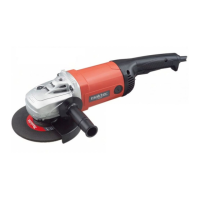

 To Next Page
 General