Need help?
Do you have a question about the Manfrotto 405 and is the answer not in the manual?
Highlights geared movement, quick release plate, camera screw types, and spirit levels for camera control.
Attaching the head to a tripod using the 3/8" female thread and set screws for secure locking.
Releasing the camera plate using the locking lever and safety button to prevent accidental detachment.
Handling 1/4" and 3/8" camera screws and their storage on the quick release plate.
Fixing the camera onto the quick release plate using the correct screw for optimal balance.
Inserting and securing the camera plate into the head's dovetail sides using the locking lever.
Safely detaching the camera from the head while holding it securely with the locking and safety levers.
Using control knobs for precise geared movement in pan, tilt, and levelling for accurate positioning.
Quickly positioning the camera using control wheels, then locking the head in place by releasing rings.
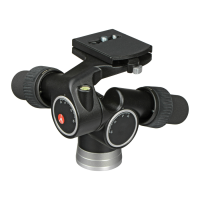
The Manfrotto 405 geared head is a precision instrument designed for photographers who require fine control over camera positioning. It offers precise geared movement in three directions, making it suitable for 35mm SLR, medium, and large format cameras. This head is engineered to provide both rapid adjustments for quick setup and fine-tuned movements for critical alignment, ensuring optimal results in various photographic scenarios.
One of the key features of the Manfrotto 405 is its ability to temporarily disengage the gear movement. This allows the user to quickly set the camera in a general position, saving time during initial setup. Once the approximate position is achieved, the geared movements can be re-engaged for final, precise adjustments. This dual functionality offers a significant advantage, combining speed with accuracy.
The head is equipped with a quick release plate system, which includes a secondary security mechanism to prevent accidental camera detachment. The quick release plate, designated as "I," comes with both 1/4" ("L") and 3/8" ("H") camera screws, accommodating a wide range of cameras. To remove an unused screw, the rubber cap ("M") can be carefully pressed out with one finger, allowing access to the screw. After removal, the rubber cap should be replaced to prevent the screw from being lost. The head itself has dedicated 1/4" and 3/8" holes for storing the unused screw, ensuring that it is always at hand when needed.
Assembling the head onto a tripod is straightforward. The head features a 3/8" female thread ("G") for secure attachment to most tripods. Manfrotto tripods, in particular, are designed with three set screws ("V") on their top plate. These screws clamp against the base of the head, ensuring an effective and secure lock, which is crucial for stability, especially with heavier camera setups.
Mounting the camera onto the head involves inserting the camera plate ("I") into the dovetail sides ("U") on the top of the head. The plate should then be pressed downwards until the locking lever ("N") clicks and closes, indicating a secure connection. To ensure the camera is fully locked, the user should push the lever "N" all the way to the left side and verify that the camera is fitted securely. This two-step locking process, involving the lever "N" and a safety button "O," prevents accidental release of the camera plate. To release the camera plate, the locking lever "N" must first be pulled in the direction indicated by an arrow until it goes no further. While holding "N" in this position, the safety button "O" must be pressed simultaneously. This action allows lever "N" to rotate further, thereby releasing the camera plate.
The camera plate "I" itself is designed for optimal camera alignment. The camera screw ("H" or "L") slides along a slit ("R") on the plate, allowing the user to align the camera lens with the plate and choose the best balance position for the camera. The heads of these screws have a groove, enabling them to be tightened with a coin for added security. Additionally, the plate "I" includes 1/4" ("S") and 3/8" ("T") thread attachments for further versatility.
The Manfrotto 405 offers three primary control knobs for fine adjustment: "A" for panning, "B" for tilting, and "C" for levelling. Fine adjustments are made by simply rotating these control knobs. The geared mechanism is designed to hold the camera in position without the need for additional locking once the desired angles are achieved, providing a smooth and stable platform for precise composition.
For rapid adjustments, the control rings ("D" for pan, "E" for tilt, and "F" for levelling) can be rotated through 90 degrees, following the indicated arrows. While holding a control wheel open, the camera can be rapidly repositioned with the other hand to the desired general position. Releasing the control ring then locks the head in place. This feature is particularly useful for quickly changing compositions without losing the precision offered by the geared movements.
To aid in precise levelling and alignment, the head is equipped with three spirit levels: "P" for panning, "X" for vertical portrait format, and "Z" for horizontal position. These spirit levels provide visual cues to ensure the camera is perfectly level in various orientations, which is essential for architectural, landscape, and studio photography.
In summary, the Manfrotto 405 geared head is a robust and versatile tool that combines the speed of rapid adjustment with the precision of geared movements. Its thoughtful design, including a secure quick release system, multiple camera screw options, and integrated spirit levels, makes it an invaluable asset for photographers seeking ultimate control and stability in their work.
 General
| Type | Geared Head |
|---|---|
| Material | Aluminum |
| Pan Range/Rotation | 360° |
| Quick Release | Yes |
| Bubble Level | Yes |
| Tilt Range | 90° |
| Base Type | 3/8" |

 To Next Page