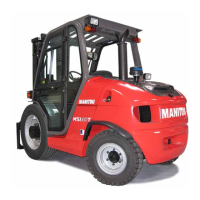
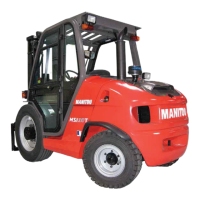
MRT 1432 - 1635 M
SS
eries
IT
EN
PO
1
11
- Check all control instruments immedia-
tely after starting up, when the I.C.
engine is warm and at regular intervals
during use, so as to quickly detect any
faults and to be able to correct them
without any delay.
- If an instrument does not show the cor-
rect display, stop the I.C. engine and
immediately carry out the necessary
operations.
D - Driving the lift truck
Safety notice
- Always drive the lift truck with the forks
or attachment at approximately 300
mm from the ground, i.e. In the tran-
sport position.
- Familiarise yourself with the lift truck
on the terrain where it will be used.
- Ensure that the service brakes and the
sound alarm are working properly.
- Drive according to, and at an appro-
priate speed for, the conditions and
state of the terrain.
- Slow down before executing a turn.
- In all circumstances make sure you are
in control of your speed.
- On damp, slippery or uneven terrain,
drive slowly.
- Brake gently, never abruptly.
- Only use the lift truck’s forward/reverse
lever from a stationary position and
never do so abruptly.
- Always remember that hydraulic type
steering is extremely sensitive to
movement of the steering wheel, so
turn it gently and not jerkily.
- Never leave the I.C. engine on when
the lift truck is unattended.
- Look in the direction you are travelling
and always keep clear visibility of the
road. Use the left and right rear view
mirrors frequently and ensure that they
are kept in good condition, are clean
and correctly adjusted.
- Never use the truck in places poorly
lighted.
- When working at night, ensure that
your lift truck is fitted with full beam
lights. There are optional solutions,
consult your agent or dealer.
- Drive round obstacles.
- Observe todos os instrumentos de
controlo imediatamente depois do
arranque, com o motor quente e a
intervalos regulares durante a utili-
zação, de maneira a localizar e resol-
ver rapidamente as eventuais anoma-
lias.
- Se um dos instrumentos assinalar uma
anomalia, desligue o motor e tome
imediatamente as providências neces-
sárias.
D - Condução do empilhador
Normas de segurança
- Conduza sempre o empilhador com os
garfos ou o acessório a cerca de 300
mm do chão, ou seja, na posição de
transporte.
- Exercite-se na condução do empilha-
dor no terreno onde deverá trabalhar.
- Certifique-se da eficiência dos travões
de serviço e da buzina.
- Conduza de maneira apropriada
escolhendo a velocidade adequada às
condições e ao tipo de terreno.
- Abrande a velocidade antes de efec-
tuar uma curva.
- Mantenha o empilhador e a respectiva
velocidade sob controlo, em todas as
circunstâncias.
- Sobre húmido, escorregadio ou irregu-
lar, conduza lentamente.
- Trave progressivamente; evite trava-
gens bruscas.
- Só accione o inversor do sentido de
marcha com a máquina parada, evi-
tando manobras bruscas.
- Lembre-se sempre de que a direcção
hidráulica é muito sensível aos movi-
mentos do volante, pelo que ele deve
ser girado com um movimento pro-
gressivo, evitando as viragens bru-
scas.
- Nunca deixe o motor ligado se o con-
dutor não estiver presente.
- Olhe sempre na direcção de marcha e
conserve uma boa visibilidade do per-
curso. Utilize frequentemente os
espelhos retrovisores laterais e contro-
le as suas condições, limpeza e regu-
lação.
- Não utilize o empilhador em ambientes
escuros ou pouco iluminados.
- De noite, verifique se o empilhador
está equipado com faróis de trabalho.
Existem soluções opcionais. Para mais
informações, dirija-se ao agente ou ao
concessionário da sua zona.
- Passe ao redor dos obstáculos.
- Osservare tutti gli strumenti di controllo
immediatamente dopo l'avvio, con il
motore caldo, e ad intervalli regolari
durante l'utilizzo, in modo da individua-
re e risolvere rapidamente le eventuali
anomalie.
- Se uno degli strumenti segnala un'ano-
malia, spegnere il motore e provvedere
immediatamente alle operazioni neces-
sarie.
D - Guida del carrello elevatore
Norme di sicurezza
- Effettuare gli spostamenti del carrello
elevatore sempre con le forche o l'ac-
cessorio a circa 300 mm dal suolo,
ossia in posizione di trasporto.
- Esercitarsi alla guida del carrello
elevatore sul terreno dove dovrà
operare.
- Accertarsi dell'efficienza dei freni di
servizio e del clacson.
- Guidare in modo appropriato sceglien
do la velocità adeguata alle condizioni
e al tipo di terreno.
- Rallentare prima di effettuare una
svolta.
- Aver in ogni circostanza il controllo del
carrello e della rispettiva velocità.
- Su terreno umido, scivoloso o
sconnesso,condurre lentamente.
- Frenare progressivamente, evitare
brusche frenate.
- Agire sull'invertitore di marcia del
carrello elevatore soltanto a macchina
ferma evitando brusche manovre.
- Ricordarsi sempre che lo sterzo di tipo
idraulico è molto sensibile ai movimenti
del volante, quindi occorre sterzare
progressivamente e non a scatti.
- Non lasciare mai il motore acceso in
assenza del conduttore.
- Guardare sempre nella direzione di
marcia e conservare una buona visibi-
lità del percorso. Utilizzare frequente-
mente gli specchi retrovisori laterali, e
controllarne le condizioni, la pulizia e la
regolazione.
- Non utilizzare il carrello in ambienti bui
o scarsamente illuminati.
- Di notte, verificare che il carrello eleva-
tore sia dotato di luci di lavoro.
Esistono soluzioni opzionali. Per mag-
giori informazioni, rivolgetevi al vostro
agente o concessionario.
- Aggirare gli ostacoli.


 To Next Page
 Loading...