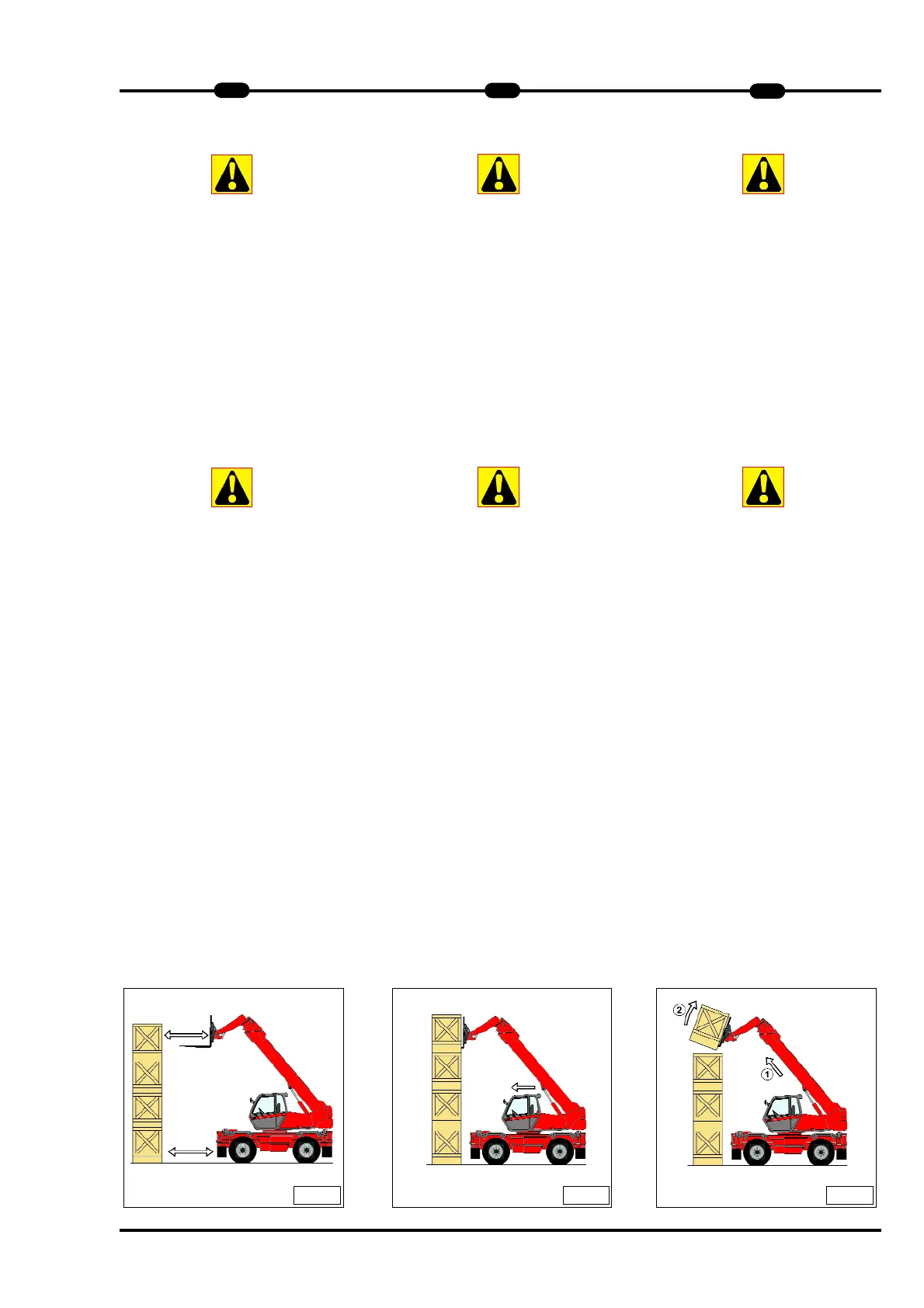
C - Taking up a high load on tyres.
Under no circumstances should you
pick up a load if the lift truck is not in a
horizontal position. (See paragraph : G -
HORIZONTAL POSITION OF THE LIFT
TRUCK in the chapter : LOAD HAND-
LING).
- Ensure that the forks will easily pass
under the load.
- Position the lift truck perpendicular to
the load with the forks in a horizontal
position (Fig. G) manoeuvring gently
and carefully (See paragraph : E -
VISIBILITY in the chapter : HANDLING
INSTRUCTIONS for visibility of the
road).
Always think about keeping the distance
necessary to fit the forks under the load,
between the pile and the lift truck (Fig.
G) and use the shortest possible
length of jib.
- Stop with the forks in front of the load
(Fig. H). Apply the parking brake and
place the forward/reverse lever in neu-
tral.
- Slightly lift the load (1) and incline the
forks carriage (2) backwards to stabili-
ze the load (Fig. I).
C - Pegar uma carga em posição alta
sobre os pneus.
É severamente proibido pegar uma
carga se o empilhador não estiver na
posição horizontal (ver o parágrafo: G -
HORIZONTALIDADE DO EMPILHA-
DOR no capítulo: MOVIMENTAÇÃO DE
UMA CARGA).
- Verifique se os garfos passam facil-
mente por baixo da carga.
- Aproxime o empilhador perpendicular-
mente à carga com os garfos na hori-
zontal (Fig. G), manobrando com sua-
vidade e cuidado (ver o parágrafo: E -
VISIBILIDADE no capítulo:
INSTRUÇÕES PARA A
MOVIMENTAÇÃO, relativo à visibilida-
de do percurso).
Lembre-se de manter sempre a distân-
cia necessária para inserir os garfos por
baixo da carga, entre a pilha e o
empilhador (Fig. G), utilizando o máxi-
mo comprimento possível do mastro.
- Ponha os garfos contra a carga (Fig.
H). Engate o travão de estacionamen-
to e ponha a alavanca do inversor de
marcha no ponto morto.
- Eleve a carga de pouco (1) e incline a
unidade porta-garfos (2) para trás para
estabilizar a carga (Fig. I).
C - Prelevare un carico in alto su
pneumatici.
È tassativamente vietato prelevare un
carico se il carrello elevatore non è in
piano (Vedi paragrafo : G -
ORIZZONTALITÀ DEL CARRELLO
ELEVATORE nel capitolo : MOVIMEN-
TAZIONE DI UN CARICO).
- Verificare che le forche passino facil-
mente sotto il carico.
- Avvicinare il carrello elevatore perpen-
dicolarmente al carico con le forche
orizzontali (Fig. G), manovrando dolce-
mente e con prudenza (Vedi paragrafo
: E - VISIBILITÀ nel capitolo : ISTRU-
ZIONI PER LA MOVIMENTAZIONE
relativo alla visibilità sul percorso).
Ricordandosi di mantenere sempre la
distanza necessaria per inserire le for-
che sotto il carico, tra la pila e il carrello
elevatore (Fig. G), utilizzando la lun-
ghezza minima possibile del braccio.
- Portare le forche contro il carico (Fig.
H). Tirare il freno di stazionamento e
mettere la leva dell'invertitore di marcia
in folle.
- Sollevare leggermente il carico (1) e
inclinare il portaforche (2) indietro per
stabilizzare il carico (Fig. I).
MRT 1432 - 1635 M
SS
eries
IT
EN
PO
1
23
G H I



 To Next Page