2-43
IT
EN
648870 IT-EN-ES (04/05/2015)
OPTIONAL FUNCTIONS SWITCHES
RADIOCONTROL SWITCH
(e, paragraph “Switches” ,3.1)
ELECTRIC ACCELERATOR SWITCH
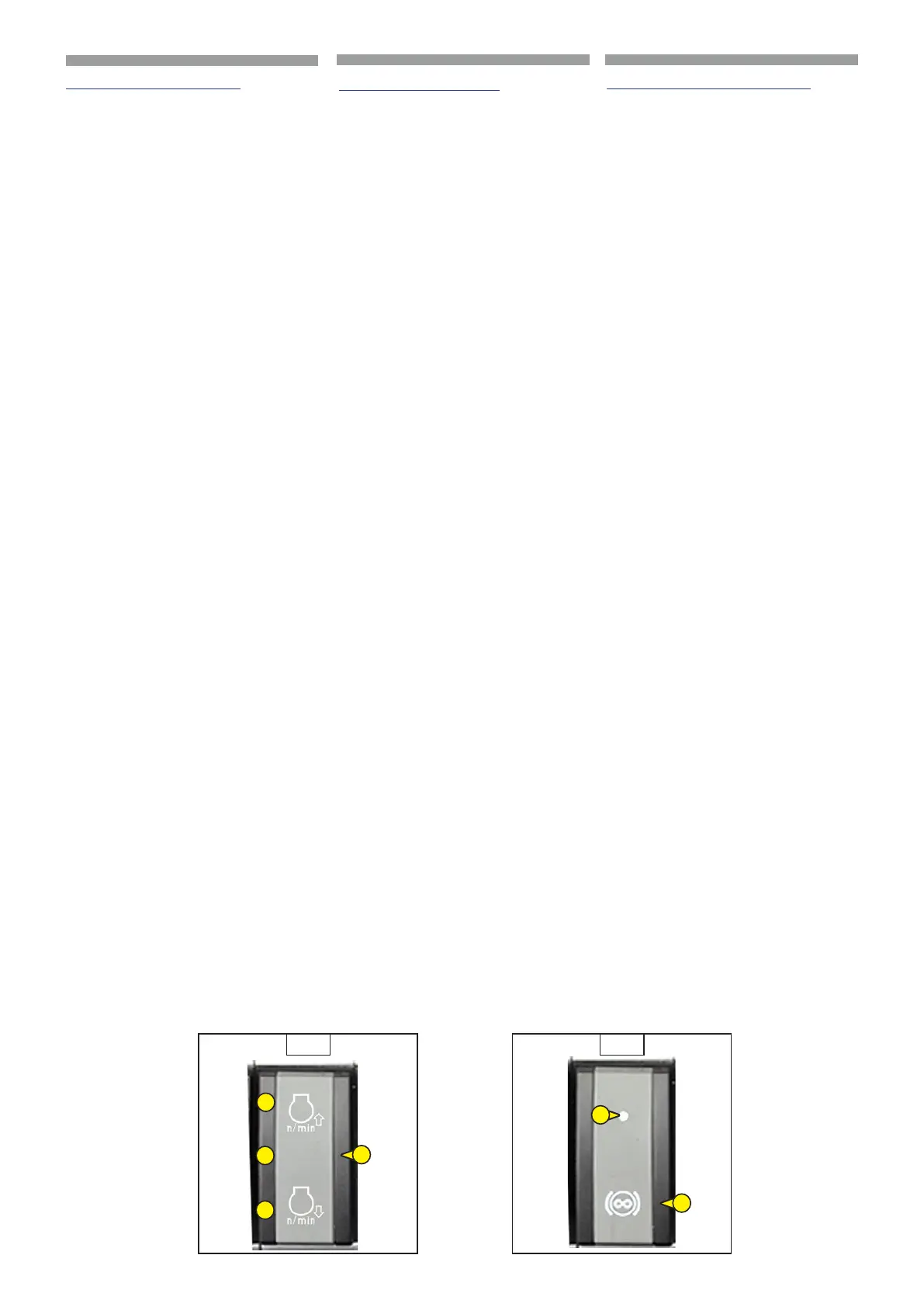
The function of the switch (1,3.20) is to
increase or decrease the I.C. engine rpm
electrically.
- The switch has two positions:
- pressing on (1a,
3.20) will cause I.C.
engine rpm to accelerate gradually,
- deactived (1c,
3.20),
- pressing on (1b,
3.20) will cause I.C.
engine rpm to decelerate gradually.
ENGINE BRAKE SWITCH
The engine brake decelerates the tele-
handler without using mechanical friction
in order to avoid the overheating of the
brake system.
This brake is mainly used in the long des-
cents, and it allows to brake the machine
without stressing the brakes.
Press switch (2,
3.21) to enable or disable
the engine brake.
On the control panel the red indicator light
indicates that the function is active (
e pa-
ragraph: “Instruments and control panel”).
On the switch (2,3.21) the led comes on
(1,
3.21) to indicate that the function is
active.
When activating the engine brake is exclu-
ded the inching function (
e paragraph:
“Service brake pedal”).
The engine brake is controlled by pressing
the brake pedal of service and allows two
stages of deceleration, a low and an inten-
se depending on the stroke of the pedal.
When starting the engine is always activa-
ted the inching function.
INTERRUTTORI FUNZIONI OPTIONAL
INTERRUTTORE RADIOCOMANDO
(e, paragrafo “Interruttori” ,3.1)
ACCELERATORE ELETTRICO
INTERRUTTORE
La funzione dell’interruttore (1,3.20) è
quella di aumentare o diminuire i giri del
motore termico elettricamente.
L’interruttore ha due posizioni:
- premendo su (1a,
3.20), farà sì che i
giri del motore termico accelerino gra-
dualmente,
- disattivato (1,
3.20),
- premendo su (1b,
3.20), farà sì che i
giri del motore termico decelerino gra-
dualmente.
INTERRUTTORE FRENO MOTORE
Il freno motore decelera il sollevatore te-
lescopico senza usare frizione meccanica
per evitare il surriscaldamento del sistema
frenante.
Questo freno è principalmente utilizzato
nelle lunghe discese, e permette di frenare
la macchina senza sollecitare i freni.
Premere l’interruttore (2,
3.21) per attiva-
re o disattivare il freno motore.
Sul pannello di controllo una spia rossa in-
dica che la funzione è attiva (e paragrafo:
“Strumenti e pannello di controllo”).
Sul interruttore (2,3.21) il led si accende
(1,3.21) per indicare che la funzione è
attiva.
Quando si attiva il freno motore viene es-
clusa la funzione inching (e paragrafo:
“pedale freno di servizio”).
Il freno motore è comandato tramite il pe-
dale del freno di servizio e consente due
fasi di decelerazione, una bassa ed una in-
tenso a secondo della corsa del pedale.
Quando si avvia il motore è sempre attivata
la funzione inching.
3.20
1a
1b
1
1c
3.21
2
1
INTERRUPTORES FUNCIONES OPCIONALES
INTERRUPTOR MANDO A DISTANCIA
(e, apartado “Interruptores”,3.1)
ACELERADOR ELÉCTRICO
INTERRUPTOR
La función del interruptor (1,3.20) es au-
mentar o disminuir de forma eléctrica las
revoluciones del motor térmico.
El interruptor tiene dos posiciones:
- pulsando (1a,
3.20), hará que las re-
voluciones del motor térmico aceleren
gradualmente,
- desactivado (1,
3.20),
- pulsando (1b,
3.20), hará que las revo-
luciones del motor térmico desaceleren
gradualmente.
INTERRUPTOR FRENO MOTOR
El freno motor desacelera el elevador tele-
scópico sin usar embrague mecánico, para
evitar el sobrecalentamiento del sistema de
frenado.
Este freno se utiliza principalmente en los
descensos prolongados, y permite frenar la
máquina sin esforzar los frenos.
Pulsar el interruptor (2,
3.21) para activar
o desactivar el freno motor.
En el panel de control un testigo rojo indi-
ca que la función está activa (
y apartado:
“Instrumentos y panel de control”).
En el interruptor (2,
3.21) el LED se en-
ciende (1,
3.21) para indicar que la fun-
ción está activada.
Cuando se activa el freno motor se excluye
la función avance gradual (
e apartado:
“pedal freno de servicio”).
El freno motor es accionado mediante el
pedal del freno de servicio y permite dos
fases de desaceleración, una baja y otra in-
tensa según la carrera del pedal.
Cuando el motor arranca está siempre acti-
vada la función avance gradual.
ES


 To Next Page
 Loading...