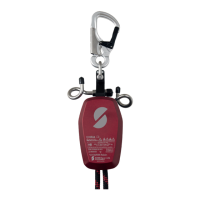
Inspection by MARK Save A Life or an authorized partner is only valid under the
proviso that
• this product has not been subjected to a fall,
• components of this product have not been modified,
• textile parts have not been contaminated with chemicals,
• this product has not been exposed to temperatures under -30°C or over +80°C,
• metal parts have not fallen to the ground from more than 2m.
6.1 Visual and function inspection before and after each use
Inspection is only valid under the proviso that
• components of this product have not been modified or changed,
• textile parts have not been contaminated with chemicals,
• this product has not been subjected to temperatures under - 30°C or over +80°C
The inspection has to be carried out by MARK Save A Life or by a competent person
MARK Save A Life can oer training to a “competent person“.
NOTE
6.2 Regular inspection
The frequency of inspections may vary according to the conditions and environment
in which this product is used.
By normal use the product has to be inspected from a competent person once a year.
Always keep these instructions for use including test protocol with the product. If this
product is subject to increased use, you may even require to inspect it more than once
a year.
If the product has been subject to a fall, it must be disposed of properly.
If this product is used as an emergency system (unused, welded in our special packaging
or sealed in the MARK Infini Box), it must be retired after 10 years at the latest. When
used as an emergency system, the packaging must be checked regularly and, if the pa-
ckaging is damaged, the product must be sent to MARK Save A Life for inspection.
RETIREMENT
• You have to retire this product if MARK Save A Life or a competent person has stated
that use is not safe.
• Retire the product in such a way that it cannot be used anymore.
• Retire this product in an environmentally friendly way. Separate materials!
• Dispose of the product only in accordance with the applicable national regulations.
RESALE
• To ensure safe and correct use, this product may only be resold with the instructions
for use and the inspection protocol.
• The instructions for use and the inspection protocol must be available in the ocal
language of the buyer. This is within the seller‘s responsibility.
DANGER
9.1 Suspension trauma
Suspension trauma
Falling into the rope, a long descent or being suspended for a long period can
induce suspension trauma (orthostatic shock). A suspension trauma can have
lifelong detrimental eects on your health and even lead to death.
• Rescue the injured person quickly.
• Perform the correct first aid measures.
How do I know it‘s a suspension trauma?
• Paleness
• Sweating
• Shortness of breath
• At the onset: increased pulse rate
• Narrowing of vision
• Dizziness
• Nausea
• Later drop in pulse rate and blood pressure
A suspension trauma is a medical emergency!
• Call the ambulance!
• Free the injured person from the suspended position.
• Position the injured person with raised upper body (sitting up or squatting).
• Open straps and tight clothes.
• Monitor cardiovascular and respiratory system.
• If the casualty has no signs of life start with CPR.
the longer it takes to rescue
the injured person
ACCIDENTS
The following information should help you avoid accidents. However, this information
does not replace experience, responsibility and know-how and does not release you
from assuming personal risk.
• Prepare a rescue plan and indicate all possible rescue measures for any given
emergency situations.
• Check use and fall area before using this product and alleviate or secure them.
• In a rescue situation communication between all involved persons has to be ensured.



 To Next Page
 Loading...