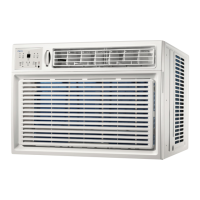
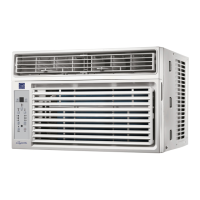
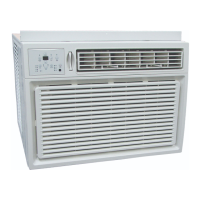
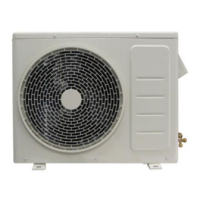
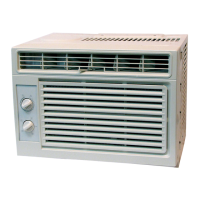
Owner’s Manual - RG/RADS Series
24
Installation
Instructions
NAIL SPACERS
TO STUDS
LEVEL
Caulks
Required
Aluminum Flashing
Over Bottom Of Frame
Over
8-1/2
)
Inside Frame Height: 18-7/8"(47.9cm) or18" (45.7cm)
Inside Frame Width: 26-3/4"(67.9cm) or 23-7/8"(60.6cm
Frame
Height
Inside
Frame
Y
Inside
Width
Up to 8-1/2"
3-3/8" MIN
(8.6 cm)
2
Prepare Wall
1
Select Wall Location
B. Thru-The-Wall Installation
NOTE:
Consult local building codes prior to
NOTE: If wall thickness is 8-1/2 " or more, add
to assure no water can enter area between inner
and outer wall.
The air conditioner has a slide-out chassis, so
that it can be installed through an outside wall
Max. Wall thickness: 12" or 10"
IMPORTANT: Side louvers must never be blocked.
NOTE: All parts needed for Thru-The-Wall
Installation are provided, except a wood frame,
shims, and 10 wood screws(#10-1" long minimum).
Select a wall surface that:
1. does not support major structural loads such
as the frame construction at ends of windows,
and under truss-bearing points, etc.
2. does not have plumbing or wiring inside.
3. is near existing electrical outlets or where
another outlet can be installed.
4.is not blocked to the area to be cooled.
end(outside) of installed air conditioner.
1. Prepare wall in frame construction (including
brick and stucco veneer). Working from inside
area where air conditioner will be installed (by
2. Cut or knock out a hole on each side of center
stud.
3. Measure between inside edges of every other
stud as shown in Fig.1.
4. Build a wooden frame with the INSIDE dimensions
of your model listed above. (Remember to measure
twice). Frame depth should be the same as wall
thickness. Fill in the space from the opening to the
studs with wood spacers,as shown.
with drywall.
Carefully measure and cut an opening with the
following dimensions depending on your model.
See Fig.1 and Fig.2.
WIDTH " X"= inside model width plus twice the
thickness of framing material used.
HEIGHT '' Y " = inside model height plus twice the
thickness of framing material used.
Fig.2
Fig.3
Fig.4
Fig.1
Installation
Instructions
NAIL SPACERS
TO STUDS
LEVEL
Caulks
Required
Aluminum Flashing
Over Bottom Of Frame
Over
8-1/2
)
Inside Frame Height: 18-7/8"(47.9cm) or18" (45.7cm)
Inside Frame Width: 26-3/4"(67.9cm) or 23-7/8"(60.6cm
Frame
Height
Inside
Frame
Y
Inside
Width
Up to 8-1/2"
3-3/8" MIN
(8.6 cm)
2
Prepare Wall
1
Select Wall Location
B. Thru-The-Wall Installation
NOTE:
Consult local building codes prior to
NOTE: If wall thickness is 8-1/2 " or more, add
to assure no water can enter area between inner
and outer wall.
The air conditioner has a slide-out chassis, so
that it can be installed through an outside wall
Max. Wall thickness: 12" or 10"
IMPORTANT: Side louvers must never be blocked.
NOTE: All parts needed for Thru-The-Wall
Installation are provided, except a wood frame,
shims, and 10 wood screws(#10-1" long minimum).
Select a wall surface that:
1. does not support major structural loads such
as the frame construction at ends of windows,
and under truss-bearing points, etc.
2. does not have plumbing or wiring inside.
3. is near existing electrical outlets or where
another outlet can be installed.
4.is not blocked to the area to be cooled.
end(outside) of installed air conditioner.
1. Prepare wall in frame construction (including
brick and stucco veneer). Working from inside
area where air conditioner will be installed (by
2. Cut or knock out a hole on each side of center
stud.
3. Measure between inside edges of every other
stud as shown in Fig.1.
4. Build a wooden frame with the INSIDE dimensions
of your model listed above. (Remember to measure
twice). Frame depth should be the same as wall
thickness. Fill in the space from the opening to the
studs with wood spacers,as shown.
with drywall.
Carefully measure and cut an opening with the
following dimensions depending on your model.
See Fig.1 and Fig.2.
WIDTH " X"= inside model width plus twice the
thickness of framing material used.
HEIGHT '' Y " = inside model height plus twice the
thickness of framing material used.
Fig.2
Fig.3
Fig.4
Fig.1


 To Next Page
 Loading...