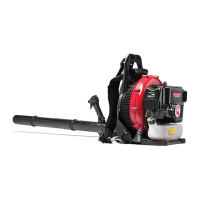
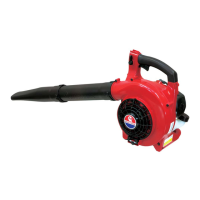
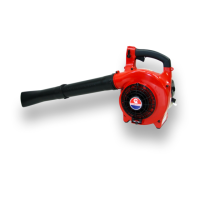
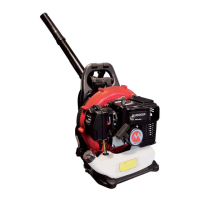
This document is the Operator's Manual for the Maruyama BLL 2600 Hand Held Blower, providing essential information for its safe and proper operation, maintenance, and troubleshooting.
Function Description:
The Maruyama BLL 2600 is a hand-held blower designed for various tasks such as clearing dry leaves from lawns or flower beds, cleaning grass and leaves from walks, patios, and drives, and moving gravel, dirt, snow, bottles, or cans from driveways, streets, parking lots, or stadiums. It operates using an air-cooled, two-stroke, single-cylinder gasoline engine, utilizing an oil-gasoline mixture for fuel. The blower is designed for one-person operation and emphasizes safety precautions throughout its use.
Important Technical Specifications:
- Model: BLL 2600
- Dimensions:
- Length: 347 mm (13.7 in.)
- Width: 235 mm (9.3 in.)
- Height: 342 mm (13.5 in.)
- Weight: 4.0 kg (8.8 lb.)
- Engine Type: Air-cooled, two-stroke, single-cylinder gasoline engine
- Bore: 33 mm (1.3 in.)
- Stroke: 30 mm (1.18 in.)
- Displacement: 25.6 cm³ (1.56 cu. in.)
- Carburetor: All position diaphragm carburetor with priming pump
- Exhaust System: Spark arrester muffler
- Ignition System: Flywheel magneto (Electronic)
- Spark Plug: NGK BPMR7A / ND W22MPR-U
- Fuel: Mixed (gasoline and oil)
- Fuel/Oil Ratio:
- 50:1 Using MARUYAMA 2-Stroke Engine Oil
- 25-30:1 Using Other Brands of TC Oil
- Fuel Tank Capacity: 500 cm³ (17.0 U.S. fl. oz.)
- Maximum Air Volume: 300 cfm
- Maximum Air Velocity: 130 mph
- Proper Idling Speed: 2,800-3,000 min⁻¹
- High Engine Speed: 7,500-8,000 min⁻¹
Usage Features:
The manual outlines detailed procedures for operating the blower, including starting, stopping, and general usage guidelines.
- Preparation: Before use, the operator must read and understand all safety precautions. The blower should be transported securely in a vehicle to prevent fuel spillage and damage. The throttle trigger must move freely and spring back to idle. The area to be cleared should be inspected for potential hazards like stones or metal objects.
- Fueling: The blower uses an oil-gasoline mixture. Only regular name-brand unleaded gasoline with a minimum octane number of 89 should be used. The manual explicitly warns against using gasoline containing alcohol. Quality two-stroke, air-cooled engine oil with TC classification is required, with specific mix ratios for Maruyama oil (50:1) and other brands (25-30:1). Fueling must be done outdoors in a well-ventilated area, at least 10 feet (3 m) from the starting spot, and without smoking or open flames nearby. The fuel filler cap should be removed carefully to release pressure slowly.
- Starting (Cold Engine):
- Slide the ignition switch to the "I" position.
- Push the priming pump several times.
- Close the choke completely.
- Grasp the throttle trigger fully, then release it slowly while pushing the lock button to set it at half-throttle.
- Place the unit on firm ground, ensuring good balance and secure footing.
- Pull the starter grip with short pulls (1/2 to 2/3 of rope length), guiding the rope slowly back into the housing.
- Grasp the trigger immediately after the engine starts to release the lock button and set the engine to idle.
- Starting (Warm Engine):
- Slide the ignition switch to the "I" position.
- Push the priming pump several times.
- Set the choke lever to "FULL OPEN".
- Pull the starter grip.
- Stopping:
- Return the throttle to the "IDLE" position and let the engine run for 2-3 minutes to cool down.
- Slide the ignition switch to the "O" position.
- General Operation: Operators should work carefully, only in good visibility and daylight. The blower must be held firmly with fingers wrapped tightly around the grip. The bevel at the end of the pipe should face downward. The engine should warm up at a fast idle for a few minutes. Lower speeds are recommended for dry leaves and flower beds, while higher speeds may be needed for heavier debris. Minimizing dust by using lower speeds and keeping debris on one's property is encouraged.
- Safety Precautions: The manual emphasizes protective clothing (sturdy, snug-fitting clothing, long pants, goggles/safety glasses, face shield, ear protection, heavy-duty nonslip gloves, sturdy boots, safety hard hat). It warns against operating in enclosed areas, pointing the blower at people or animals, and operating while fatigued or under the influence of substances. Spectators, children, and animals must be kept at least 50 feet (15m) away. The engine exhaust contains chemicals known to cause cancer, birth defects, or other reproductive harm (California Proposition 65 warning). Carbon monoxide hazards are also highlighted, requiring adequate ventilation.
Maintenance Features:
The manual provides a comprehensive maintenance chart and detailed instructions for various components, emphasizing that maintenance, replacement, or repair of emission control devices and systems may be performed by any nonroad engine repair establishment or individual.
- Maintenance Chart: Specifies maintenance intervals (Before Use, Monthly/50 Hours, Three Months/150 Hours, Six Months/300 Hours, Yearly/600 Hours) for various parts.
- Complete Machine: Visual inspection (condition, leaks) before use, page 17.
- Fuel Filter: Check monthly, replace as needed, page 16.
- Carburetor: Adjust as needed, clean yearly, overhaul/replace as needed, pages 13-14.
- Cooling System: Clean as needed, page 15.
- Muffler: Check monthly, clean as needed, page 15.
- Fuel Leakage: Check before use, repair as needed, page 3.
- Fuel Lines: Check monthly, replace as needed, page 16.
- All Accessible Screws and Nuts: Retighten before use, page 3.
- Air Filter Element: Clean monthly, replace as needed, page 14.
- Spark Plug: Check/clean/adjust monthly, replace as needed, page 14.
- Carburetor Adjustment: The carburetor is factory preset. Minor adjustments may be needed for high altitudes or sea level. This involves checking/cleaning the air filter and spark arresting screen, adjusting the idle speed screw (Ref. L) for smooth idling, and adjusting the high speed adjustment screw (Ref. H) for stable engine rotation and smooth acceleration. Standard screw turns are 1 for low speed and 1 for high speed, with an allowance of ±1/4 turn.
- Spark Plug Checking: If the engine lacks power, is difficult to start, or runs poorly at idle, check the spark plug. Remove, clean, and check the electrode gap (0.5mm-0.6mm or 0.020"-0.024"). Only suppressed spark plugs (NGK BPMR7A, ND W22MPR-U) should be used.
- Air Filter Cleaning: Dirty air filters reduce engine power and increase fuel consumption. To clean: turn the choke lever to "CLOSE", loosen the screw, remove the air filter cover, remove the foam element, wash it in warm soapy water, and dry. Replace damaged elements.
- Cooling System Maintenance: Ensure cooling air passes freely through the cylinder fin area by removing dust and dirt. The engine cover may need to be removed for thorough cleaning. Overheating can occur if air intakes are blocked or if dust/grass builds up on the cylinder.
- Exhaust Port Cleaning: Place the piston at top dead center. Clean deposits from the muffler and cylinder exhaust port with a nonmetallic scraper. Inspect and replace the gasket if necessary. Do not use metal tools to avoid scratching the cylinder or piston.
- Fuel System Maintenance: Change the fuel pick-up body annually. Before long-term storage, drain and clean the fuel tank, and run the engine until the carburetor is dry. The fuel tank and storage container should be cleaned periodically.
The manual also includes a troubleshooting guide to help diagnose common issues and provides information on the Federal and California Emission Control Warranty, outlining owner responsibilities and warranty coverage for emission-related parts.

 Need help?

 To Next Page
 General