EasyManua.ls Logo

Master PRO Series - User Manual

Master PRO Series
2 pages
Print Icon
To Next Page IconTo Next Page
Loading...
Geng Set Up
Make sure that you securely connect one end of an air hose to the air inlet of the airbrush and the other end of the
hose to a compressor. Remember to always wear a dust mask or respirator for solvent based paint, while airbrushing.
Holding and Triggering a Dual-Acon Airbrush
Hold the airbrush like you would hold a pen with your index nger on the trigger for control. For a dual-acon airbrush
press down on the trigger for air ow and while the trigger is pushed down pull back on it to release paint ow.
Fundamental Airbrushing Techniques for Best Results
When using your airbrush, spraying distance, applicaon speed, airbrush angle and air pressure are the key principles
to consistently achieving the best airbrush spraying results. To get comfortable using the airbrush, pracce spraying
with it at dierent distances and spray angles, while also adjusng your speed of applicaon and air pressure.
(For airbrushing pracce exercises and detailed step by step airbrush ps, tricks and video guides visit
www.airbrushresourcecenter.com)
Special Features Available on Some Models of Master and Master Pro Airbrushes
A. Quick Flush Cutaway Handle
The cutaway handle allows you to pull the needle chucking nut
back to quickly ush and clean uid passages within the airbrush.
B. Preset Knob Handle
The handles preset uid control knob allows you to set the
limit on the travel distance of the airbrush trigger. This enables
complete control of paint ow, so you can spray consistent
repeatable lines.
C. Micro Airow Adjustment Control Valve
A specialized air control valve at the head of the airbrush that can
be adjusted to lower the air ow (psi), which enables accurate
micro ne spray control.
AIRBRUSH QUICK START GUIDE
For further specic detailed instrucon and informaon for each model of Master and Master Pro Airbrushes,
please go to www.airbrushresourcecenter.com
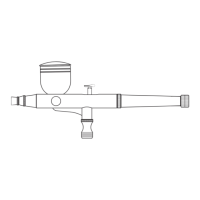
Dual-acon airbrushes are the most widely used style of airbrush,
as they allow the user to have superior control of the air ow, uid
ow and spray paern. The three main dual-acon airbrush types
are Gravity Feed, Siphon Feed and Side Feed.
DUAL-ACTION refers to the triggering method of acvang the
airbrush, as pressing down on the trigger releases the air ow and
drawing back on the trigger releases the paint ow. Since a dual-
acon airbrush combines the two separate moons of the trigger
into a single control, it makes it much easier for the user to achieve
consistent ne detail line spraying results.
A.
B.
C.
PUSH DOWN
FOR AIR
PULL BACK FOR FLUID
PULL BACK
Dual-Acon
Siphon Feed
AIR
AIR
FLUID
FLUID
Air source
Air source
Dual-Acon
Gravity Feed
Dual-Acon
Side Feed
Question and Answer IconNeed help?

Do you have a question about the Master PRO Series and is the answer not in the manual?

Summary

Getting Set Up

Holding and Triggering a Dual-Action Airbrush

Fundamental Airbrushing Techniques

Master & Master Pro Airbrush Features

Quick Flush Cutaway Handle

Allows needle chucking nut to be pulled back for quick flushing and cleaning of fluid passages.

Preset Knob Handle

Preset fluid control knob limits trigger travel distance for consistent, repeatable lines.

Micro Airflow Adjustment Control Valve

Adjustable air control valve at the head lowers airflow (psi) for micro fine spray control.

Airbrush Types Overview

Pistol Trigger Airbrush Description

Offers spray gun feel with accurate airbrush control, some with fixed dual-action.

Single-Action Airbrush Description

Easy to operate with one-step triggering for air and paint flow, ideal for beginners.

Single-Action External Mix Airbrush Description

Air and paint mix externally; paint flow controlled by a knob near the tip.

Cleaning the Airbrush

Overview

This document describes Master and Master Pro Series Airbrushes, providing a quick start guide for their use, features, and maintenance.

Function Description

Airbrushes are precision tools used for applying paint or other media in a fine, controlled spray. They are primarily used for detailed work such as illustration, custom painting, model making, and various artistic applications. The core function involves mixing air and paint to create a fine mist that can be directed onto a surface. The document highlights dual-action airbrushes as the most widely used type, offering superior control over airflow, fluid flow, and spray pattern. Dual-action refers to the triggering method where pressing down on the trigger releases air, and pulling back releases paint. This combined control allows for consistent fine detail line spraying. The document also briefly mentions single-action airbrushes, which activate both air and paint flow with a simple push down, making them ideal for beginners but offering less spray control. External mix airbrushes, where air and paint mix in front of the needle, are also described.

Important Technical Specifications

While specific technical specifications like nozzle sizes or PSI ranges are not explicitly detailed for individual models, the document emphasizes the precision and control capabilities of these airbrushes.

  • Dual-Action Airbrushes:
    • Gravity Feed: The paint cup is located on top of the airbrush, allowing gravity to assist in feeding paint.
    • Siphon Feed: The paint bottle is located below the airbrush, and a vacuum created by airflow draws paint up.
    • Side Feed: The paint cup is located on the side, offering flexibility in angle and visibility.
  • Single-Action Airbrushes: Simpler operation, suitable for beginners, with less fine control compared to dual-action.
  • External Mix Airbrushes: Air and paint mix externally, with paint flow controlled by a knob near the tip.

Usage Features

The document provides comprehensive guidance on how to use Master and Master Pro airbrushes effectively.

  • Getting Set Up: Securely connect one end of an air hose to the airbrush's air inlet and the other to a compressor. Emphasizes wearing a dust mask or respirator for solvent-based paints.
  • Holding and Triggering: Hold the airbrush like a pen with the index finger on the trigger. For dual-action, press down for air, then pull back for paint flow.
  • Fundamental Airbrushing Techniques: Key principles include spraying distance, application speed, airbrush angle, and air pressure. Users are encouraged to practice spraying at different distances and angles, adjusting speed and pressure.
  • Special Features (Available on some models):
    • Quick Flush Cutaway Handle: Allows quick access to the needle chucking nut for flushing and cleaning fluid passages.
    • Preset Knob Handle: Enables setting a limit on the trigger's travel distance, providing consistent, repeatable lines by controlling paint flow.
    • Micro Airflow Adjustment Control Valve: A specialized valve at the head of the airbrush to lower airflow (PSI) for accurate micro fine spray control.
  • Pistol Trigger Airbrushes: Offer a spray gun feel with accurate airbrush control. Some models feature a fixed dual-action where a slight pull releases air, and a further pull releases paint.

Maintenance Features

Proper maintenance is crucial for the longevity and performance of airbrushes, and the document provides clear instructions.

  • Cleaning the Airbrush:
    • Always empty excess paint first.
    • Clean between color changes and at the end of each painting session to prevent color contamination and clogging.
    • Never allow paint to dry inside the airbrush.
    • Refill the airbrush cup or bottle with the appropriate cleaning solution for the paint medium used (warm water for most water-based mediums).
    • Flush the airbrush by back flushing (plugging the tip while pulling the trigger back) and spray out until clear.
  • Resource Center (www.airbrushresourcecenter.com): This online resource provides extensive support, including:
    • How-to guides, eBooklets, and videos.
    • Step-by-step tips, tricks, and videos.
    • Product information and usage manuals.
    • Exploded view diagrams for each model.
    • Replacement parts, repair kits, and accessories.
    • Airbrush maintenance and cleaning guides.
    • Disassembly and reassembly instructions.
    • Troubleshooting procedures.
    • Warranty information.
    • Frequently asked questions (FAQ).

The Master Airbrush series offers a professional line of value-priced precision airbrushes with exceptional atomization and accurate spray control, suitable for all levels of users and types of spray applications. The Master Pro Series airbrushes are described as a new line of superior quality airbrushes designed for elite spraying performance, built with high-quality materials for perfect results. The document also includes a warning about cancer and reproductive harm, directing users to www.P65Warnings.ca.gov.

Master PRO Series Specifications

General IconGeneral
BrandMaster
ModelPRO Series
CategoryAirbrushes
LanguageEnglish