This document provides comprehensive instructions for the Hot Wheels RC vehicle, covering its functions, usage, and maintenance. It is designed to ensure safe and enjoyable operation for users.
I. Contents/Features
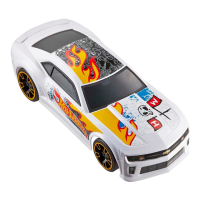
The set includes one Hot Wheels RC vehicle, one transmitter, and one antenna tube.
The transmitter features controls for:
- Forward / Reverse: Allows the vehicle to move forwards or backwards.
- Left / Right: Enables steering the vehicle to the left or right.
- Battery cover: Provides access for battery installation.
- ON(I) / OFF(0): Power switch for the transmitter.
- Steering adjuster: A control to adjust the steering, if necessary, to ensure the vehicle runs straight.
Antenna Tube Installation:
To prepare the transmitter for use, the flexible antenna wire needs to be properly installed. First, insert the flexible antenna wire through the antenna tube. Then, firmly insert the end of the antenna tube into the designated hole on the transmitter. To secure the tube and wire, tie a knot at the end of the flexible antenna wire. This prevents the tube from coming loose during operation.
II. Battery Installation
Batteries are required for both the vehicle and the transmitter.
- Vehicle: Requires four AA alkaline batteries.
- Transmitter: Requires two AA alkaline batteries.
Batteries are not included in the set.
Vehicle Battery Installation:
- Locate the battery cover on the vehicle.
- Unscrew the battery cover using a Phillips head screwdriver (not included).
- Insert four AA alkaline batteries into the battery compartment, ensuring correct polarity (+/-) as indicated inside the compartment.
- Replace the battery cover and tighten the screw securely.
Transmitter Battery Installation:
- Remove the battery cover from the transmitter.
- Insert two AA alkaline batteries into the battery compartment, ensuring correct polarity (+/-) as indicated.
- Replace the battery cover and push it shut until it clicks into place.
Note: Once the batteries are installed in the transmitter, it will always be "ON" and will automatically activate the moment you begin to use it. There is no separate power switch for the transmitter itself once batteries are inserted.
III. Operation
The vehicle's movement is controlled entirely by the transmitter.
- Forward: To move the vehicle forward, push the control stick on the transmitter forward.
- Reverse: To move the vehicle backward, pull the control stick on the transmitter backward.
- Forward Left or Right: To move forward and steer, push the control stick forward while simultaneously moving it left or right.
- Reverse Left or Right: To move backward and steer, pull the control stick backward while simultaneously moving it left or right.
IV. Quick Tips
These tips help optimize performance and troubleshoot common issues:
- Loss of Power: If the vehicle starts to lose power, functionality, or performance, it's an indication that the batteries need to be replaced with fresh ones. The vehicle's running time can vary based on driving style.
- Radio Interference: Performance can be affected by radio interference from other R/C vehicles operating on the same frequency, electrical wires, large buildings, or CB radios. To avoid this, try to operate the vehicle away from such sources.
- Transmitter Orientation: Always point the transmitter up, not down, toward your vehicle. If the vehicle moves too far away from the transmitter, it may lose connection and stop working properly.
- Environmental Conditions: Avoid driving the vehicle in sand, water, or snow. If the vehicle accidentally gets wet, wipe it thoroughly with a towel and allow it to dry completely overnight before further use.
- Storage: Do not store the vehicle near heat sources or in direct sunlight. Always turn the vehicle's switch OFF and remove all batteries from both the vehicle and transmitter before storing to prevent leakage and prolong battery life.
- Malfunction Reset: If the vehicle malfunctions, turn the power OFF on both the vehicle and transmitter, then turn them ON again. This action should reset the device and allow you to resume normal operation.
Proper battery handling is crucial to prevent chemical burn injuries or product damage from leakage.
General Battery Safety Guidelines:
- Non-rechargeable batteries: These are not to be recharged.
- Rechargeable batteries: If using rechargeable batteries, they must be removed from the product before being charged. Charging should only be done under adult supervision.
- Mixing Batteries: Do not mix different types of batteries (alkaline, standard carbon-zinc, or rechargeable nickel-cadmium). Also, do not mix old and new batteries.
- Battery Type: Only use batteries of the same or equivalent type as recommended by the manufacturer.
- Polarity: Always insert batteries with the correct polarity (+/-) as indicated in the battery compartments.
- Exhausted Batteries: Remove exhausted batteries from the product promptly.
- Short-circuiting: The supply terminals should not be short-circuited.
- Disposal: Dispose of batteries safely according to local regulations. Do not dispose of this product in a fire, as the batteries inside may explode or leak.
For optimal performance, use regular or high-performance alkaline batteries. If the vehicle comes with standard (carbon-zinc) batteries for initial use or demonstration, it is recommended to replace them with alkaline batteries when necessary. Battery life can vary depending on the battery brand and usage patterns.
Safety Tips for Adults:
To ensure a safe and fun play experience for children, adults should review all operating instructions and safety rules with their child.
- Driving Location: NEVER drive the vehicle on public streets; these are for real cars.
- Handling During Operation: DO NOT pick up the vehicle while it is in motion.
- Safety Around Moving Parts: Keep fingers, hair, and loose clothing away from the tires and wheel hubs while the vehicle is switched ON.
- Adult Supervision: Adult supervision is recommended when the vehicle is being operated, especially by younger children.
- Accidental Operation Prevention: To prevent accidental operation, always remove all batteries from the vehicle and transmitter when not in use.
Environmental Protection:
Protect the environment by not disposing of this product with household waste (in accordance with directive 2002/96/EC). Check with your local authority for recycling advice and facilities to ensure proper disposal.
FCC Rules Compliance:
This device complies with Part 15 of the FCC Rules. Operation is subject to two conditions:
- This device may not cause harmful interference.
- This device must accept any interference received, including interference that may cause undesired operation.
The equipment has been tested and found to comply with the limits for a Class B digital device, pursuant to part 15 of the FCC rules. These limits are designed to provide reasonable protection against harmful interference in a residential installation. This equipment generates, uses, and can radiate radio frequency energy. If not installed and used according to the instructions, it may cause harmful interference to radio communications. There is no guarantee that interference will not occur in a particular installation.
If this equipment causes harmful interference to radio or television reception (which can be determined by turning the equipment off and on), the user is encouraged to try to correct the interference by one or more of the following measures:
- Reorient or relocate the receiving antenna.
- Increase the separation between the equipment and receiver.
- Connect the equipment into an outlet on a circuit different from that to which the receiver is connected.
- Consult the dealer or an experienced radio/TV technician for help.
NOTE: Changes or modifications not expressly approved by the manufacturer responsible for compliance could void the user's authority to operate the equipment.

 Need help?
 General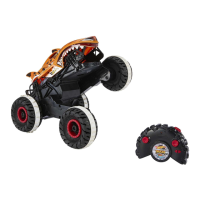



 To Next Page