WARNING!
CAUTION!
• Potential hazard that may result in moderate injury or
damage to equipment.
• Wear safety glasses when opening the drain valve, as
the air and moisture releases out from the tank can
propel debris that may cause eye injury.
CHECKING THE PRESSURE RELIEF VALVE
1. Turn OFF the power supply to the pump.
2. Pull the relief valve ring to check whether it s operating properly and to clear
possible obstructions of the valve.
CHANGING THE AIR FILTER
After continuous use of the compressor, the air filter may get clogged. This will reduce
the air intake capability of the compressor. Therefore it is necessary to replace the air
filter.
1. Turn OFF the power supply to the pump.
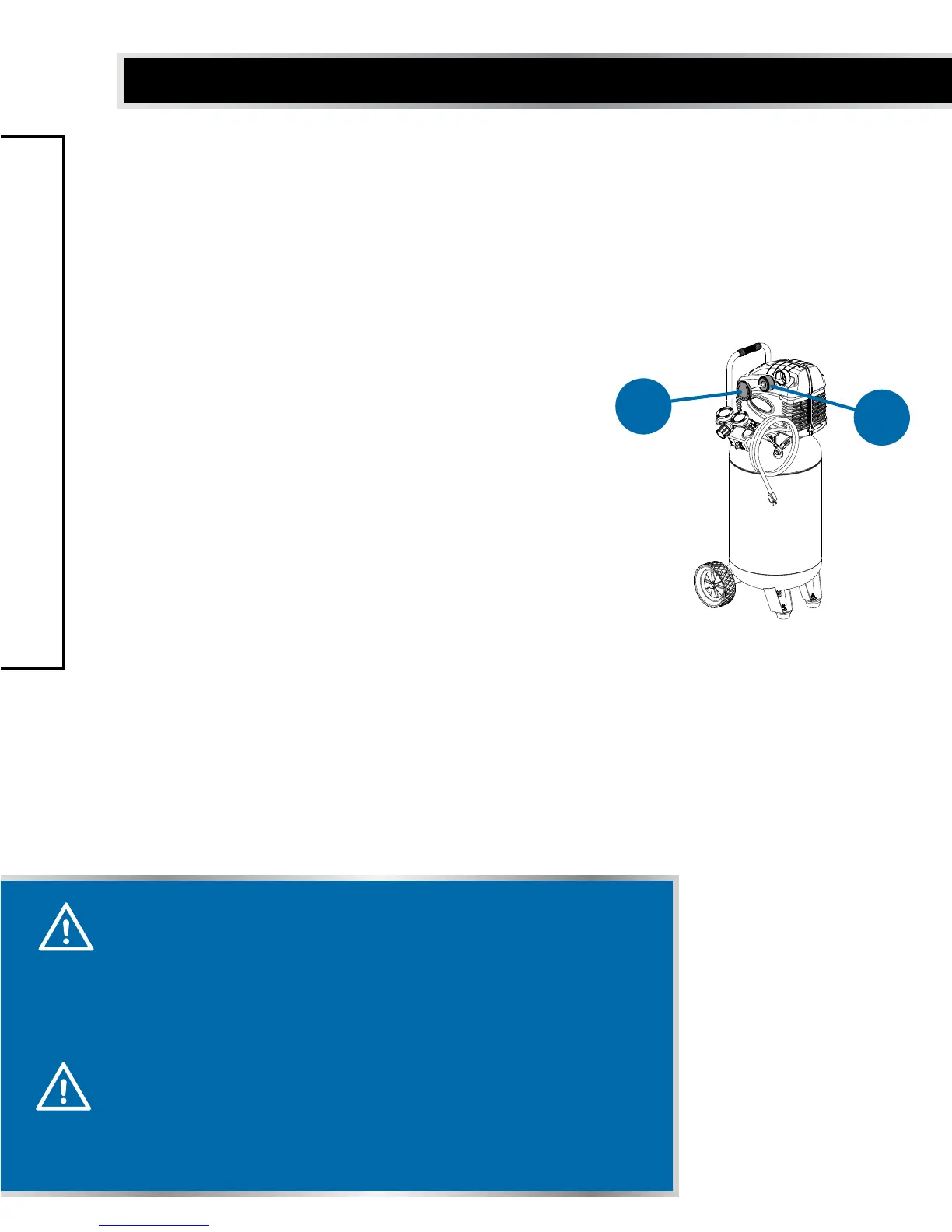
2. Open the air filter cap (1) and remove the old
air filter (2) (FIG. N).
3. Place a new air filter and close the filter cap.
NO
OFF
1
2
TESTING FOR LEAKS
Check whether all connections are tight. To find leakage
in hose, transfer tube, or pipe connection, spray a small
amount of soapy water around the damaged area with
a spray bottle. If bubbles appear around the area, repair
or replace the faulty component. Do not overtighten any
connections.
STORAGE
Before storing the compressor for a prolonged period, follow the below steps correctly.
• Disconnect the power cord and coil it up on the handle.
• Clean all dust and debris from the compressor using an air blow gun.
• Pull the relief valve ring to release all pressure from the tank.
• Drain all moisture from the air tank.
• Cover the compressor to protect it from moisture and dust.
FIG. N


 To Next Page