EasyManua.ls Logo

Maxitrol Selectra 14R Series - User Manual

Maxitrol Selectra 14R Series
8 pages
Print Icon
To Next Page IconTo Next Page
Loading...
1
© 2013 Maxitrol Company, All Rights Reserved
DESCRIPTION
Selectra Series 14R electronic gas flame modulation systems
are designed primarily for make-up air heating, as components
of direct fired equipment. They may be field installed on existing
equipment or specified for new equipment installation.
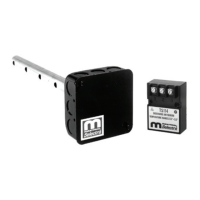
The system uses Modulator or Modulator-Regulator valves,
ampliers which include low-re start, and integral or remote
temperature selection and a discharge air temperature sensor that
is mounted within a mixing tube.
SYSTEM COMPONENTS
A1014R Amplier
A1014R (all remote temperature ranges)
Included Integral Ranges:
40º to 80ºF
55º to 90ºF
90º to 140ºF
110º to 160ºF
160º to 210ºF
Remote Temperature Selectors
TD114...................55° to 90°F w/override
0° to 40°F over set point
TD114A................................ 80° to 130°F
TD114A-1...........80° to 130°F w/override
0° to 40°F over set point
TD114B................................120 to 170°F
TD114C..............................160° to 210°F
TD114D..............................200° to 250°F
TD114E..............................100° to 250°F
TD114F..............40° to 80°F w/override
0° to 40°F over set point
TD114G...............................90° to 140°F
TD114-1........55° to 90°F w/120° to 170°F
override, use w/TS114
TD114-2...........55° to 90°F w/two outputs
TD114G-2........90° to 140°F w/two outputs
Remote Temperature Selectors Continued
IMPORTANT: The A1014R integral or remote temperature
selector’s (TD114) temperature range must match the temperature
sensor’s (TS114) temperature range. See page 7 for available
integral dial ranges.
Optional: ETD-1 enclosure, EFP-1 cover plate only - no enclosure
Discharge Air Temperature Sensors: use with Mixing Tube
TS114..........................................................................55° to 90°F
TS114A.....................................................................80° to 130° F
TS114B....................................................................120° to 170° F
TS114C....................................................................160° to 210° F
TS114D..................................................................200° to 250° F
TS114E..................................................................100° to 250° F
TS114F.....................................................................40° to 80° F
TS114G....................................................................90° to 140° F
TS114J.................................110° to 160° F, use w/ AD1014-1116,
TS214__...........................dual sensor - any combination
of 2 standard ranges available
Example 1 - TS214G....................55° to 90° F and 90° to 140° F,
use w/TD114 & TD114G, or TD214G (selector w/switch).
Example 2 - TS214AD..................80° to 130° F and 200° to 250° F,
use w/TD114A & TD114D, or TD214AD (selector w/ switch).
Mixing Tubes: (and sensor)
Lengths:
MT1-9 or 2-9............................9”
MT1-12 or 2-12......................12”
MT1-23 or 2-23......................23”
MT1-28 or 2-28......................28”
MT1-57...................................57”
Valves
Pipe Sizes:
M411........................... 3/8” & 1/2”
M511...........................1/2” & 3/4”
M611 ............................3/4” & 1”
MR212D...................1”, 1¼”, 1½”
MR212E.........................1½” & 2”
MR212G....................... 2½” & 3”
MR212J.......................4” anged
2 Speed Blower or Dual Fuel
Operation:
MR212D-2................1”, 1¼”, 1½”
MR212E-2.....................1½” & 2”
MR212G-2.....................2½” & 3”
MR212J-2....................4” anged
NOTE: M (Modulator) valve requires an
upstream pressure regulator for
low re & high re settings. MR
(Modulator/Regulator) valve
requires no upstream pressure
regulator up to 5 psi inlet.
TABLE OF CONTENTS
System Components....................................................................1
Dimensions..................................................................................2
Specications................................................................................3
Installation of Components............................................................3
Wiring Diagrams............................................................................4
Settings..........................................................................4-5
Valve Adjustments.........................................................................5
Field Service Checklist.................................................................6
Preliminary Circuit Analysis.........................................................7
Label Instructions..........................................................................7
Read these instructions carefully and completely before
installing or operating. Failure to follow them could result in a re
or explosion causing property damage, personal injury, or loss of
life. The product must be installed and operated according to all
local regulations.
Service and installation must be performed by a trained/
experienced service technician.
Series 14R Installation Instructions and Field Service Checklist

Question and Answer IconNeed help?

Do you have a question about the Maxitrol Selectra 14R Series and is the answer not in the manual?

Overview

This document describes the Maxitrol Selectra Series 14R Installation Instructions and Field Service Checklist, which pertains to a device used in heating and ventilation systems.

Function Description

The Selectra Series 14R electronic gas flame modulation systems are primarily designed for make-up air heating, as components of direct-fired equipment. They may be field installed on existing equipment or specified for new equipment installation. The system uses a Modulator or Modulator-Regulator valve, amplifiers, which include low-fire start, and integral or remote temperature selection and a discharge air temperature sensor that is mounted within a mixing tube.

Important Technical Specifications

Power Requirements:

  • 24 VAC, 50/60 Hz Class II transformer

Ambient Limits:

  • Operating: -40° to 125°F (-40° to 52°C)
  • Non-operating: -50° to 185°F (-46° to 85°C)

Vent:

  • M411, 511, 611: vertical vent outlet 1/8" NPT - 12A06 installed.
  • MR212: two vents located in upper housing, both equipped with vent limiting means.

Pressure Limits:

  • Maximum Discharge Pressure (M411, 511, 611): 7" w.c. (17.4 kPa)
  • Static Pressure Rating (M411, 511, 611): 5.0 psi (34.5 kPa)
  • Maximum Operating Inlet Pressure (M411, 511, 611): 1.0 psi (7.0 kPa)
  • MR212: 5.0 psi (34.5 kPa)
  • Maximum Emergency Exposure (M411, 511, 611): 3.0 psi (21.0 kPa)
  • MR212: 12.5 psi (86.2 kPa) *May not function properly at this pressure, but will suffer no internal damage.

Remote Temperature Selectors:

  • TD114...: 55° to 90°F w/override
  • TD114A...: 0° to 40°F over setpoint
  • TD114A-1: 80° to 130°F
  • TD114B: 0° to 40°F over set point
  • TD114C: 120° to 170°F
  • TD114D: 200° to 250°F
  • TD114E: 200° to 250°F
  • TD114F: 40° to 80°F w/override
  • TD114G: 55° to 90°F and 90° to 140°F w/override, use w/TS114
  • TD114-1: 55° to 90°F w/two outputs
  • TD114-2: 90° to 140°F w/two outputs

Discharge Air Temperature Sensors (use with Mixing Tube):

  • TS114: 55° to 90°F
  • TS114A: 80° to 130°F
  • TS114B: 120° to 170°F
  • TS114C: 160° to 210°F
  • TS114D: 200° to 250°F
  • TS114E: 200° to 250°F
  • TS114F: 40° to 80°F
  • TS114G: 90° to 140°F
  • TS114-1: 110° to 160°F, use w/AD1214, TD114G
  • TS214: dual sensor - any combination of 2 standard ranges available

Inlet Air Temperature Sensors (use with Mixing Tube):

  • TS10765A (8:1 ratio), TS10765B (5:1 ratio), TS10765C (3.5:1 ratio): Provides inverse change in discharge air for each degree change in inlet air - when installed in a convenient duct location upstream of the burner.

Room Override Thermostat:

  • T115 (40° to 90°F): Provides space temperature control by raising the discharge air temperature to a pre-selected point when used in conjunction with the remote temperature selectors TD114, TD114F, TD114-1, or TD114A-1.

Usage Features

Installation:

  • Read all instructions carefully and completely before installing or operating. Failure to follow them could result in a fire or explosion causing property damage, personal injury, or loss of life.
  • Product must be installed and operated according to all local regulations.
  • Service and installation must be performed by a trained/experienced service technician.
  • Wiring Run: Control wires connected to the Override Stat, Discharge Air Sensor, or Remote Temperature Selector must not be run close to or inside conduit with power or ignition wires. Doing so may cause the unit to function erratically or may destroy the amplifier. If shielded wires are used, shield must be isolated and grounded at the amplifier location only. If control wiring is inside conduit with line voltage wiring, use shielded cable up to 100 ft. For best results up to 200 ft, run control wiring in separate conduit. For longer runs see Remote Selector below.
  • Amplifier / Amplifier-Selector: Contains the wiring terminals and sensitivity adjustment - install in any convenient location that is protected from the weather and contaminated atmosphere.
  • Remote (or Dual) Selector: Install in control cabinet or other chosen location. NOTE: Suffix letters must match, e.g. TS114A must be used with TD114A. For wiring runs longer than 200 ft substitute ES261-1 for the TD114. The ES261A is a piece version of the TD114. ES261-1 is a temperature setting dial only, ES261-2 must be mounted at furnace location.
  • Discharge Temperature Sensor / Mixing Tube Assembly: Sensor housed in mixing tube, install in discharge air stream.
  • Dual Temp. Selector (optional): See preceding Remote/Dual Selector.
  • Room Override Stat (optional): Mount in heated area not in direct path of discharge air stream.
  • Inlet Air Sensor (optional): Install in convenient location upstream of burner, in intake air duct.

Settings:

  • Sensitivity Adjustment: The sensitivity control allows the user to control the response of the system. Caution should be exercised in the use of this adjustment. Under normal usage the pointer should be in line with the mark on the label. If hunting (oscillation) is encountered, rotating the sensitivity adjustment counter-clockwise will dampen the oscillation - stabilizing the flame. Do not adjust unless necessary. Decreasing the sensitivity can increase the temperature "DROOP" of the system.
  • Integral or Remote Temperature Dial Selection (TDS): The desired discharge temperature can be selected using the amplifiers integral temperature dial or connecting a TD114 Remote Temperature Selector to terminals 1 & 2. Set dipswitch #1 to the desired temperature setting selection mode. Placing dipswitch #1 in the "UP" position enables the integral dial. Placing dipswitch #1 in the "DOWN" position enables the remote dial. The amplifier will only respond to the dipswitch's selected temperature setting method, integral or remote.
  • Low Fire Start (LFS) Time Adjustment: The low fire start duration can be set to 0 or approximately 10 seconds and begins timing after the amplifier has been energized. The time is set by placing DIP Switch #2 to the appropriate position. LFS: Up = 10 Seconds, Down = 0 Seconds. The M/MR valve remains in the low fire setting position during the low fire start time period.

Maintenance Features

Valve Adjustments:

  • See bulletin MMR_MT_EN for additional M/MR valve information.
  • NOTE: Low fire adjustment should be checked whenever the high fire adjustment is changed.

MR 212 Valve:

  • High Fire Manifold Adjustments:
    1. Disconnect wires from amplifier terminal 4.
    2. Remove seal cap (A), and turn regulator pressure adjusting screw to obtain desired manifold pressure. (Clockwise rotation increases pressure.)
    3. Reconnect the wires to amplifier terminal 4.
  • Low Fire or Bypass Adjustments:
    1. Disconnect wire from amplifier terminal 8.
    2. Remove seal cap (B), and turn adjusting screw (C) to desired low fire adjustment. (Clockwise rotation reduces minimum flow rate.)
    3. Tighten set screw (C), replace cap (B) and reconnect wire to amplifier terminal 8.
  • NOTE: If low fire bypass is on maximum, the desired high fire outlet pressure may not be achieved.

M411, 511, 611 Valve:

  • High Fire Manifold Adjustments:
    1. Disconnect wires from amplifier terminal 4.
    2. Adjust the pressure regulator to obtain the desired manifold pressure (7" w.c. maximum).
    3. Reconnect the wires to amplifier terminal 4.
  • Low Fire or Bypass Adjustments:
    1. Disconnect wire from amplifier terminal 8.
    2. Remove cap (A), and turn adjusting screw (B) to desired low fire adjustment. (Clockwise rotation reduces minimum flow rate.)
    3. Replace cap (A), and reconnect wire to amplifier terminal 8.

Preliminary Circuit Analysis:

  • For ease in troubleshooting, it is advisable to wire the system as follows (this differs from the normal connection). Disconnect the Discharge Air Sensor and replace it with a 10,000 ohm, 1/2 watt test resistor (terminals 3 and 4). If the air sensor is being used, disconnect and replace with a jumper. On units where the Remote Temperature Selector is located a considerable distance from the heater, it may be advantageous to use the selector at the heater location or use the integral selector.
  • Connect a DC volt meter (capable of reading 0.24 VDC) on the Modulator or Modulator-Regulator Valve terminals. Set the temperature to the minimum dial setting. The DC voltage should read 0 volts. The DC voltage should gradually increase to about 20 volts as you slowly rotate the dial to the maximum dial setting. If these voltages are obtained, the valve function can now be checked out.
  • The operation of the valve with regard to voltage is as follows: from 0 volts to approximately 5 volts, the modulating valve should be on bypass with the heater operating on low or minimum fire. From approximately 5 volts to 15 volts DC, the valve should be performing its modulating function, and the heater should be firing at a modulated flow rate between low and high fire, depending upon the voltage. Above approximately 15 volts DC, the valve should be operating full flow to the heater and the unit should be on full fire. If the DC voltage is obtained on the valve terminals, but the heater does not respond as described, the problem can be isolated to the valve itself or to the gas control manifold of the heater (see "Field Service Checklist", page 6).
  • In the event proper voltages are obtained, and the valve responds correctly to these DC voltages, the problem could well be in the wiring leading to the Discharge Air Sensor or the Discharge Air Sensor itself. This should be also reviewed in the Field Service Checklist.
  • If the proper voltages are not obtained when wired as instructed, the problem can be isolated to the electronics and this may once again be reviewed in the Field Service Checklist.
  • After the troubleshooting test, remove the test resistor and reconnect the Discharge Air Sensor to terminals 3 and 4. If Remote Temperature Selector has been moved or disconnected return it to its original position.

Maxitrol Selectra 14R Series Specifications

General IconGeneral
BrandMaxitrol
ModelSelectra 14R Series
CategoryAmplifier
LanguageEnglish