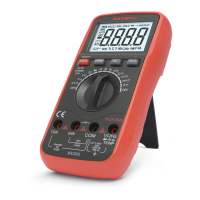
• Connect the black measuring wire to the
„COM” connector and the red one to the „mA”
connector (max. 200 mA) or to the socket
„2/20 A”, if you wish to measure 200 mA, 2 A
or 20 A.
• Set the function switch to the proper range.
• Connect the wires paralelly to the power
source for the measurement.
Note:
• If you are unsure about the range of the measured value,
switch to the highest available one and go backwards
from that until you reach the proper range.
• If only „1” is displayed on the screen, it means overload.
Switch the range switch to a higher value.
• Maximum inward current may be 200 mA or 20 A based
on the connector used. (Time for test is maximum 10
seconds). A current too high may melt the fuse, which
needs to be replaced.
Resistance measuring
• Connect the black wire to the „COM” connector
and the red one to the „V/ Ω” connector.
• Set the function switch to the desired
resistance range.
• Touch the wires to the measured circuit
paralelly. WARNING! Make sure the measured
circuit is not under power!
• Maximum overload value for the connector is
250 V RMS (for max. 10 seconds).
Note:
• If the value of the measured resistor exceeds the
maximum value of the range and the device shows
overload („1”), select a higher range. With resistors
above 1 MΩ it may take a few seconds until the device
stabilizes the value. This is completely normal.
• If you do not connect a resistor to the connectors, „1” will
appear on the screen because of the range exceed.
• If measuring a resistor within a circuit, make sure the
circuit is not under power for the time of the test and that
all capacitors are discharged.
• Do not connect inward voltage to the device as that may
lead to damage to the inside circuits.
• Outward voltage in connectors is appr. 3 V
Capacity measuring
• Set the function switch to "2000 μF" position.
• Connect the capacitor to the Cx connector, pay
attention to the correct polarity when needed.
Note:
If the measured capacitor's value exceed the maximum
value of the range and the device shows overload („1”),
select a higher range.
Unit: 1 nF=10
-3
μF or 1000 pF
Do not connect external voltage or current to the
connector. Turn o power and discharge capacitors
before measuring. Discharge electrolyte capacitors before
measuring!
Diode and continuity test
• Connect the black measuring wire to the
„COM” connector and the red one to the „V/ Ω”
connector.
(Note: the polarity of the red wire is +)
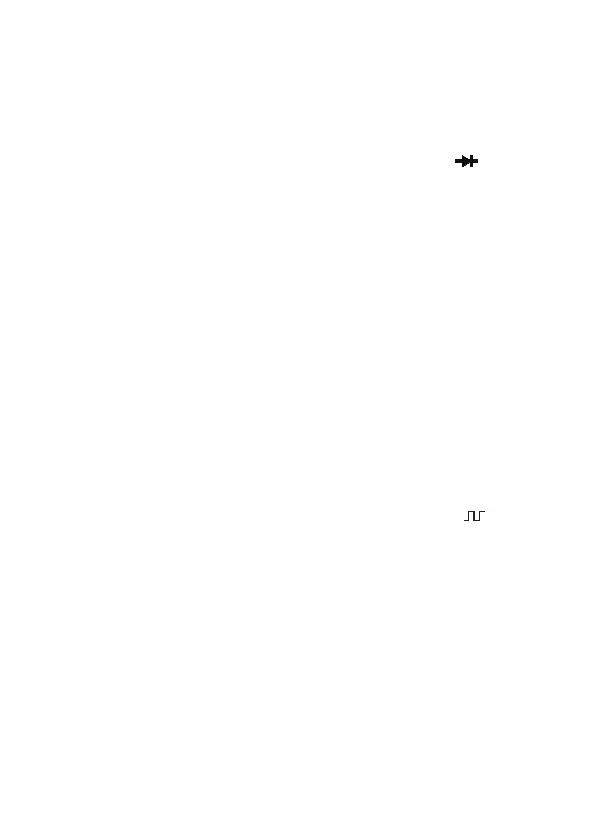
• Set the function switch to position.
• Connect the wires to the ends of the diode. The
opening voltage of the diode is displayed on
the screen.
• Connect the wires to the two points of
the circuit. There is a beeping sound if the
resistance is below 90 Ω.
Note:
• If you do not connect a part to the connector (or there is a
break), the screen will show „1”.
• The diode receives 1 mA of current under the test.
• The display shows the opening voltage of the diode in
mV and overload if you connected the diode with reverse
polarity.
Transistor hFE test
• Set the function switch to hFE position.
• Determine if the transistor is NPN or PNP
and place the part into the connector
corresponding to its type.
• The amplication factor of the transistor is
displayed on the screen. I = 10 μA, V
BC
= 3 V
Usage of logistics test
• Set the function switch to " " position.
• A test marking (50 Hz-5000 Hz) appears
between “V/Ω ” and “COM” jack sockets. The
frequency of the test marking can be changed
by pushing the HOLD button shortly. The
outgoing voltage is approx. 5 V.
warning
• When measuring voltage make sure that the
wires do not connect to a current measuring
connector and that the function switch is not
set to resistance or diode measuring mode.
Always make sure that the wire is connected to
the proper connector.
• Be careful when measuring voltage above 50 V,
especially with high voltage equipment.
• Avoid connecting to "live" circuits.
EN



 To Next Page
 Loading...