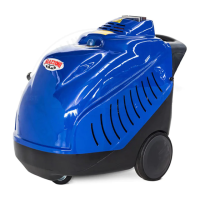
The KC3000/3050/3060/3080/4000/4050 and KC3005/3055/3065/3085/4005/4055 series are cold water pressure cleaners designed for efficient cleaning tasks. These machines are robust and user-friendly, suitable for various cleaning needs.
Function Description
These devices are cold water pressure cleaners, meaning they use high-pressure cold water to clean surfaces. They are designed for professional use, offering powerful cleaning capabilities for a range of applications. The machines are equipped with features that ensure effective dirt removal and ease of operation. They can be used with or without detergents, depending on the cleaning requirements. The design emphasizes durability and performance, making them suitable for demanding environments.
Important Technical Specifications
The KC series offers several models with varying technical specifications to cater to different needs. Here's a summary of the key technical data:
Pressure:
- KC3000/KC3005: 150 bar
- KC3050/KC3055: 160 bar
- KC4000/KC4005: 200 bar
- KC4050/KC4055: 150 bar
Capacity (Flow Rate):
- KC3000/KC3005: 10 l/min
- KC3050/KC3055: 13 l/min
- KC4000/KC4005: 15 l/min
- KC4050/KC4055: 20 l/min
Power:
- KC3000/KC3005: 2.2 kW
- KC3050/KC3055: 4 kW
- KC4000/KC4005: 5.5 kW
- KC4050/KC4055: 5.5 kW
Motor Type:
- Monophase (230V) for KC3000/KC3005.
- Triphase (400V/230V) for KC3050/KC3055, KC4000/KC4005, KC4050/KC4055.
Current Intensity (A):
- KC3000/KC3005: 13.5-14 A
- KC3050/KC3055: 9-16 A
- KC4000/KC4005: 12.5-24 A
- KC4050/KC4055: 12.9-24.5 A
Max. Speed (g/min):
- All models: 1450-1725 g/min
Motor Protection:
Insulation Class:
Motor Protector:
Max. Water Inlet Temperature:
Max. Water Inlet Pressure:
Hose Length:
- KC3000/KC3005, KC3050/KC3055: 5/16" 10mt
- KC4000/KC4005, KC4050/KC4055: 3/8" 10mt
Oil Capacity:
- KC3000/KC3005, KC3050/KC3055: 0.4 l
- KC4000/KC4005: 0.7 l
- KC4050/KC4055: 1.2 l
Detergent Capacity:
Oil Type:
Dimensions (Cm):
Weight:
Usage Features
The KC series pressure cleaners are designed for ease of use and safety.
Starting Stages:
- Open the water supply cock.
- Open the gun and keep it open for a few seconds to allow air in the pipes to come out.
- Turn the start switch.
- WARNING: Grip the lance and the gun firmly with both hands.
Stopping Stages:
- Close the water supply cock.
- Open the gun and keep it open for a few seconds so that the water in the line drains out.
- Close the spray gun.
- Turn the off switch.
- Disconnect the machine from the electric supply by removing the plug from the power socket.
Detergent and Liquid Additives:
The pump is predisposed to aspirate and mix detergents or other liquid additives. An automatic device allows remote control of the detergent aspiration from the 4F head. To aspirate detergent or other liquid additives, it is necessary to place the 4F head in low pressure. Once the detergent aspiration operation is finished, return the pump to high pressure using the 4F head.
Safety Gun Usage:
- Safe release (1)
- Safe locking (2)
Safety Rules:
- Do not leave the machine on with the gun closed for more than five minutes to prevent overheating and damage.
- Do not place the machine in enclosed rooms or where ventilation is inadequate.
- The electricity supply must include a differential safety breaker which will cut off the power supply if the ground leakage current exceeds 30mA for 30ms.
- Before doing any work on the appliance, it is necessary to take the plug out of the power socket. All technical operations must be carried out by an authorized service center.
- Never handle the power socket with wet hands.
- The earth connection is compulsory.
- It is forbidden to make precarious repairs to the electric cable.
- It is forbidden to use extension sockets and precarious plugs or ones not in conformity with the standards.
- Do not direct the water spout towards equipment, persons, animals or other electric instruments.
- Protect the machine from atmospheric agents. Avoid using the machine under rain or thunderstorms, and in all situations when water or other liquids can reach the electrical parts.
- Make sure the water pipe is not squashed anywhere.
- Never use the appliance close to anyone not wearing protective clothing.
- Never use the supply cable or the connecting pipes to move the machine.
- Never use the power plug for switching on or off.
- Never use the appliance if the power supply cable or other important parts are damaged (e.g. safety devices, high pressure hoses, spray gun and electric wiring).
- WARNING: The high pressure hoses, accessories and unions are important for the appliance's safety. Use only original accessories or spare parts.
- WARNING: High pressure water jet. The water jet may be dangerous if improperly used; never point it at people or animals. Not to be used by children.
- Use only anaerobic detergents (which do not solidify in air). If in doubt, consult your specialist retailer.
Maintenance Features
Regular maintenance is crucial for the longevity and optimal performance of the KC series pressure cleaners.
Routine Maintenance:
- Important! When the machine is new, the pump/motor assembly must be run in for a short period. This running-in period entails running the machine for not more than one hour and then waiting for an hour for it to cool. Repeat this procedure 4 or 5 times.
- The oil must be changed after 100 hours of work; subsequently, every 500 hours. Use SAE15/40 grade oil.
- If the machine is not to be used for a long period or if it might be left at a temperature below 0°C, run the pump for a few minutes with anti-freeze liquid through the water suction pipe.
- Avoid aspirating corrosive liquids (paint, acid, solvent, diluent or very dense liquids) as these can permanently damage the pump. After use, rinse the machine thoroughly and prevent the formation of scale.
- Control and clean the water filter of the pressure cleaner at least once a month.
- Park the machine on a level floor. When not in use, keep the pressure cleaner in a place protected from atmospheric agents.
Troubleshooting:
The manual provides a comprehensive troubleshooting guide with common problems, their causes, and remedies. Examples include:
- The pump turns but fails to reach the required pressure:
- Causes: Suction/delivery valves worn or jammed, inadequate or worn nozzle, worn gaskets, filter clogged, adjustment valve needle worn.
- Remedies: Clean or replace relevant parts.
- Irregular swings in pressure:
- Causes: Air suction, worn gaskets, worn nozzle.
- Remedies: Check and clean air suction, replace gaskets or nozzle.
- Drop in pressure:
- Causes: Suction/delivery valves dirty or jammed, adjustment valve needle worn or jammed, worn gaskets.
- Remedies: Clean or replace relevant parts.
- Noisiness:
- Causes: Air suction, worn, dirty valves, worn bearings.
- Remedies: Check water intake lines, clean and/or replace valves or bearings.
- Water in the oil:
- Causes: Worn water-oil seals.
- Remedy: Replace.
- Water leaking from the head:
- Causes: Worn O-rings.
- Remedy: Replace.
- Oil leakage:
- Causes: Oil seal rings worn.
- Remedy: Replace.
- The motor fails to start:
- Causes: Not plugged in properly, no power, voltage too low, the pump is jammed or frozen, electrical extensions inadequate or cross-section.
- Remedies: Check plug, cable, switch, check the electrical system, make sure the motor turns by hand, refer to table for correct use of extensions.
- The motor stops suddenly:
- Causes: Thermal cut-out has tripped due to overheating.
- Remedies: Check that the voltage is as required, disconnect the switch and leave to cool for a few minutes.
All maintenance and repair work not explicitly described in the manual should be carried out by authorized personnel (service center).

 Need help?
 General

 To Next Page