CAUTIONS:
Remove any loose fitting jewelry from the patient before activation.
Examine all accessories and connections to the electrosurgical desiccator before use. Ensure that
the accessories function as intended. Improper connection may result in arcs, sparks, accessory
malfunction, or unintended surgical effects. Refer to the accessories instructions for use for more
detailed instructions.
Accessories must be connected to the proper receptacle type. In particular, bipolar accessories
must be connected to the Bipolar Instrument output jack only. Improper connection may result in
inadvertent desiccator activation.
When not using active accessories, place them in a holster or in a clean, dry, non-conductive, and
highly visible area not in contact with the patient. Inadvertent contact with the patient may result
in burns.
Avoid HF output settings where maximum output voltage may exceed rated accessory voltage.
Refer to the accessory’s voltage rating.
To avoid incompatibility and unsafe operation, use suitable cables, accessories, active and neutral
electrodes, including values for the highest allowed H.F. peak voltage.
Connected accessories need be rated for at least the maximum peak output voltage of the H.F.
desiccator set at the intended output control setting in the intended operating mode.
The output power selected should be as low as possible for the intended purpose. Certain devices
or accessories may present a safety hazard at low power settings.
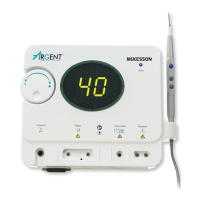
Apparent low output or failure of the McKesson Argent High Frequency Electrosurgical Desiccator
to function correctly at the normal operating settings may indicate faulty application of the neutral
electrode or poor contact in its connections. In this case, the application of the neutral electrode
and its connections should be checked before selecting a higher output power.
When using Monopolar mode, associated equipment and active accessories should be selected
that have a voltage rating of 6.3 kVp or greater.
When using Bipolar mode, associated equipment and active accessories should be selected that
have a voltage rating of 1 kVp or greater.
Studies have shown that smoke generated during electrosurgical procedures can be potentially
harmful to patients and the surgical team. These studies recommend adequately ventilating the
smoke by using a surgical smoke evacuator or other means.
1
1. U.S. Department of Health and Human Services. National Institute for Occupational Safety
and Health (NIOSH). Control of Smoke from Laser / Electric Surgical Procedures. HAZARD
CONTROLS, Publication No. 96-128, September, 1996.
CONTRAINDICATIONS
There are no known contraindications.
NOTICES:
If required by local codes, connect the desiccator to the hospital equalization connector with an
equipotential cable.
Do not clean the desiccator with abrasive cleaning or disinfectant compounds, solvents, or other
materials that could scratch the panels or damage the desiccator.
6 McKesson Medical-Surgical Inc.


 To Next Page