EasyManua.ls Logo

Meade 2045 - Alignment of the Optical System

Meade 2045
15 pages
Print Icon
To Next Page IconTo Next Page
To Previous Page IconTo Previous Page
Loading...
from
the
main
tube).
Importantly,
do
not
remove
the
actual
correcting
lens
from
its
machined
cell
housing
for
cleaning
or
other
purposes.
You
will
almost
certainly
not
be
able
to
replace
the
correcting
lens
in
its
proper
rotational
orientation,
and
serious
degradation
of
optical
performance
may
result.
Alignment
of
the
Optical
System
All
Meade
Schmidt-Cassegrain
telescopes
are
precisely
collimated
(aligned)
at
the
factory
before
packing
and
shipment,
and
it
is
probable
that
you
will
not
need
to
make
any
optical
adjustments
before
making
observations.
However,
if
the
telescope
sustained
rough
handling
in
shipment,
you
may
need
to
recollimate
the
optical
system.
Such
recollimation
is
not
difficult,
in
any
case.
To
check
the
collimation
of
your
telescope,
locate
in
the
telescope
a
moderately
bright
(first
or
second
magnitude)
star
near
the
zenith.
To
perform
the
test,
center
the
starpoint
in
the
telescopic
field
with
a
low
power
eyepiece,
such
as
the
25mm
eyepiece
supplied
as
standard
equipment.
Defocus
the
image
to
fill
about
1/4
of
the
field
of
view.
You
will
see
in
the
out-of-focus
image
a
circle
of
light
with
the
darker
circular
shadow
of
the
secondary
mirror
somewhere
within.
If
the
darker
shadow
is
well
centered
within
the
lighter
shadow(see
(C),
Fig.
4),
your
telescope
is
well
collimated,
but
continue
to
read
this
section
for
the
more
sensitive,
high
power
tests
to
be
described
below.
If
the
darker
shadow
is
not
so
centered
(see
(A),
Fig.
4),
follow
this
procedure:
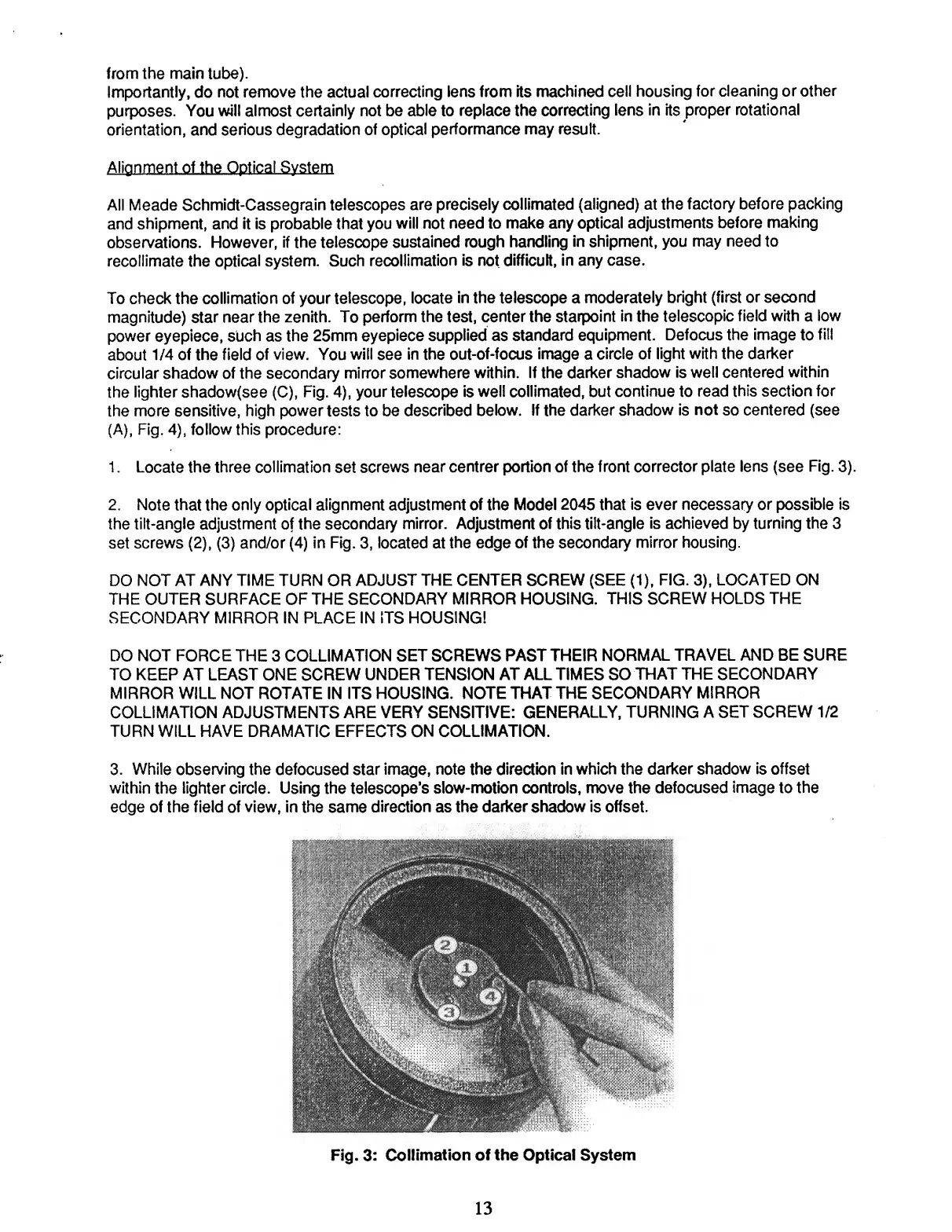
1.
Locate
the
three
collimation
set
screws
near
centrer
portion
of
the
front
corrector
plate
lens
(see
Fig.
3).
2.
Note
that
the
only
optical
alignment
adjustment
of
the
Model
2045
that
is
ever
necessary
or
possible
is
the
tilt-angle
adjustment
of
the
secondary
mirror.
Adjustment
of
this
tilt-angle
is
achieved
by
turning
the
3
set
screws
(2),
(3)
and/or
(4)
in
Fig.
3,
located
at
the
edge
of
the
secondary
mirror
housing.
DO
NOT
AT
ANY
TIME
TURN
OR
ADJUST
THE
CENTER
SCREW
(SEE
(1),
FIG.
3),
LOCATED
ON
THE
OUTER
SURFACE
OF
THE
SECONDARY
MIRROR
HOUSING.
THIS
SCREW
HOLDS
THE
SECONDARY
MIRROR
IN
PLACE
IN
ITS
HOUSING!
DO
NOT
FORCE
THE
3
COLLIMATION
SET
SCREWS
PAST
THEIR
NORMAL
TRAVEL
AND
BE
SURE
TO
KEEP
AT
LEAST
ONE
SCREW
UNDER
TENSION
AT
ALL
TIMES
SO
THAT
THE
SECONDARY
MIRROR
WILL
NOT
ROTATE
IN
ITS
HOUSING.
NOTE
THAT
THE
SECONDARY
MIRROR
COLLIMATION
ADJUSTMENTS
ARE
VERY
SENSITIVE:
GENERALLY,
TURNING
A
SET
SCREW
1/2
TURN
WILL
HAVE
DRAMATIC
EFFECTS
ON
COLLIMATION.
3.
While
observing
the
defocused
star
image,
note
the
direction
in
which
the
darker
shadow
is
offset
within
the
lighter
circle.
Using
the
telescope’s
slow-motion
controls,
move
the
defocused
image
to
the
edge
of
the
field
of
view,
in
the
same
direction
as
the
darker
shadow
is
offset.
Fig.
3:
Collimation
of
the
Optical
System
13

Other manuals for Meade 2045

Related product manuals