EasyManua.ls Logo

Meade 2045 - Lining Up With The Celestial Pole

Meade 2045
15 pages
Print Icon
To Next Page IconTo Next Page
To Previous Page IconTo Previous Page
Loading...
appear
to
be
placed.
The
Poles
of
the
celestial
coordinate
system
are
defined
as
those
two
points
where
the
Earth’s
rotational
axis,
if
extended
to
infinity
North
and
South,
intersect
the
celestial
sphere.
Thus,
tHe
North
Celestial
Pole
is
that
point
in
the
sky
where
an
extension
of
the
Earth’s
axis
through
the
North
Pole
intersects
the
celestial
sphere.
In
fact,
this
point
in
the
sky
is
located
near
the
North
Star,
Polaris.
On
the
surface
of
the
Earth,
"lines
of
longitude”
are
drawn
between
the
North
and
South
Poles.
Similarly,
"lines
of
latitude"
are
drawn
in
an
East-West
direction,
parallel
to
the
Earth’s
equator.
The
celestial
equator
is
simply
a
projection
of
the
Earth’s
equator
onto
the
celestial
sphere.
Just
as
on
the
surface
of
the
Earth,
imaginary
lines
have
been
drawn
on
the
celestial
sphere
to
form
a
coordinate
grid.
Celestial
object
positions
are
mapped
on
this
grid
in
the
same
manner
as
positions
on
the
Earth’s
surface
are
specified
by
their
latitude
and
longitude.
The
celestial
equivalent
to
Earth
latitude
is
called
"Declination,”
or
simply
"Dec.,"
and
is
measured
in
degrees,
minutes
and
seconds
North
("+")
or
South
of
the
celestial
equator.
Thus
any
point
on
the
celestial
equator
(which
passes,
for
example,
through
the
constellations
Orion,
Virgo
and
Aquarius)
is
specified
as
having
0°0
min
0
sec
Declination.
The
Declination
of
the
star
Polaris,
located
very
near
the
North
Celestial
Pole,
is
+89.2°.
The
celestial
equivalent
to
Earth
longitude
is
called
"Right
Ascension,"
or
"R.A.,"
and
is
measured
in
hours,
minutes
and
seconds
from
an
arbitrarily
defined
"zero"
line
of
R.A.
passing
through
the
constellation
Pegasus.
Right
Ascension
coordinates
range
from
o
hr
o
m
i
n
O
sec
up
to
(but
not
including)
24
hr
o
m
i
n
o
sec
.
Thus
there
are
24
primary
lines
of
R.A.,
located
at
15°
intervals
along
the
celestial
equator.
Objects
located
further
and
further
East
of
the
prime
(o
hr
o
m
,
n
O
sec
)
Right
Ascension
grid
line
carry
increasing
R.A.
coordinates.
With
all
celestial
objects
therefore
capable
of
being
specified
in
position
by
their
celestial
coordinates
of
Right
Ascension
and
Declination,
the
task
of
finding
objects
(in
particular
faint
objects)
in
the
telescope
is
greatly
simplified.
The
setting
circles
of
the
Modei
2045
may
be
dialed,
in
effect,
to
read
the
object-coordinates,
and
the
object
found
without
resorting
to
visual
location
techniques.
However,
these
setting
circles
may
be
used
to
advantage
only
if
the
telescope
is
first
properly
aligned
with
the
North
Celestial
Pole.
LINING
UP
WITH
THE
CELESTIAL
POLE
Objects
in
the
sky
appear
to
revolve
around
the
celestial
pole.
(Actually,
celestial
objects
are
essentially
"fixed,"
and
their
apparent
motion
is
caused
by
the
Earth’s
axial
rotation).
During
any
24-hour
period,
stars
make
one
complete
revolution
about
the
Pole,
describing
concentric
circles
with
the
Pole
at
the
center.
By
lining
up
with
the
telescope’s
polar
axis
with
the
North
Celestial
Pole
(or,
for
observers
located
in
the
Earth’s
Southern
Hemisphere,
with
the
South
Celestial
Pole),
astronomical
objects
may
be
followed,
or
tracked,
simply
by
moving
the
telescope
about
one
axis,
the
polar
axis.
In
the
case
of
the
Meade
Model
2045,
this
tracking
may
be
accomplished
automatically
with
the
electric
motor
drive.
For
the
purposes
of
casual
visual
telescopic
observations,
lining
up
the
telescope’s
polar
axis
to
within
a
degree
or
two
of
the
Pole
is
more
than
sufficient.
With
this
level
of
pointing
accuracy,
the
telescope’s
motor
drive
will
track
accurately
and
keep
objects
in
the
telescopic
field
of
view
for
perhaps
20
to
30
minutes.
To
line
up
the
telescope
with
the
North
Celestial
Pole,
follow
this
procedure:
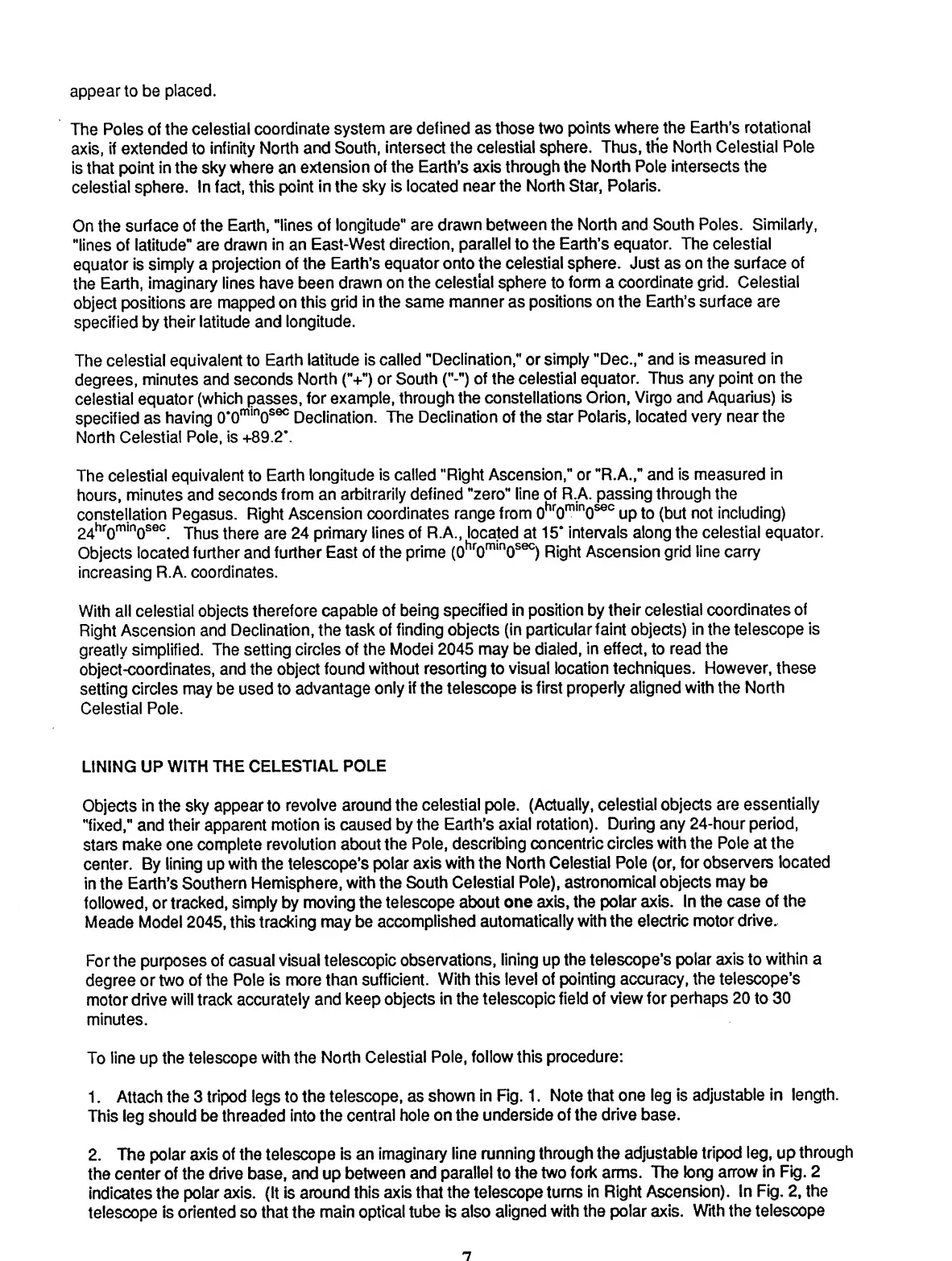
1.
Attach
the
3
tripod
legs
to
the
telescope,
as
shown
in
Fig.
1.
Note
that
one
leg
is
adjustable
in
length.
This
leg
should
be
threaded
into
the
central
hole
on
the
underside
of
the
drive
base.
2.
The
polar
axis
of
the
telescope
is
an
imaginary
line
running
through
the
adjustable
tripod
leg,
up
through
the
center
of
the
drive
base,
and
up
between
and
parallel
to
the
two
fork
arms.
The
long
arrow
in
Fig.
2
indicates
the
polar
axis.
(It
is
around
this
axis
that
the
telescope
turns
in
Right
Ascension).
In
Fig.
2,
the
telescope
is
oriented
so
that
the
main
optical
tube
is
also
aligned
with
the
polar
axis.
With
the
telescope
7

Other manuals for Meade 2045

Related product manuals