(circle 2, Fig. 2) should appear slightly offset to the left, as shown in Fig. 2. If the secondary mirror does not
appear correctly offset, then slightly loosen the secondary-mirror-holder's attaching screw (see (3), Fig. 3), and
move the secondary mirror so that this mirror appears offset as shown in Fig. 2.
Step 2: Center the primary mirror (circle 3, Fig. 2) in the secondary mirror. This centering, if necessary, is
accomplished by loosening slightly screws (1) and (2), Fig. 3, so that the single-strut steel vane, (5), Fig. 3 may
be pivoted up or down. In addition, loosening screw (3), Fig. 3, permits lateral centering of the primary mirror
in the secondary mirror. Re-tighten all screws when the required centering is accomplished.
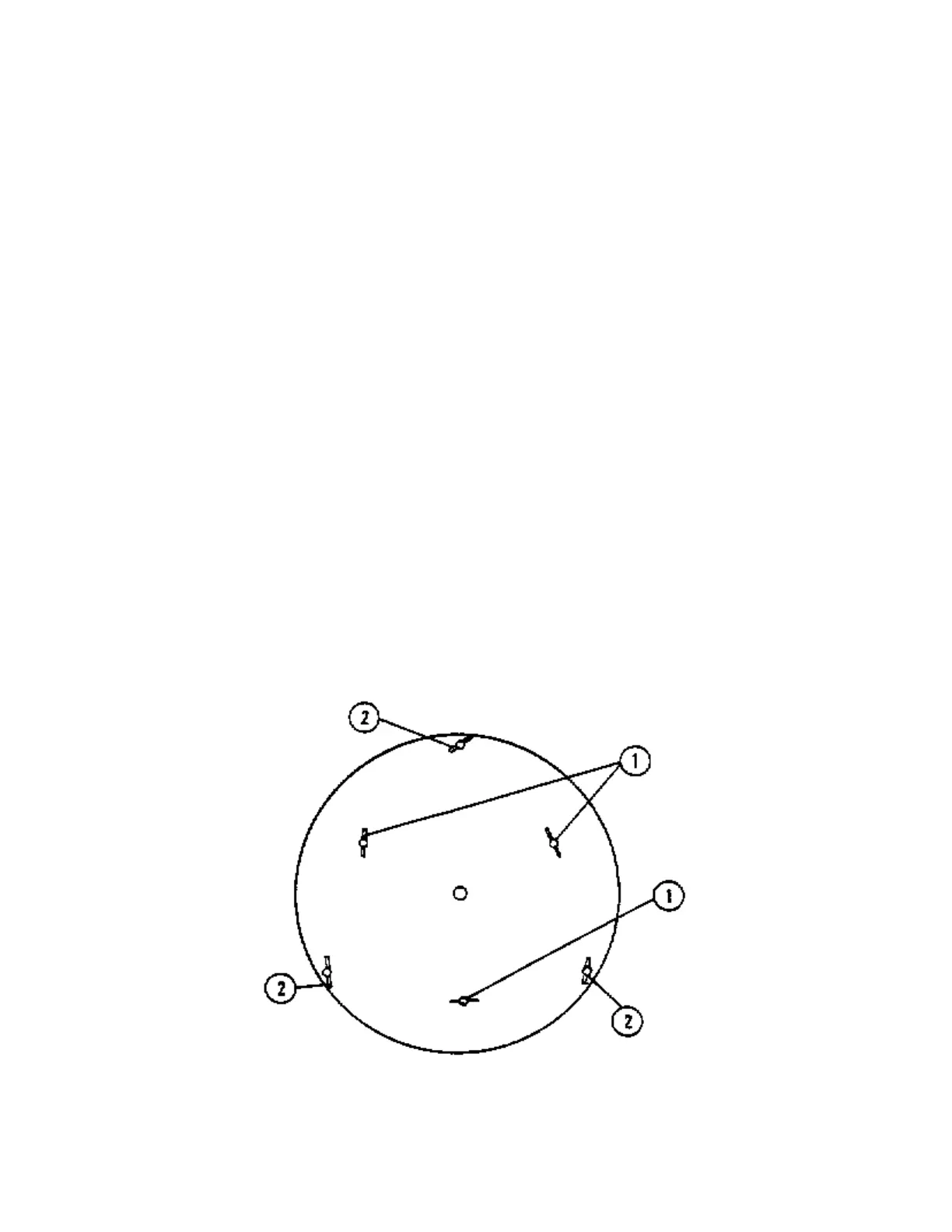
Step 3: Turn the wing nuts located on the back side of the primary mirror cell (see Fig. 5), so that the dark
circle, (5) Fig. 2, is centered relative to the primary mirror, (3) Fig. 2. (These wing nuts adjust the tilt-angle of
the primary mirror.)
Step 4: After Steps 1-3 have been followed, your DS-10 telescope will be well-collimated. Final "fine-tuning"
of the collimation must be performed while observing a star through the telescope, with an eyepiece in place.
Center a fairly bright star in the telescope's field of view. Then defocus the star image. It will then appear as in
Fig. 4, with several rings surrounding the central star. If Step 3 was performed accurately, these rings will be
round and concentric; if not, adjust the wing nuts of the primary mirror cell until the rings are well-centered, as
in Fig. 4b. (In any case, it is not necessary to re-do Steps 1 and 2.) With this centering accomplished,
collimation is completed.
II. USE OF THE TELESCOPE
Lining up the Telescope with the Pole: The Meade Model DS-10 utilizes an equatorial mount, a type of
mounting which greatly facilitates the tracking of astronomical objects. To use the telescope properly, the
equatorial mount must be roughly aligned with the North Celestial Pole before each observing session. This
polar alignment need require no more than 30 seconds for visual telescopic observations. If photographs are to
be taken through the telescope, it is advisable to exercise greater care in lining up with the Pole, particularly if
the photographs are to be of long exposure. Polar alignment consists of two operations:
FIG. 5: Primary Mirror Cell (As seen from behind the primary mirror.)
(1) Wing nuts for tilting primary mirror. (Steps 3 & 4 of collimation procedure.)



 To Next Page