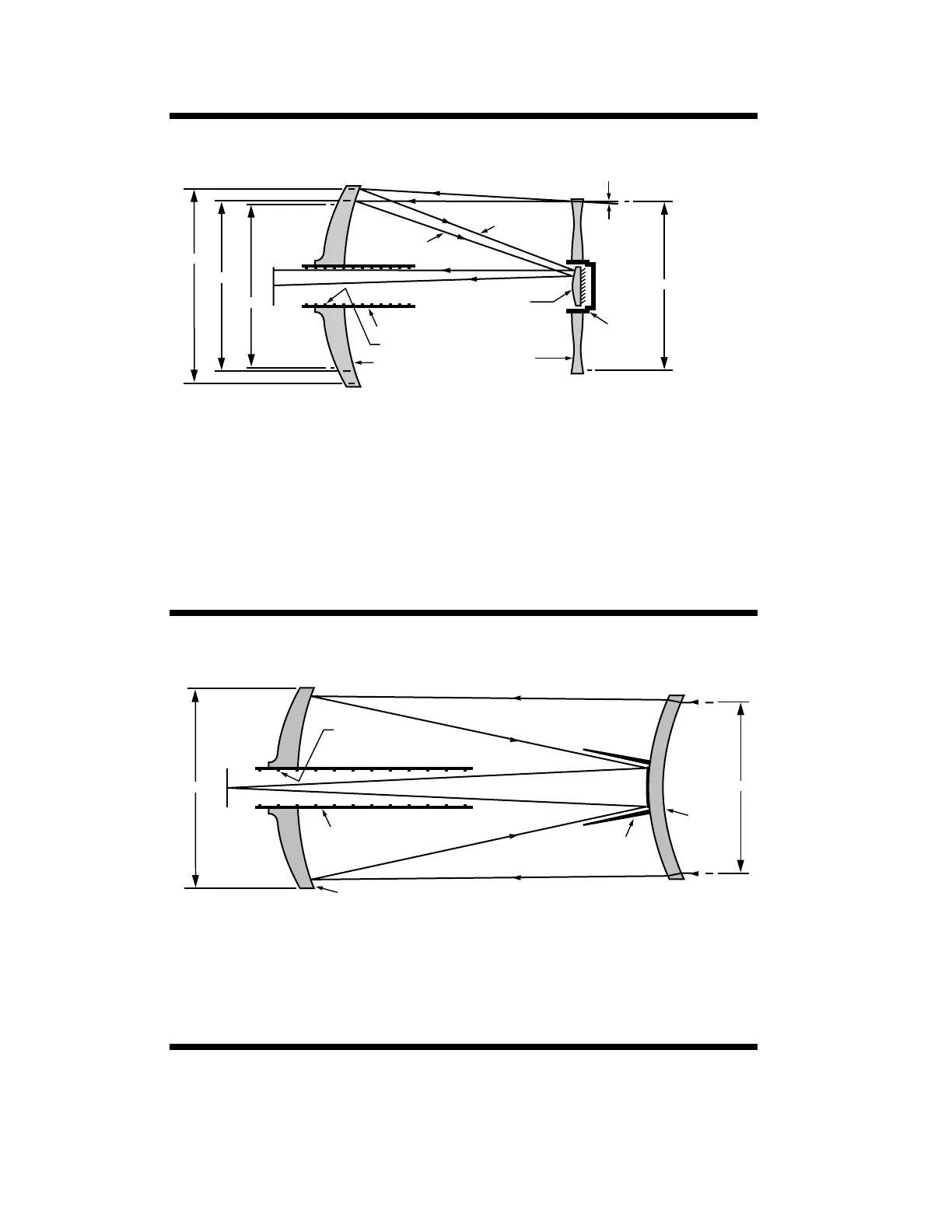
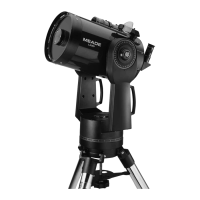
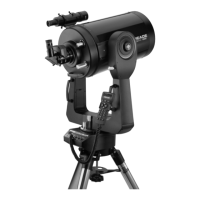
In the Schmidt-Cassegrain design of the Meade 8", 10", 12", 14", and 16" LX200GPS models, light enters from the right,
passes through a thin lens with 2-sided aspheric correction (“correcting plate”), proceeds to a spherical primary mirror, and
then to a convex secondary mirror. The convex secondary mirror multiplies the effective focal length of the primary mirror
and results in a focus at the focal plane, with light passing through a central perforation in the primary mirror.
The Meade 8", 10" and 12" Schmidt-Cassegrain models include an oversize primary mirror, yielding a fully illuminated field-
of-view significantly wider than is possible with a standard-size primary mirror. Note that light ray (2) in the figure would be
lost entirely, except for the oversize primary. It is this phenomenon which results in Meade Schmidt-Cassegrains having
off-axis field illuminations about 10% greater, aperture-for-aperture, than other Schmidt-Cassegrains utilizing standard-size
primary mirrors. Field stops machined into the inside-diameter surface of the primary mirror baffle tube significantly
increase lunar, planetary, and deep-space image contrast. These field stops effectively block off-axis stray light rays.
The Meade Schmidt-Cassegrain Optical System
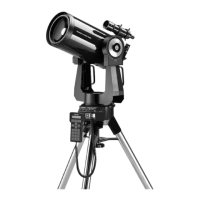
The Meade 7" Maksutov-Cassegrain design optimizes imaging performance by utilizing a combination of a two-sided
spherical meniscus lens (right), a strongly aspheric f/2.5 primary mirror, and a spherical secondary mirror. The convex sec-
ondary mirror multiplies the effective focal length of the primary by a factor of six, resulting in an overall a focal length of
2670mm and a focal ratio of f/15 system at the Cassegrain focus.
The oversize 8.25" primary mirror results in a fully-illuminated (unvignetted) field of view significantly wider than can be
obtained with Maksutov optics incorporating primary mirrors of the same aperture as their meniscus correcting lenses.
Computer-optimized primary and secondary mirror baffles, as well as a sequence of field stops internal to the primary mir-
ror baffle, yield lunar, planetary, stellar, and deep-space images of uncommonly high contrast and resolution.
The Meade Maksutov-Cassegrain Optical System




 To Next Page