The MESA Automation GmbH MQC series comprises compact PWM servo amplifiers designed for 4-quadrant speed control of DC servo motors, utilizing either tacho or BEMF feedback. These amplifiers are specifically engineered for regulating brush DC motors and include an internal power supply. They convert DC voltage into current for the motor, with the output current being PWM controlled. The high chopper frequency ensures a large bandwidth and dynamic response.
Function Description:
The MQC servo amplifiers provide precise speed control for DC servo motors. They are designed to operate as standalone units. The core function involves generating a PWM-controlled output current that drives the motor, with torque being proportional to the output current and speed proportional to the output voltage. The direction of rotation corresponds to the sense of the output voltage.
The amplifier features various control and feedback mechanisms:
- Speed Control: Achieved through an input command (differential ±10V, Ri = 20 kΩ) and a tacho reference signal (differential ±5V to ±60V, Ri = 54 kΩ). A PI (D) compensation network, adjustable via potentiometer or components, optimizes speed control. The speed control range is 1:20000, with static errors of ±0.1% for 30-3000 rpm, ±2.0% for 1-30 rpm, and ±5.0% for <1 rpm.
- Current Control: Features a band width of 1 kHz and a PI compensation network. It includes two current limitations: I_arms and max. output current I_Amax.
- Enable Signal: The amplifier is enabled by connecting X1/PIN5 to 0V (optional +24V).
- Braking Module: An integrated braking system is available, with specific technical dates and power ratings.
- Protection and Fault Signalling: The unit monitors for ground faults, overvoltage, undervoltage, and over-temperature of the power stage. A green LED indicates proper function, while a red LED signals a fault, disabling the power stage and opening the "ready/drive healthy" relay contact.
Important Technical Specifications:
- Input Voltage (Power Stage): 85 VDC (U_A=60V), 160 VDC (U_A=120V), 190 VDC (U_A=150V).
- Over Voltage Protection: D_max, -I_max, -U_max.
- Chopper Frequency: 8 kHz (to GND).
- Form Factor (nominal ratings): 1.01 (Rated current).
- Power Stage Protection: Short circuit.
- Drive Healthy Signal (Relay Contact): X1/PIN6 connect to X1/PIN7, 160 VDC/20 mA.
- Electronic Supply: Internal DC/DC converter ±15V, max external charge with 20 mA.
- Operating Temperature: 0 to 45 °C (derating 2%/K from 45 °C to 60 °C).
- Storage Temperature: -10 to +70 °C.
- Cooling: By air convection or fan.
- Relative Humidity: 65%, without condensation.
- Protection Class: IP 20.
- Isolation Group: C/VDE 0110.
Basis Models (Examples):
| TYPE |
U_A (V) |
I_max (A) |
I_NRMS (A) |
U_CCN (V DC) |
U_N (V AC) |
U_min (V AC) |
U_max (V AC) |
| MQC 0506 |
48 |
12 |
6 |
55 |
24-48 V DC |
16 V DC |
65 V DC |
| MQC 0610 |
60 |
20 |
10 |
65 |
46 |
30 |
51 |
| MQC 1208 |
120 |
16 |
8 |
125 |
90 |
30 |
98 |
| MQC 1515 |
150 |
30 |
15 |
155 |
113 |
30 |
125 |
Usage Features:
- Setting Up the Amplifier:
- Tacho Adjustment (P3): Adjusts the maximum motor speed to correspond to a 10V input command. Standard range: 5V tacho input voltage for 10V set value (left side), 60V tacho input voltage for 10V set value (right side).
- Offset (P1): Eliminates motor creep when a 0V command input is applied.
- Speed Controller Gain Adjustment (P2): Optimizes the speed circuit. Amplifiers are factory-optimized, but P2 allows adaptation. P-Gain range: 8 (left side) to 160 (right side).
- Armature Current Measurement: A shunt measures armature current, with 10V output at the "I Monitor" test point corresponding to the amplifier's maximum current.
- Max. Output Current (P4): Adjusts the peak current, which can be up to twice the rated current for 1.5-5 seconds.
- RMS Function (P5): Adjusts the I_rms current, which is maintained irrespective of the armature current's actual value curve shape.
- BEMF Feedback Speed Control with I x R-compensation: Solder jumpers Br1 and Br2 enable BEMF operation (Br3 must be open). For output voltages > 60V, two additional resistors (R211/212) are required instead of direct Br1+Br2 closure.
- Wiring Suggestions:
- Proper earthing of the amplifier is crucial to prevent damage in case of an earth fault in the motor circuit.
- Each motor must be wired separately, with shielded cables recommended for reduced electrical noise.
- Speed demand and tacho circuits should use individually shielded (twisted) pairs.
- Differential speed demand inputs allow either polarity. If a single-ended input is used, one amplifier input must be connected to ground, ensuring the controller and amplifier share the same GND reference potential.
- All control inputs (limit switch, speed demand) should use twisted and shielded pairs.
- For cables with two outside shields (better EMV security), the outside shield should be earthed on both sides, and the inside shield connected to the rack. GND contacts of amplifiers are not suitable for shield circuits.
Maintenance Features:
- Faultfinding and Remedy: The manual provides a comprehensive table for diagnosing and resolving common issues, including:
- Motor not starting (supply voltage missing, drive not enabled, motor wiring open).
- Uncontrollably high speed after switching on (control circuit polarized).
- Motor not starting despite current presence (motor blocked, shorted motor circuit).
- Uneven motor running (P-portion too high, I-portion too small, wiring fault at control leads/tachometer).
- Red fault LED lit after enable (choke not wired, choke/motor inductance too low, short circuit in motor/wiring/chokes, defective power stage).
- Red LED on after long running time (power stage overheat).
- Red LED on during deceleration (overvoltage due to high system inertia).
- Red LED on immediately after power up (overvoltage due to high bus voltage).
- Resetting the Amplifier: In case of a fault, the amplifier can be reset by cycling the supply voltage off and then on.
- Monitoring: The device monitors for ground faults, overvoltage, undervoltage, and over-temperature of the power stage (up to 90 °C or 190 °F).

 Need help?
 General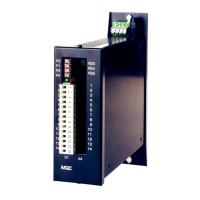

 To Next Page