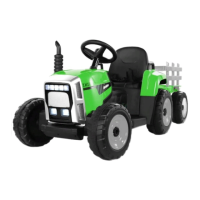
This document describes a children's electronic toy tractor, designed for children aged 3 years and older, with a maximum user weight of 30 kg. The product is intended for decorative purposes only, and passenger and loading are not allowed on its trailer. Assembly of the toy tractor must be performed by an adult.
The toy tractor provides children with many miles of riding enjoyment. To ensure a safe ride, users are advised to read the manual carefully and keep it for future reference. The recommendations in the manual are designed to improve the safety and operation of the ride-on car and its rider.
Usage Features:
The toy tractor is operated using several controls:
- One-button start: This button turns the vehicle on and off.
- High/Low speed forward & Reverse shift: This lever changes the direction and speed of the vehicle.
- To move the vehicle forward in high speed, shift the lever to the top position.
- To move the vehicle forward in low speed, shift the lever to the middle position.
- To move the vehicle backward, shift the lever to the down position.
- Hint: The vehicle is designed to operate in low speed only in reverse.
- Lights switch: This switch turns the vehicle's lights on and off.
- Foot pedal: Pressing the pedal moves the vehicle. Releasing pressure from the pedal brakes or slows down the vehicle.
- Horn button: Pressing this button activates the horn or plays sounds.
The toy tractor also features a player with the following functions:
- USB slot: Supports a maximum of 15GB.
- Audio input change: Allows switching the audio input between Bluetooth and USB.
- Play/Next button: For controlling media playback.
- Decrease volume button: Reduces the audio volume.
- Increase volume button: Increases the audio volume.
- Battery display: Shows the power level of the battery when the vehicle stops. When only one indicator remains, the battery needs recharging.
For models equipped with a remote controller, the following features are available:
- Forward button: Moves the vehicle forward.
- Reverse button: Moves the vehicle backward.
- Brake button: Stops the vehicle when pressed once; pressing again releases the brake.
- Right button: Controls direction.
- Speed select button: Operates the vehicle in low, normal, or high speed. Hint: This switch does not work when the vehicle is moving in reverse.
- Speed indicator: Displays the selected speed.
- Left button: Controls direction.
To establish a connection with the remote controller:
- Long press the forward and reverse buttons for 3 seconds; the speed indicator will flash.
- Power on the vehicle; the speed indicator will become steadily bright, indicating a successful connection. If the speed indicator does not respond, the connection has failed, and batteries should be replaced, and the process retried.
Note on Remote Controller:
- If left idling for about 10 seconds, the remote controller will shut down automatically.
- The connection needs to be rebuilt when replacing the batteries of the remote controller.
- Prevent Injuries and Deaths:
- Never leave a child unattended. Adult direct supervision is required. Always keep the child in view when they are in the vehicle.
- This toy should be used with caution as skill is required to avoid falls or collisions.
- Protective equipment should be worn.
- Never use in roadways, near cars, on steep inclines or steps, near swimming pools, or other bodies of water.
- Always wear shoes and sit on the seat.
- Not to be used in traffic.
- This toy is unsuitable for children under 36 months due to its maximum speed; the maximum user weight is 30 kg.
- This toy has no brake.
- Choking Hazard: Not suitable for children under 36 months.
- Must be assembled by an adult.
Rules for Safe Riding:
- Keep children within safe riding areas: Never use in roadways, near motor vehicles, on lawn space, on or near steep inclines or steps, swimming pools, or other bodies of water.
- Use the toy only on flat surfaces, such as inside your house, garden, or playground.
- Never use in the dark. Operate the vehicle only in the daytime or a well-lit area.
- It is prohibited to change the circuit or add other electric parts.
- Inspect wires and connections of the vehicle periodically.
- Do not let any child touch the wheels or be near them when the car is moving.
- This vehicle has adjustable play seat belts. Instruct children on how to tie the safety belt before using to guarantee security.
Charging:
- Only an adult can charge and recharge the battery.
- The product has charging protection: all functions are cut off during charging.
- The POWER SWITCH must be in the OFF position when charging.
- Before first use, charge the battery for at least 4-6 hours, but no more than 10 hours to avoid overheating.
- Recharge the battery when the vehicle begins to run slowly.
- To charge:
- Plug the charger port into the input socket (below the seat).
- Plug the charger plug into a wall outlet. The battery will begin charging.
Troubleshooting:
The manual provides a troubleshooting guide for common issues:
- Vehicle does not run: Possible causes include low battery, tripped thermal fuse, loose battery connectors/wires, dead battery, damaged electrical system, or damaged motor. Solutions involve recharging, resetting the fuse, checking connections, or contacting the distributor.
- Vehicle does not run very long: Possible causes include undercharged battery or old battery. Solutions involve recharging or replacing the battery.
- Vehicle runs sluggishly: Possible causes include low battery, old battery, or vehicle overload. Solutions involve recharging, replacing the battery, or reducing weight on the vehicle.
- Vehicle needs a push to go forward: Possible causes include poor contact of wires/connectors or a "dead spot" on the motor. Solutions involve checking connections or contacting the distributor for repair.
- Difficult shifting from forward to reverse or vice-versa: This usually occurs when attempting to shift while the vehicle is in motion. The solution is to completely stop the vehicle before shifting.
- Loud grinding or clicking noises from motor or gear box: Indicates damaged motor or gears. Contact the distributor.
- Battery will not recharge: Possible causes include loose battery/adapter connector, charger not plugged in, or a faulty charger. Solutions involve checking connections, ensuring the charger is plugged into a working outlet, or contacting the distributor.
- Charger feels warm when recharging: This is normal and not a cause for concern.
Maintenance Features:
- Parents are responsible for regularly checking main parts of the toy for potential hazards, such as the battery, charger, cable or cord, plug, screws, and other fastenings. If damage is found, the toy must not be used until properly repaired.
- Ensure plastic parts of the vehicle are not cracked or broken.
- Occasionally use a lightweight oil to lubricate moving parts like wheels.
- Park the vehicle indoors or cover it with a tarp to protect it from wet weather.
- Keep the vehicle away from heat sources like stoves and heaters, as plastic parts may melt.
- Recharge the battery after each use. Only an adult should handle the battery. Recharge the battery at least once a month when the vehicle is not being used.
- Do not wash the vehicle with a hose, soap, or water. Do not drive in rainy or snowy weather, as water can damage the motor, electric system, and battery.
- Clean the vehicle with a soft, dry cloth. Use a non-wax furniture polish to restore shine to plastic parts; do not use car wax or abrasive cleaners.
- Do not drive the vehicle in loose dirt, sand, or fine gravel, which could damage moving parts, motors, or the electric system.
- When not in use, turn off all electrical sources and disconnect the battery connection.
Fuse:
The battery features a thermal fuse that automatically trips and cuts all power if the motor, electric system, or battery is overloaded. The fuse resets and power is restored after the unit is turned OFF for 20 seconds and then turned ON again. If the thermal fuse trips repeatedly, the vehicle may need repair; contact the distributor.
To avoid losing power, follow these guidelines:
- Do not overload the vehicle.
- Do not tow anything behind the vehicle.
- Do not drive up steep slopes.
- Do not drive into fixed objects, which may cause wheels to spin and the motor to overheat.
- Do not drive in very hot weather, as components may overheat.
- Do not allow water or other liquids to contact the battery or other electric components.
- Do not tamper with the electric system, as this may cause a short and trip the fuse.
Disposal of Battery:
- The sealed lead-acid battery must be recycled or disposed of in an environmentally sound manner.
- Do not dispose of the lead-acid battery in a fire, as it may explode or leak.
- Do not dispose of the lead-acid battery in regular household trash. Incineration, landfilling, or mixing sealed lead-acid batteries with household trash is prohibited by law.
The products are suitable for ASTM F963; GB6675; EN71 and EN62115 standards.


 To Next Page
 General