The 3M
™
Petrifilm
™
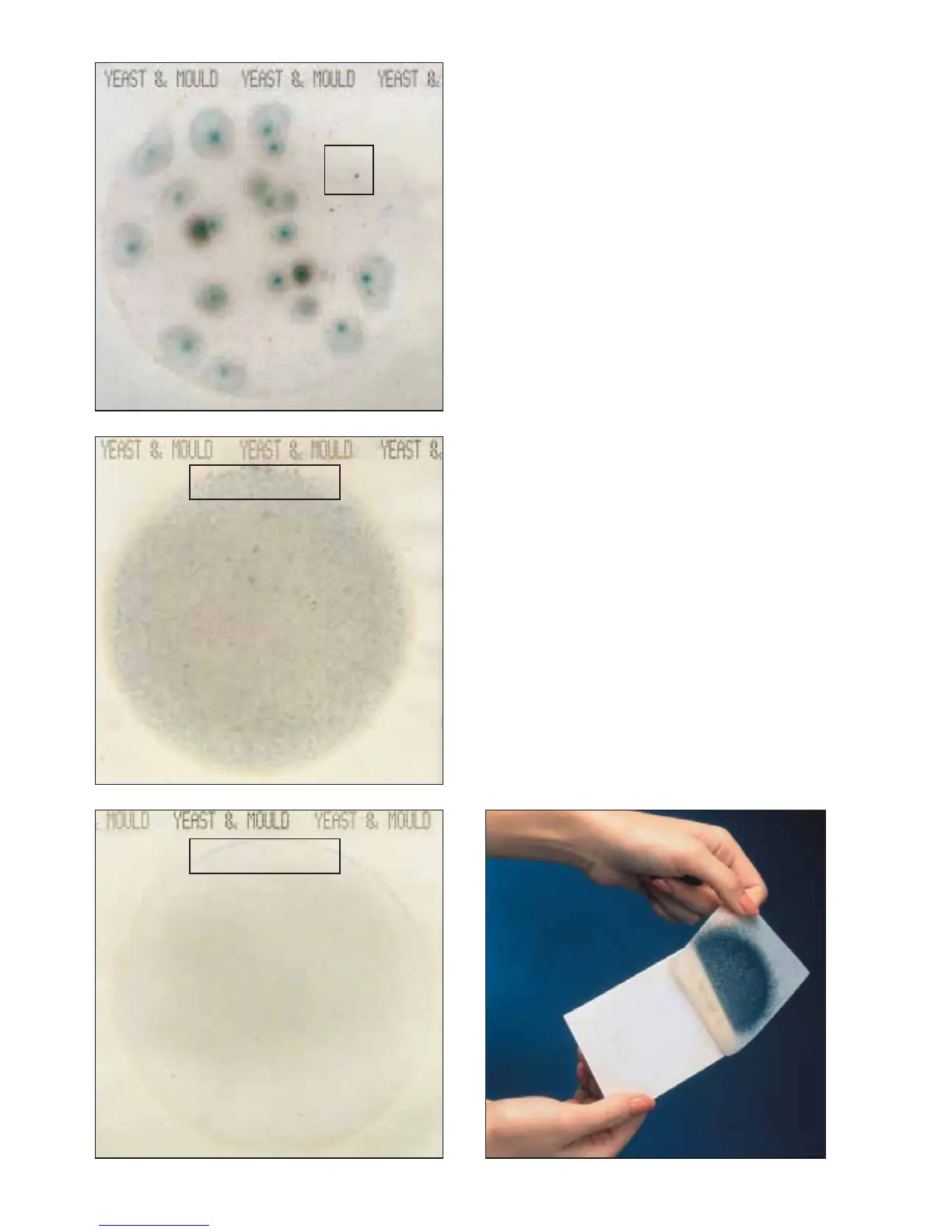
Yeast and Mould Count Plate in figure 3
contains as easily countable number of mould colonies,
(large, green colonies with diffuse edges, and centre foci)
and a high number of yeast colonies. The yeast colonies are
small, tan colonies with defined edges, and no foci. When
colonies number more than 150, estimate the count. (Yeast
count = 480 (estimate); Mould count = 21)
Determine the average number of colonies in one square
(1 cm
2
) and multiply it by 30 to obtain the total count per
plate. The inoculated area of a Petrifilm Yeast and Mould
count plate is approximately 30 cm
2
.
The Petrifilm Yeast and Mould count plate in figure 4
contains a high number of yeast colonies - too numerous to
count (TNTC). The small, blue colonies outlined at the
edge of the plate differentiate the plate 'from a TNTC mould
count. (Yeast count = TNTC actual count > 10
4
)
Sometimes Petrifilm Yeast and Mould count plates with
high numbers of yeast colonies may appear to have blue
growth only around the edges (figure 5). This is also
recorded as a yeast count of TNTC. (Yeast count = TNTC
actual count > 10
6
)
If Petrifilm Yeast and Mould count plates appear to have
no growth, lift the top film and examine the gel that adheres
to the top film (figure 6). If numerous yeast are present,
you will see white colonies in the gel. This is recorded as a
yeast count of TNTC. (Yeast count = TNTC)
Yeast
Yeast count = 480 (estimate);
Mould count = 21
Figure 3
Yeast count = TNTC (actual count < 10
4
)
Figure 4
Yeast count = TNTC (actual count < 10
6
)
Figure 5
Yeast count = TNTC
Figure 6


 To Next Page
 Loading...