MFJ-1026 Instruction Manual Deluxe Noise Canceling Signal Enhancer
12
Operation
This unit requires 10 to 15 volts dc, available from your station supply or an optional MFJ-1312B
power supply.
If you have a general coverage receiver, select a strong steady signal between 1.5 and 30 MHz. The
ideal signal would be ground wave, although the time and frequency standards on 5 , 7.335, and 10 MHz
are good alternatives. It is important to select a signal with little or no fading for initial practice.
1. Connect the MFJ-1026 to your station and a suitable power source. See the Installation instructions
on page 8.
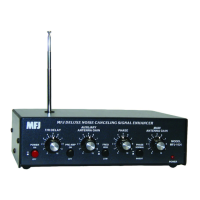
2. From left to right:
a. Turn the T/R DELAY control fully clockwise.
b. Press and release the POWER switch to place it in the OFF (out) position.
c. Turn the AUXILIARY ANTENNA GAIN control fully counter-clockwise.
d. Release the frequency range for operation below 7-12 MHz, or press and lock it for operation
above 7-12 MHz. In the range of 7-12 MHz, either setting may work.
e. Adjust the MAIN ANTENNA GAIN control fully clockwise.
3. Tune in a strong steady signal.
4. Turn the MFJ-1026 power switch on. The red LED should light and you should hear the internal
relay click.
5. You should still hear the same signal. Look at the receiver's S meter and remember the signal
strength. Adjust the MAIN ANTENNA GAIN control counter-clockwise, signal strength should
decrease. Turn the control fully counter-clockwise.
6. Advance the AUXILIARY ANTENNA GAIN control clockwise. You should hear signals from the
AUXILIARY antenna.
7. Adjust the AUXILIARY ANTENNA GAIN until the signal is just exactly the same as the level
observed on the MAIN antenna, or as high as possible.
8. Advance the MAIN ANTENNA GAIN until you just see the S meter change.
9. Adjust the PHASE control for minimum signal. If the signal strength increases or won't null,
change the position of the PHASE switch.
10. Go back and forth between the PHASE and the GAIN control that isn't totally against the stop while
watching for a null. Adjust only one GAIN control, do not adjust the control that is fully advanced.
This step may take some practice until you get a "feel" for how the controls work..
11. Practice nulling several steady signals until you are comfortable with the action of the controls.


 To Next Page