EasyManua.ls Logo

MFJ MFJ-249 - Page 12

MFJ MFJ-249
20 pages
Print Icon
To Next Page IconTo Next Page
To Previous Page IconTo Previous Page
Loading...
MFJ-249
SWR
Analyzer
Instruction
Manual
Impedance
of
Transmission
Lines
The
impedance
of
transmission
lines
between
15
and
150
ohms
can
be
measured
with
the
MFJ-
249,
a
250
ohm
potentiometer,
and
an
ohm
meter.
Lines
of
higher
impedance
can
be
measured
with
a
higher
resistance
potentiometer
if
a
broad
band
transformer
is
used
(see
the
section
on
testing
transformers)
to
transform
the
line
tmpedance
to
approximately
50
ohms.
1
Measure
the
1/4
wavelength
frequency
of
the
transmission
line
to
be
tested
as
in
Testing
and
Tuning
Stubs
on
page
8.
3
vi
Terminate
the
far
end
of
the
transmission
line
with
a
non-inductive
250
ohm
potentiometer.
Connect
the
transmission
line
to
the
MFJ-249
"ANTENNA"
connector
and
set
the
analyzer
to
the
1/4
wave
frequency.
ee
Observe
the
SWR
as
you
vary
the
"TUNE"
from
end
to
end
of
the
"FREQUENCY"
range
selected.
vi
Adjust
the
potentiometer
until
the
SWR
reading
varies
as
little
as
possible,
over
the
"TUNE"
range.
Note
that
the
value
of
the
SWR
is
not
important.
Only
the
change
in
SWR
as
the
frequency
is
varied
1s
important.
The
value
of
the
potentiometer
will
correspond
closely
to
the
line
impedance.
Estimating
transmission
line
loss
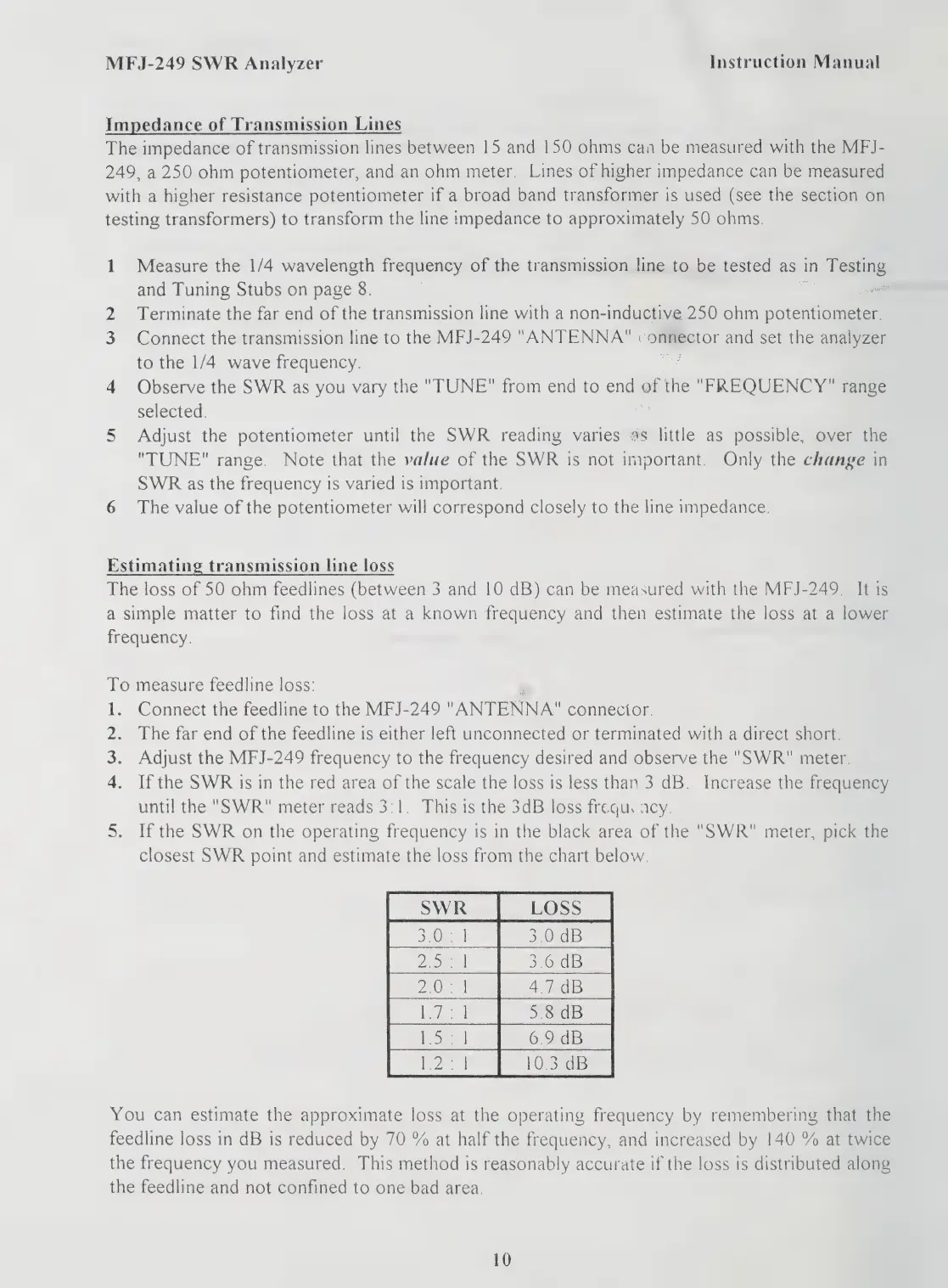
The
loss
of
50
ohm
feedlines
(between
3
and
10
dB)
can
be
measured
with
the
MFJ-249.
It
is
a
simple
matter
to
find
the
loss
at
a
known
frequency
and
then
estimate
the
loss
at
a
lower
frequency.
To
measure
feedline
loss:
ie
De
3.
4
Connect
the
feedline
to
the
MFJ-249
"ANTENNA"
connector.
The
far
end
of
the
feedline
is
either
left
unconnected
or
terminated
with
a
direct
short.
Adjust
the
MFJ-249
frequency
to
the
frequency
desired
and
observe
the
"SWR"
meter.
If
the
SWR
is
in
the
red
area
of
the
scale
the
loss
is
less
than
3
dB.
Increase
the
frequency
until
the
"SWR"
meter
reads
3:1.
This
is
the
3dB
loss
frequs
acy.
If
the
SWR
on
the
operating
frequency
is
in
the
black
area
of
the
"SWR"
meter,
pick
the
closest
SWR
point
and
estimate
the
loss
from
the
chart
below.
You
can
estimate
the
approximate
loss
at
the
operating
frequency
by
remembering
that
the
feedline
loss
in
dB
is
reduced
by
70
%
at
half
the
frequency,
and
increased
by
140
%
at
twice
the
frequency
you
measured.
This
method
ts
reasonably
accurate
if
the
loss
is
distributed
along
the
feedline
and
not
confined
to
one
bad
area.

Related product manuals