
 Need help?
Do you have a question about the MFJ MFJ-9420 and is the answer not in the manual?
Details power, antenna jacks, mic gain, CW adapt, and key inputs.
Covers meter, power switch, mic jack, tuning, XMIT/PWR LEDs, volume.
Covers problems with powering up, receiving signals, and transmission.
Addresses erratic transmit, AGC/S-meter, and frequency drift problems.
Deals with poor carrier suppression, low transmit audio, and transmit audio noise.
Lists necessary tools, parts, and test equipment for alignment.
Outlines the initial steps for setting up the transceiver for testing.
Details voltage checks and necessary adjustments for proper operation.
Provides steps for calibrating the Voltage Controlled Oscillator (VFO) frequency.
Covers checking and aligning the Beat Frequency Oscillator (BFO).
Describes the procedure for nulling the carrier signal.
Details how to check and optimize receiver sensitivity.
Covers alignment of transmitter filters and speech processor.
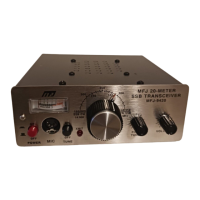
The MFJ-9420 is a 20-Meter transceiver designed for efficient low-power radio operation, emphasizing ease of use and a "back to basics" approach. It allows users to operate the unit with minimal setup time.
The MFJ-9420 serves as a complete transceiver for the 20-meter band, capable of both transmitting and receiving signals. Its core function is to provide reliable communication for amateur radio enthusiasts, particularly those interested in low-power (QRP) operation. The device incorporates a speech processor that enhances the clarity and punch of transmitted audio, allowing it to compete effectively with higher-powered radios, even in noisy conditions. This speech processing is designed to make signals cut through QRM (man-made noise) and be heard clearly.
The transceiver features a quiet DBM (Double Balanced Mixer) front end and ample overall gain, contributing to its excellent sensitivity. This means that even weak signals can be detected and heard. A sharp ladder filter is integrated to cut down on adjacent channel interference, focusing the transmitter's power and improving selectivity.
For tuning, the MFJ-9420 utilizes a custom-manufactured 8:1 reduction drive ball bearing VFO (Variable Frequency Oscillator) tuning capacitor, which provides smooth and stable frequency adjustment. An analog S meter is included to measure signal strength, allowing for precise antenna tuning or beam aiming. This meter also monitors the speech processing level during transmission.
The device is designed to be highly portable, capable of running on NiCd batteries or an ultra-light AC wall adapter supply, eliminating the need for a heavy 10 Amp power supply often associated with 50-Watt radios. Its rugged Motorola PA (Power Amplifier) transmitter is built to run cool and tolerate a 3:1 VSWR (Voltage Standing Wave Ratio), even with accidentally opened or shorted feedlines.
For CW (Continuous Wave) operation, an optional CW adapter board can be installed, allowing users to access the lower end of the band for Morse code communication. The transceiver also supports semi-break-in keying and includes a sidetone feature.
Operating the MFJ-9420 is straightforward. To get started, users need a 12-14 Volt, 2 Amp power source, a 600 Ohm dynamic PTT (Push-To-Talk) microphone, and a 20-meter antenna. The MFJ-4114 AC/NiCd Portable Power Pack or MFJ-4110 AC Wall adapter are specifically designed for this radio, though any filtered DC power source meeting the voltage and current requirements can be used. It's crucial to ensure the positive terminal is connected to the center pin of the 5.5mm OD, 2.1mm ID coaxial power plug.
For microphones, the MFJ-9420's speech processor circuit is optimized for 600 Ohm dynamic microphones, such as the MFJ-290. Other suitable 600 Ohm desk or hand mics can be used by installing a 5-pin DIN plug. A critical warning is to never use an amplified microphone, as the transceiver's speech processor already provides very high gain, and an amplified mic could cause severe distortion.
Regarding antennas, the MFJ-9420 works best with 20-meter antennas exhibiting a VSWR of 3:1 or less. This includes home station antennas, portable dipoles like the MFJ-1772, or non-resonant wires used with a tuner such as the MFJ-971. Users are advised to avoid antennas with unknown or high VSWR, as the PA is not protected by high VSWR shutdown circuitry, and such conditions could lead to out-of-band parasitics. When using an antenna tuner, it's recommended to "rough tune" for maximum receiver sensitivity using incoming signals and the S meter before activating the CARRIER switch for final adjustment.
The operating procedure involves connecting the microphone, power source, and antenna, then turning the VOLUME control fully counter-clockwise before pressing the ON switch. The PWR indicator should light up. The VOLUME is then adjusted for a comfortable listening level. For transmitting, the microphone's PTT switch is pressed, and the user speaks at a normal conversational level, holding the mic about 2 inches from the mouth. The potent speech processor will pick up the voice at full intensity, so shouting or "close talking" into the microphone should be avoided to prevent overloading the processing circuit and hurting signal intelligibility. The S meter should deflect about half-scale during speech, though this may vary with antenna load.
The analog VFO tuning dial covers 14.150-14.350 MHz (or 14.000-14.100 MHz with the CW adapter). While calibrated at the factory, its analog nature means it may have some inaccuracy compared to digital readouts. Users are encouraged to periodically check the VFO dial with a digital transceiver or counter to confirm band edge locations and to avoid transmitting on the margins of their allocation unless certain of being "in band" to comply with FCC rules.
The MFJ-9420 is designed for optimal performance with lightweight, constant current power sources like NiCd cells or the MFJ wall adapter AC supply.
The MFJ-9420 is built with conservative design principles, featuring a premium plate-through PC board, quality components, a handsome brushed aluminum panel, and a tough vinyl-clad case, all contributing to years of dependable service.
For troubleshooting, a series of checks are provided to help users diagnose common issues before contacting customer service. These include verifying power supply integrity (plug, wire, battery, fuse), antenna connection and condition, microphone and connector functionality, and SWR levels. If the radio drifts in frequency, environmental factors like direct sunlight, hot surfaces, cold drafts, or rapid temperature changes (condensation) should be considered.
For poor carrier suppression, users are advised to check if the radio was exposed to extreme cold-to-warm transitions, rough handling, or shock. To null the carrier, the mic pin 4 should be shorted to ground, and pin 3 grounded to key the radio. Then, R36 and T3 are adjusted for minimum carrier while monitoring with a second receiver.
Low transmit audio issues might stem from using a non-600 Ohm dynamic mic or having the MIC GAIN set too low. Conversely, noise on transmit audio could be due to the MIC GAIN being set too high in a noisy room or the mic being too close to a power transformer or motor.
If these initial checks do not resolve the problem, or if the user is not comfortable making prescribed adjustments, MFJ customer service is available. The product is backed by MFJ's "No Matter What" 1-year guarantee, ensuring repairs if it breaks. After the guarantee period, technicians are still available to help maintain the rig.
Field alignment procedures are also detailed for advanced users, requiring specific tools like an AC power supply, voltmeter, non-inductive alignment tool kit, frequency counter, wattmeter with a dummy load, and a signal generator or weak signal source. These procedures cover initial test setup, voltage checks and adjustments (for regulator and AGC), VFO calibration, BFO frequency check and alignment, and carrier null. A DC voltage chart is provided for troubleshooting, listing typical DC voltages at key test points (Vcc, TP1, TP2) and integrated circuit pins for both RX and TX modes. This allows for detailed diagnosis of circuit performance.
The manual also emphasizes antenna grooming as a maintenance aspect, recommending inspection and cleaning of traps and contacting surfaces, replacement of corroded hardware and dirty connectors, and retuning for minimum SWR. Raising wire dipoles high and clear, and adding radials for multiband verticals, are suggested for optimal performance.
 General
| Dimensions | 6.25 x 2.5 x 6.5 inches |
|---|---|
| Weight | 2.5 lbs |
| Frequency Range | 14.000 - 14.350 MHz |
| Modes | CW, SSB |
| Type | QRP |
| Voltage | 12 VDC |
| Power Supply | 12 VDC |

 To Next Page