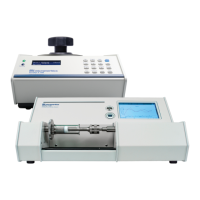
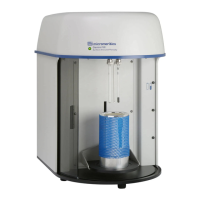
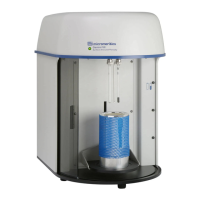
The Gemini VII Surface Area Analyzer is a high-performance system designed to characterize particles, powders, and porous materials by measuring single and multipoint surface area and pore size. This manual covers three models: the Gemini 2390a, 2390p, and 2390t. The 2390a and 2390p share the same cabinet size, with the 2390p uniquely featuring a P0 (saturation pressure) tube for continuous saturation pressure measurement. The 2390t model has a slightly larger cabinet to accommodate a larger dewar and longer sample tubes for extended analyses, and it also includes a P0 tube. Most application features are available across all models, with the exception of continuous P0 measurement and a few specific reports.
Function Description
The Gemini VII series analyzers perform single and multipoint surface area and pore size measurements. They are designed for use with non-corrosive adsorbate gases that have acceptable vapor pressures at both room and bath temperatures, relative to the resolution of the 1,000 mmHg pressure transducer. While optimized for nitrogen in a liquid nitrogen sample bath, they can also use oxygen, argon, carbon dioxide, butane, methane, and other light hydrocarbons to produce useful data above absolute pressures of a few mmHg.
Important Technical Specifications
- Analysis:
- Surface Area: From 0.1 m²/g (total), From 0.01 m²/g (specific)
- Pore Volume: From 4 × 10⁻⁶ cm³/g
- Electrical:
- Frequency: 50/60Hz
- Power: 50VA
- Voltage: 100-240VAC
- Overvoltage Category: II
- Environment:
- Humidity: 20% relative, non-condensing
- Temperature: 10 °C to 35 °C (50 °F to 95 °F) operating; 0 °C to 50 °C (32 °F to 122 °F) non-operating
- Indoor/Outdoor Use: Indoor only (not suitable for wet locations)
- Altitude: 2000 m max
- Pollution degree of the intended environment: 2
- Degree of Ingress Protection: IPX0
- Pressure Measurement:
- Range: 0 to 950 mmHg
- P/P0 Resolution: <10⁻⁴
- Relative Pressure Range: 0 to 1.0 P/P0
- Pressure Resolution: <0.1 mmHg
- Accuracy and Linearity (transducer manufacturer specification): Better than ± 0.5% full scale
- Sample Tube and Dewar:
- Standard Tube (Gemini VII 2390a and 2390p): 0.95 cm (3/8 in.) OD, 15.5 cm (6.1 in.) long with 6.5 cm³ volume. Sample capacity approximately 2.0 cm³.
- Standard Tube (Gemini VII 2390t): 0.95 cm (3/8 in.) OD × 20.5 cm (8.1 in.) long with 8.9 cm³ volume. Sample capacity approximately 2.0 cm³.
- Dewar (Gemini VII 2390a and 2390p): 8 hours
- Dewar (Gemini VII 2390t): >24 hours
- Physical:
- Height (Gemini VII 2390a and 2390p): 59 cm (23 in.)
- Height (Gemini VII 2390t): 74 cm (29 in.)
- Width: 40 cm (16 in.)
- Depth: 51 cm (20 in.)
- Weight (Gemini VII 2390a and 2390p): 32 kg (75 lbs.)
- Weight (Gemini VII 2390t): 35 kg (78 lbs.)
- Computer Requirements:
- Operating System: 32-bit Windows 7 Professional or higher (Windows 10 Professional or Enterprise for 21 CFR Part 11 environments).
- Desktop Installation: Application should not be installed on a network drive with shared access. Multiple users cannot operate simultaneously.
- Ethernet Port: Two Ethernet ports required if connected to a network. An Ethernet switch is needed if more than one Ethernet-based unit or a Smart VacPrep is connected.
- Read/Write Permissions: All users need Read/Write permission to installation directories. For 21 CFR Part 11 environments, permissions may be limited to the installation directory.
- Drives: USB port.
Usage Features
The Gemini VII is operated via software with a standard Windows menu structure. It allows other computer programs to run concurrently with an automatic operation.
- Option Presentation: Users can choose between Advanced, Basic, or Restricted display modes for sample and parameter files. Advanced mode shows all file parts, Basic mode uses drop-down lists for pre-created parameter files, and Restricted mode is similar to Basic but with disabled functions and password protection, typically for constant analysis conditions.
- Libraries: Provides an organized way to locate and open analyzer files from various storage locations (C: drive, network, external hard drive, USB flash drive). Libraries do not store actual files but provide access to them.
- Methods: Templates for sample identification format, sequence number, and complete sets of parameters for common sample types.
- Unit Configuration: Displays hardware/software configurations and calibration data.
- Instrument Status: Includes an Instrument Log (recent analyses, calibrations, errors) and an Instrument Schematic for visualizing the analyzer system.
- Export Files: Data can be exported as .PDF, .TXT, .XML, or .XLS files.
- Sample Files: Contain information for analysis, including sample identification, analysis conditions, and report options. Parameter files (Adsorptive Properties, Analysis Conditions, Degas Conditions, Methods, Report Options, Sample Tube) can be used independently or as part of a sample file.
- Manual Data Entry: Pressure data can be manually entered or imported from ASCII text files into interactive reports.
- Analysis Preparation: Includes steps for cleaning and labeling sample tubes, determining sample mass, degassing the sample (using FlowPrep, Smart VacPrep, or VacPrep), and installing the sample tube and dewar.
- Sample Analysis: Guides users through performing a sample analysis, empty tube analysis, reference material analysis, QuickStart analysis, and saturation pressure measurement.
- Reports: Generates various reports including SPC, Regression, Control Chart, Heat of Adsorption, Interactive, MicroActive, Alpha-S Method, BET Surface Area, BJH Adsorption/Desorption, DFT Pore Size, DFT Surface Energy, Dollimore-Heal Adsorption/Desorption, Dubinin, f-Ratio Method, Freundlich, Horvath-Kawazoe, Isotherm, Langmuir, MP-Method, Sample Audit Trail, Sample Log, Summary, t-Plot, Temkin, and Validation reports. Reports can be customized with overlays, axis settings, and graphical features.
Maintenance Features
The manual outlines preventive maintenance procedures to ensure optimal performance and longevity of the analyzer.
- Routine Checks:
- Alumina in vapor oil traps: Replace as required (oil-sealed pumps only).
- Analyzer exterior: Clean as required or every 3 to 6 months.
- Dewar: Check and clean weekly.
- Diaphragm vacuum pump: Replace diaphragm(s) every 12 months (oil-free pumps only).
- Dry forepumps: As required or every 24 months.
- Port filters and O-rings: Replace every 3 to 6 months.
- Sample tube O-ring: Replace as required or every 3 to 6 months.
- Test for leaks: As required or every 12 months.
- Vacuum pump exhaust filter: Replace as required or every 12 months.
- Vacuum pump fluid: Inspect and change as required or every 3 to 6 months (oil-sealed pumps only).
- Cleaning Procedures:
- Instrument: Exterior casing can be cleaned with IPA, mild detergent, or 3% hydrogen peroxide solution. Avoid abrasive cleaners and liquid penetration.
- Gas Delivery Tubes: Wipe with a lint-free cloth after each use. Replace if clogged or damaged.
- Dewar: Remove from analyzer, pour out liquid nitrogen, rinse with warm water to melt ice, and dry thoroughly.
- Lubrication: The elevator screw is lubricated at the factory. If it vibrates or becomes noisy, contact a Micromeritics Service Representative for lubrication with Teflon Magnalube-G grease.
- Calibration: Calibration files are created specifically for each analyzer. Recalibration is generally not necessary unless the system appears out of calibration. Calibration data can be saved and reloaded.
- Troubleshooting: Provides solutions for common operational problems such as elevator issues, specified pressure not being reached, unsatisfactory vacuum, gas depletion, and power issues. Diagnostic tests, including leak tests and gas line verification, are available.
- Power Failure Recovery: The analyzer saves entered and collected data. If a power failure occurs during analysis, the analysis will be canceled but data collected up to that point will be present.
- Sample Port Frit Replacement: Instructions are provided for replacing contaminated or incorrect-sized frits in the sample port.
- Sample Tube O-ring Replacement: Instructions for replacing worn or cracked O-rings to maintain a vacuum-tight seal.

 Need help?
 General

 To Next Page