Need help?
Do you have a question about the Microsemi Adaptec ASR-8405 and is the answer not in the manual?
Explains FCC regulations regarding RF interference for digital devices.
Details UL certification and safety standards for products.
Covers EU directives for EMC and hazardous substances.
States compliance with Australian/New Zealand digital device standards.
Details compliance with Canadian interference regulations.
Mentions compliance with Japanese VCCI standards for IT equipment.
Lists KCC certifications for specific product series.
Lists prerequisites like hardware, data storage, and RAID/SAS knowledge.
Defines key terms like controller, disk drive, enclosure, and array.
Guides users to additional resources like Readme and online documentation.
Lists the items included in the RAID controller kit.
Specifies hardware, OS, and software requirements for the controller.
Lists general features like SAS/SATA support, flash ROM, hot-swapping.
Describes features related to array creation, management, and redundancy.
Details features like Copyback Hot Spare, RAID 1E, and RAID 6.
Explains supported flash backup modules for cache protection.
Guides on updating controller firmware using utilities.
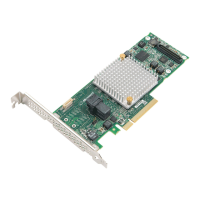
Details features and specifications of the RAID 8405 controller.
Details features and specifications of the RAID 8405E controller.
Details features and specifications of the RAID 8805 controller.
Details features and specifications of the RAID 8805E controller.
Details features and specifications of the RAID 8885/8885Q controllers.
Details features and specifications of the RAID 81605Z/81605ZQ controllers.
Overview of supported RAID levels with drive requirements.
Guidance on choosing compatible disk drives and necessary cables.
Instructions for swapping the controller bracket for low-profile cases.
Describes two primary installation methods: bootable array or existing OS.
Outlines the general steps for installing the controller and drivers.
Pre-installation checks and familiarization with controller features.
Steps for physically installing the RAID controller into the computer.
Guidance on connecting SAS, SATA HDDs, and SSDs to the controller.
How to connect external disk drives or enclosures.
Information on what to do after physical installation.
Steps to configure the system BIOS to boot from the RAID controller.
Overview of array creation methods and tools.
Using the BIOS utility to create RAID arrays.
Using the graphical tool to create arrays.
Final steps to make the created array bootable.
Pre-installation checks for driver and OS setup.
How to prepare a driver disk for installation.
Steps to install driver and OS on Windows.
Steps for Red Hat, CentOS, SuSE, and Ubuntu driver/OS installation.
Steps for installing driver and OS on VMware and XenServer.
Pre-installation checks for driver installation on existing OS.
How to prepare a driver disk for installation.
Steps to install driver on existing Windows OS.
Steps for Linux driver installation on existing OS.
Steps for driver installation on VMware and XenServer.
Steps for installing DKMS deb package on Ubuntu.
Steps for installing DKMS RPM package on RPM-based systems.
Information on DKMS commands for driver management.
Overview of the browser-based storage management application.
Guidance on installing the maxView Storage Manager software.
Covers ARCCONF, ARC, and Adaptec Flash Utility for management.
Helps users choose the appropriate management tool for tasks.
Initial checks to perform when encountering installation or usage difficulties.
How to monitor SAS/SATA disk drive status using LED flash states.
Procedure to silence the controller's alarm using management tools.
Steps to recover from various disk drive failure scenarios and array types.
Procedure to reset or reflash an inoperable controller.
Defines SAS terms, communication methods, ports, addresses, connectors, and cables.
Explains drive identification and connection options like direct-attach and backplane.
Compares SAS features, speed, and compatibility to parallel SCSI.
Defines drive segments and explains RAID 0 for performance without redundancy.
Covers RAID 1, 1E, and 10 for mirroring and striping data for redundancy and performance.
Explains RAID 5, 5EE, 50, 6, and 60 using parity for data protection.
Table comparing RAID levels based on redundancy, performance, and drives.
Introduction to ARC utility, its tools, interfaces, and how to run it.
Creating/managing arrays, initializing, erasing, formatting, locating, and identifying drives.
Modifying controller settings, power management, cache, firmware, and CPLD.
Creating support archives and viewing the event log.
System requirements, firmware download, and update disk creation.
How to run AFU via menu or command line.
Lists and explains AFU commands for firmware operations.
Precautions to prevent ESD damage to components.
Details ambient temperature, humidity, and altitude limits.
Specifies voltage and ripple/noise requirements for PCIe bus.
Lists typical current draw for various controller models.
Specifications for the AFM-700 flash backup module supercapacitor.
 General
| Controller Model | ASR-8405 |
|---|---|
| Controller Type | RAID Controller |
| RAID Levels | 0, 1, 5, 6, 10, 50, 60 |
| Data Transfer Rate | 6 Gbps |
| External Ports | 0 |
| Internal Ports | 8 |
| Operating Temperature | 0°C to 55°C |
| Interface | PCIe Gen3 x8 |
| Port Interface | SATA/SAS |
| Ports | 8 |
| Operating Systems Supported | Windows, Linux |

 To Next Page