Q18: Can I install a DC power supply in an AC power supply bay or vice versa in the
SyncSystem 4380A chassis?
A18: No. The AC power supply only works when installed in the AC power supply bay within
the 4380A chassis and the DC power supply only works in the DC power supply bay within the
4380A chassis. The power supply configuration for the 4380A chassis is specified when
ordering the unit.
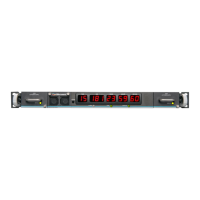
Q19: If the alarm light is red on the front panel of the SyncSystem 4380A, how do I determine
what is causing the alarm condition?
A19: To determine what alarm condition has activated the red alarm light, initiate a Telnet
communication session with port 1700 of the 4380A via the Ethernet connection on the rear
panel of the unit. Once at the “4380A>” command prompt, enter alarm as shown in the
example below:
4380A>alarm
[alarm] no alarm
[OK] 2016-01-06T19:05:02Z
This is equivalent to entering the status alarm command. If there is no alarm condition, then
the system will respond as shown in the example above. Otherwise, the returned alarm
information provides the most significant alarm condition that is currently active. It does not
necessarily indicate all alarm conditions currently present. For that purpose, use the alarms
command or review the health nodes that are used to monitor the current state of the system.
The health nodes themselves are part of the status tree and can be viewed by typing status
health
at the command prompt.
Q20: How do I configure the output signals from my SyncSystem 4380A?
A20: The PPS signal from the GNSS receiver/reference source is used to align both the IRIG-B
signal and the CPU clock to UTC(USNO). At startup, this PPS is used to align the internally
generated 1 PPS and IRIG-B signal with the correct 10 MHz clock cycle. From that point on, the
1 PPS and IRIG-B signals are kept on time by using the OCXO 10 MHz signal as its reference. The
1 PPS signal from the GNSS receiver generates an interrupt to the processor which serves as an
indicator of the top-of-second. This is used by the CPU, along with messages received from the
GNSS receiver, to set the CPU time to UTC(USNO). In doing this, the CPU can serve as a
Stratum-1 network time protocol (NTP) server and provide time to computers and other
systems on the network.
The 4380A will operate with several different types of input and output cards. These cards can
be operated in any of the six slots. The unit will automatically detect and configure the system
based on the card(s) installed. The card slots are identified by slot number so the operator is
capable of identifying a card’s physical location in the chassis. The view below is from the rear
of the unit from left to right.
© 2016 Microsemi Corporation. All rights reserved. SyncSystem 4380A FAQs Version 1.0 (22 Feb 2016)
12


 To Next Page
 Loading...