
 Need help?
Do you have a question about the Midea M18DB9339BB3A and is the answer not in the manual?
Details on the time delay feature for scheduling washes and the error alarm system for status notifications.
Table outlining wash programs, cycle descriptions, detergent use, and resource consumption.
List of error codes, their meanings, and possible causes for dishwasher malfunctions.
Specifications for power supply and proper electrical connection, including grounding.
Solutions for issues like power failure, low water pressure, and abnormal noises.
Troubleshooting tips for excessive suds, stained interiors, and poor dish drying.
Advice for improving dish cleanliness and removing spots or filming on glassware.
Causes and remedies for cloudiness on glassware and yellow/brown stains inside.
Solutions for water standing in the tub and preventing or fixing dishwasher leaks.
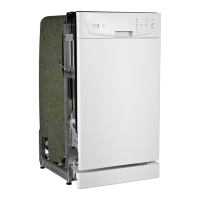
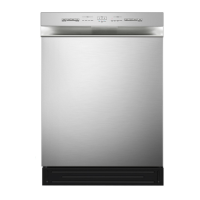
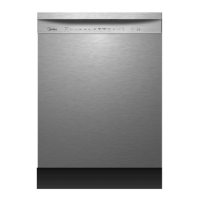
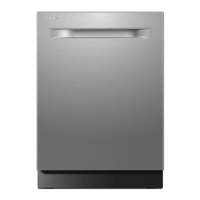
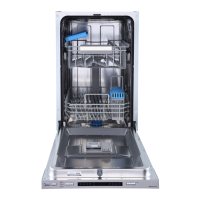
This document describes an 18-inch built-in dishwasher, model M18DB9339WW3A/M18DB9339SS3A/M18DB9339BB3A, designed for household use. It emphasizes quality, innovation, and style.
The dishwasher offers several key features to enhance its functionality and user experience. A "Time delay" feature allows users to program the start of a wash cycle between 1 and 24 hours in advance. This is particularly useful for taking advantage of off-peak electricity rates or ensuring the wash cycle finishes at a convenient time. The appliance also includes an "Error alarm" system that displays fault codes to inform the user of any abnormal operational status, facilitating quick troubleshooting. A "Rinse aid Warning Indicator" is present, alerting users when rinse aid levels are low and need refilling to maintain optimal washing and drying performance. The dishwasher is constructed with a "Stainless steel tub," which eliminates concerns about staining.
For washing flexibility, the dishwasher provides "6 wash programs," allowing users to select the most appropriate cycle based on the soil level of their dishes. These programs include "All in 1," "Heavy," "Normal," "Light," "Rinse," and "Speed wash."
The control panel is intuitively designed with several indicators and buttons. A "Display window" shows the program remaining time, delay time, and any fault codes. A "Delay Button" is used to set the delayed start. "Program indicator lights" illuminate to show the selected washing program, which is chosen using the "Washing Program Selector." "Rinse aid warning lights" indicate when the rinse aid container needs refilling. A "Power indicator light" confirms the power supply status. The "Power switch" turns the appliance on or off, and a "Start/Pause button" initiates or pauses the selected washing program.
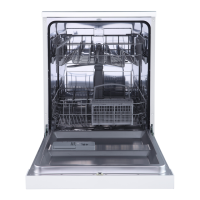
The internal features of the dishwasher include an "Upper Rack," "Spray Arms," a "Lower Rack," "Water Softener," "Main Filter," "Detergent Dispenser," "Cup Shelf," "Silverware Basket," "Coarse Filter," "Rinse Aid Dispenser," "Inlet Valve," and a "Junction Box."
Regarding detergent usage, the manual advises against using too much detergent, as the dishwashers are equipped with specially designed water softeners. The detergent dispenser should be refilled before each wash cycle according to the "Wash Cycle Table." Generally, one tablespoon of detergent is sufficient for a normal wash load, with more heavily soiled items requiring additional detergent. Detergent should be added just before starting the dishwasher to prevent it from getting damp and not dissolving properly. The amount of detergent needed can vary based on water hardness; users are encouraged to adjust the amount in small increments until the correct amount is found. For removing hard water spots, a specific procedure involving running a normal wash program with vinegar or citric acid crystals (without detergent) is recommended. Only detergents specifically made for dishwashers should be used, and they should be kept fresh and dry, out of reach of children.
The "Rinse Aid Dispenser" is crucial for preventing water spots and streaks and improving drying. It should be refilled when the indicator shows low levels. The dispenser holds about 100 ml of liquid rinse aid, and care should be taken not to overfill it to avoid oversudsing. The rinse aid dispenser has four adjustable settings, with "2" being the suggested starting point. If spots or poor drying persist, the setting can be increased. If the water is soft, rinse aid may not be necessary.
The dishwasher also supports an "All in 1 Program" for use with "All in 1 tablets," which do not require separate salt and rinse aid. Instructions are provided for hanging the "All in 1 tablet container" on the upper basket and ensuring it does not obstruct the upper sprayer.
Loading the dishwasher racks properly is essential for optimal performance. The "Upper Rack" is designed for delicate and lighter items like glasses, cups, saucers, small bowls, and shallow pans. Dishes should be positioned to prevent movement during the wash cycle. The upper rack's height can be adjusted. The "Lower Rack" is intended for larger, more difficult-to-clean items such as pots, pans, lids, and serving dishes. Serving dishes and lids should be placed on the side of the racks to avoid blocking the top spray arm. Pots and serving bowls should be placed top down, and deep pots should be slanted for water drainage. The bottom rack features fold-down tine rows to accommodate larger items. The "Silverware Basket" should be loaded with handles at the bottom, and long utensils should be placed horizontally at the front of the upper rack.
To start a wash cycle, users must ensure the appliance is plugged in, the water supply is on, dishes are loaded, and detergent is added. After closing the door, pressing the ON/OFF button, selecting the desired "Wash cycle" with the "prog button," and then pressing the start button will initiate the wash. A cycle can be modified if it has only been running for a short time, by opening the door, pressing the "Prog key-press" for three seconds, selecting a new program, and closing the door. If a dish is forgotten, it can be added by opening the door slightly to stop the washing, waiting for the spray arms to stop, opening the door completely, adding the dish, and then closing the door.
Maintenance features are critical for the longevity and performance of the dishwasher. The "Filtering System," located inside the tub, consists of a "Main filter," "Coarse filter," and "Fine filter." These filters trap food and soil particles, which are then pulverized or trapped. Regular cleaning of these filters is necessary. Instructions are provided for disassembling and cleaning the filters by turning them anti-clockwise and lifting them out.
"Caring for the Dishwasher" includes cleaning the control panel with a lightly dampened cloth and the exterior with appliance polish wax, avoiding sharp objects or harsh cleaners. To "Protect Against Freezing" if the dishwasher is in an unheated area, the electrical power and water supply should be cut off, and water should be drained from the inlet pipe and water valve. "Cleaning the Spray Arms" is also recommended regularly, as hard water chemicals can clog the jets. The spray arms can be removed by unscrewing a nut, washed with soapy water, and cleaned with a soft brush.
"User-Maintenance Instructions" also cover "Cleaning the Door" edges with a soft, warm, damp rag, avoiding spray cleaners or abrasive materials. Advice is given for "When You Go on Holiday," suggesting running an empty wash cycle, unplugging the appliance, turning off the water supply, and leaving the door ajar to prevent odors. If "Moving the Appliance," it should be kept in a vertical position if possible. "Seals" should be periodically cleaned with a damp sponge to prevent food from getting trapped and causing odors.
Troubleshooting tips are provided to address common issues such as the dishwasher not running (checking fuse, power supply, water pressure), noise (securing utensils, motor hum), suds in the tub (improper detergent), stained tub interior (spilled rinse aid, detergent with colorant), dishes not dried (empty rinse aid dispenser), dishes and flatware not clean (improper program, rack loading), and spots/filming on glasses/flatware (hard water, low inlet temperature, overloading, improper loading, old/damp detergent, empty rinse aid, incorrect detergent dosage). Solutions for cloudiness on glassware, yellow/brown film, white film, detergent cup lid not latching, detergent left in cups, steam, black/gray marks on dishes, water standing in the tub, and dishwasher leaks are also detailed.
 General
| Brand | Midea |
|---|---|
| Model | M18DB9339BB3A |
| Category | Dishwasher |
| Language | English |


 To Next Page