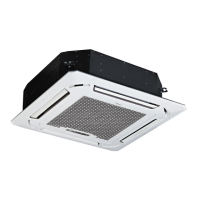
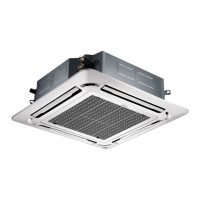
This document is the Owner's Manual for a Midea Super-Slim Four-Way Cassette Cassette-Type Air Conditioner. It provides information on operation, maintenance, and troubleshooting for the unit.
Function Description:
The Midea Super-Slim Four-Way Cassette is an air conditioning unit designed for indoor use, providing cooling, heating, and dehumidification functionalities. It features a super-slim design and a four-way air outlet for efficient air distribution. The unit can be operated via a remote control, and in case the remote is misplaced or out of batteries, a display panel on the indoor unit allows for manual operation.
Important Technical Specifications:
The manual lists several models with their corresponding indoor and outdoor unit designations:
- MCD-18FNXD0 / MOU-18FN8-QD0
- MCD-24FNXD0 / MOU-24FN8-QD0
- MCD-36FNXD0 / MOU-36FN8-QD0
- MCD-36FNXD0 / MOU-36FN8-RD0
- MCD-48FNXD0 / MOU-48FN8-RD0
- MCD-55FNXD0 / MOU-55FN8-RD0
Operating Conditions:
The unit operates within specific temperature ranges for safe and effective performance.
- Inverter Split Type:
- COOL mode:
- Room Temperature: 17°C-32°C (62°F - 90°F)
- Outdoor Temperature: 0°C-50°C (32°F - 122°F); -15°C-50°C (5°F - 122°F) for models with low temp. cooling systems; 18°C-54°C (64°F - 129°F) for special tropical models.
- HEAT mode:
- Room Temperature: 0°C-30°C (32°F - 86°F)
- Outdoor Temperature: -15°C-24°C (5°F - 76°F); -7°C-24°C (19°F - 75°F) for special tropical models.
- DRY mode:
- Room Temperature: 17°C-32°C (62°F - 90°F)
- Outdoor Temperature: 0°C-50°C (32°F - 122°F); 0°C-60°C (32°F - 140°F) for special tropical models.
- Fixed-speed Type:
- COOL mode:
- Indoor Temperature: 17°-32°C (62°-90°F)
- Outdoor Temperature: 18°-43°C (64°-109°F); -7°-43°C (19°-109°F) for low temperature cooling models; 18°-54°C (64°-129°F) for special tropical models.
- HEAT mode:
- Indoor Temperature: 0°-30°C (32°-86°F)
- Outdoor Temperature: -7°-24°C (19°-75°F)
- DRY mode:
- Indoor Temperature: 17°-32°C (62°-90°F)
- Outdoor Temperature: 18°-43°C (64°-109°F); 18°-54°C (64°-129°F) for special tropical models.
For outdoor units with auxiliary electric heaters, it is recommended to keep the unit plugged in at all times when the outside temperature is below 0°C (32°F) for smooth ongoing performance.
Usage Features:
- Default Setting: After a power failure, the unit restarts with factory settings (AUTO mode, AUTO fan, 24°C (76°F)). The remote control can be used to update the status.
- Auto-Restart (some models): If equipped, the unit will restart with the same settings after a power failure.
- Louver Angle Memory Function (Optional): Some models remember the horizontal louver angle after a power failure. The louver angle should not be set too small to prevent condensation. The manual button can reset the louver.
- Refrigerant Leak Detection System (some models): If a refrigerant leak is detected, the LCD screen will display "EC" and the LED indicator light will flash.
- Manual Operations: The indoor unit has a display panel with a "MANUAL" button to select modes (AUTO, FORCED COOL, OFF) in case the remote control is unavailable.
- FORCED COOL mode: The Operation light flashes, and the system cools at high wind speed for 30 minutes before switching to AUTO. The remote control is disabled during this.
- OFF mode: Turns off the unit and re-enables the remote control.
Maintenance Features:
- Unit Maintenance:
- Always turn off the system and disconnect power before cleaning.
- Do not use chemicals, benzene, paint thinner, polishing powder, or other solvents.
- Clean the unit with a damp, lint-free cloth and neutral detergent, then dry with a dry, lint-free cloth.
- Do not wash the unit under running water.
- Do not use water hotter than 40°C (104°F) on the front panel.
- Air Filter Cleaning:
- The air filter should be cleaned every two weeks, or more frequently in dusty areas, to maintain efficiency.
- To clean, unlock the grille by pushing two tabs, unplug the display panel cable, and detach the grille.
- Remove the air filter.
- Clean the filter by vacuuming or washing in warm water with mild detergent. If washing, the inlet side should face down and away from the water stream.
- Rinse with clean water and air-dry, avoiding direct sunlight.
- Reinstall the filter, front grille, and reconnect the display panel cable.
- Some models have an auto-lifting panel function to simplify filter cleaning.
- Preparation for Periods of Non-Use:
- Maintenance after Extended Non-Use: Remove obstacles from vents, clean the air filter and front grille, and turn on the main power switch at least 12 hours before operating.
- Storing the Unit While Not In Use: Run on FAN mode for 12 hours to dry and prevent mold, then turn off and unplug. Clean and reinstall the air filter, and remove batteries from the remote control.
- Refrigerant Leaks: If a leak occurs, turn off the unit, ventilate the room, and call a dealer immediately. Do not use the unit until repaired.
Safety Precautions:
The manual emphasizes several safety warnings and cautions:
- Installation must be performed by an authorized dealer according to national regulations.
- Do not let the indoor unit or remote control get wet.
- Do not insert fingers or objects into air inlets/outlets.
- Do not use flammable sprays near the unit.
- Do not use means to accelerate defrosting other than those recommended by the manufacturer.
- The appliance must be stored in a room without continuously operating ignition sources and to prevent mechanical damage.
- Refrigerants may not contain an odor.
- Keep ventilation openings clear.
- Do not pierce or burn the unit.
- The appliance should be stored in a well-ventilated area corresponding to the room size specified for operation.
- Servicing involving refrigerant circuits must be performed by industry-accredited personnel.
- If the supply cord is damaged, it must be replaced by the manufacturer or service agent.
- Do not touch the air outlet while the swing flap is in motion.
- Do not inspect the unit yourself.
- Do not use the air conditioner for preservation purposes (food, plants, animals, art).
- Do not touch evaporator coils.
- Do not operate with wet hands.
- Do not place items affected by moisture damage under the unit.
- Do not expose heat-producing appliances to cold air or place them under the unit.
- Check for damage after long periods of use.
- Ensure proper ventilation if used with other heating devices.
- Do not climb or place objects on the outdoor unit.
- Do not operate when using fumigant insecticides.
- Do not let children play with the air conditioner.
- Do not operate in wet rooms (bathroom, laundry room).
- The appliance can be used by children aged 8 and above and persons with reduced capabilities if supervised and instructed.
- The appliance must be installed according to national wiring regulations, at least 2.5m above the floor.
- An all-pole disconnection device with at least 3mm separation distance and an RCD with a rating above 10mA must be incorporated into the fixed wiring.
Troubleshooting:
The manual includes a section for common problems and troubleshooting tips, listing possible causes and solutions for issues like the unit not turning on, poor cooling/heating performance, and various noises. It also provides error codes for both Inverter Split Type and Fixed-speed Type units, indicating the cause and the corresponding error code displayed by the operation and timer indicators.
European Disposal Guidelines:
Users in European Countries are required to dispose of the unit properly due to refrigerants and hazardous materials. It should not be disposed of as household waste. Options include municipal electronic waste collection facilities, retailer take-back programs when buying a new appliance, manufacturer take-back, or selling to certified scrap metal dealers. Disposing of the appliance in natural surroundings is harmful to health and the environment.

 Need help?
 General

 To Next Page
