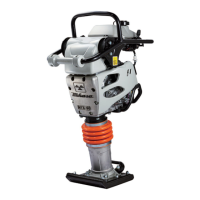
The Mikasa MTX-60E & MTX-70E Tamping Rammers are robust construction machines designed for compacting various types of soil and asphalt. These devices are primarily used in road construction, trench work, and landscaping to ensure a solid and stable base. The manual emphasizes the importance of proper operation and maintenance to ensure the safety of the user and the longevity of the machine.
Function Description
The tamping rammer operates by delivering powerful, high-frequency impacts to the ground, effectively compacting loose materials. This action is achieved through a combination of engine power, a spring-loaded ramming mechanism, and a heavy foot plate. The engine drives a crank mechanism that moves a piston and spring cylinder, generating the vertical force required for compaction. The handle assembly provides control and maneuverability, while shock absorbers minimize vibration transferred to the operator.
Important Technical Specifications
The MTX-60E and MTX-70E models are equipped with different engines and have varying performance characteristics.
Engine Type:
- MTX-60E/FE/ER/FER: Honda GX100U-KRBF / KRB5
- MTX-70E/FE/ER/FER: Robin ER120D45001 / 45010
- MTX-80E/FE/ER/FER: Robin EH12-2D46530 / 46650
- MTX-90E/FE/ER/FER: Robin EH12-2D46530 / 46650
Engine Speed:
- Idling: 1900-2000 rpm (for all models)
- Setting Speed:
- MTX-60/70: 3800-4100 rpm
- MTX-80: 3400-3600 rpm
- MTX-90: 3500-3700 rpm
Fuel Tank Capacity:
- 2.5 liters (2.65 quarts) for all models.
Lubricant for Body:
- Automobile Oil SAE 10W-30; Class SE or higher.
- Capacity:
- MTX-60: 0.65 liters (0.69 quarts)
- MTX-70/80/90: 0.82 liters (0.87 quarts)
Lubricant for Engine:
- Automobile Oil SAE 10W-30; Class SE or higher.
- Capacity:
- MTX-60: 0.28 liters (0.30 quarts)
- MTX-70/80/90: 0.4 liters (0.42 quarts)
Fuel Type:
- Unleaded Gasoline for all models.
Standard Torque Table (for collar screws):
- M6:
- Aluminum type: 11.8-14.7 N-m (120-150 Kgf-cm, 8.7-10.8 ft-lbf)
- SS,FCD: 14.7-17.7 N-m (150-180 Kgf-cm, 10.8-13.0 ft-lbf)
- M8:
- Aluminum type: 24.5-29.4 N-m (250-300 Kgf-cm, 18.1-21.7 ft-lbf)
- SS,FCD: 32.4-35.3 N-m (330-360 Kgf-cm, 23.9-26.0 ft-lbf)
- M10:
- Aluminum type: 58.8-68.6 N-m (600-700 Kgf-cm, 43.4-50.6 ft-lbf)
- SS,FCD: 73.5-78.5 N-m (750-800 Kgf-cm, 54.2-57.9 ft-lbf)
- M12:
- Aluminum type: 98.1-107.9 N-m (1000-1100 Kgf-cm, 72.3-79.6 ft-lbf)
- SS,FCD: 112.8-122.6 N-m (1150-1250 Kgf-cm, 83.2-90.4 ft-lbf)
- M14:
- Aluminum type: 117.7-127.5 N-m (1200-1300 Kgf-cm, 86.8-94.4 ft-lbf)
- SS,FCD: 166.7-176.5 N-m (1700-1800 Kgf-cm, 123.0-130.2 ft-lbf)
Usage Features
The Mikasa Tamping Rammers are designed for ease of use and durability. Key features include:
- Ergonomic Handle: The handle assembly is designed for operator comfort and control, reducing fatigue during prolonged use.
- Robust Construction: Components like the crankcase, guide cylinder, and foot plate are built to withstand the rigorous demands of compaction work.
- Engine Control: The combination lever allows for easy control of engine speed, including idling and operating speeds, which are crucial for efficient compaction.
- Safety Features: Warning labels and safety precautions are integrated into the design and manual to guide operators on safe handling, refueling, and maintenance practices.
- Hoisting Hook: A dedicated one-point hoisting hook is provided for safe lifting of the machine, emphasizing the importance of using appropriate lifting equipment and procedures.
Maintenance Features
Regular maintenance is crucial for the performance and lifespan of the Mikasa Tamping Rammer. The manual provides a detailed schedule and instructions for various checks and adjustments.
Daily Maintenance (before starting operation):
- Appearance: Check for flaws, deformity, and dirt.
- Air Cleaner: Inspect for dirt, flaws, and deformation.
- Bolts, Nuts: Check for looseness or missing parts.
- Handle: Inspect for flaws, deformity, cracks, and damage.
- Rubber Damper: Check for wear, deformity, cracks, and damage.
- Engine Oil: Check dirt and oil level.
- Lubrication Oil (main body): Check dirt and oil level.
- Fuel Tank: Inspect for leaks, fuel level, and dirt.
- Fuel System: Check for leaks, wear, and looseness.
- General Cleaning: Wipe off mud, dirt, or oil. Retighten joints if oil leaks.
After First 20 Hours:
- Engine Oil: Replace once.
Every 50 Hours:
- Spark Plug: Clean and adjust gap (0.6-0.7 mm).
- Engine Oil: Replace.
- Fuel Filter: Remove cup and clean thoroughly.
Every 200 Hours:
- Lubrication Oil (main body): Replace.
- Oil Drainage: Remove the drain plug on the lower part of the machine body, drain the oil, and add the specified amount of new oil.
Every 200 to 300 Hours:
- Pre-air Cleaner (primary element): Clean.
- Remove the upper air cleaner cover and Phillips screws.
- Wash the primary element with gasoline or lamp kerosene, then dip in SAE10W-30 engine oil and wring out (25-30 cc of oil should remain).
- Wash the secondary element with neutral detergent solution and dry well.
Every 2 Years:
- Fuel Hose: Replace, even if no abnormality is visible.
Disassembly and Reassembly:
The manual provides detailed instructions for disassembling and reassembling various components, including the engine, guide cylinder, spring cylinder, crankcase, handle, and combination lever.
- Engine Disassembly: Involves removing the EX bar, muffler guard, link guard, engine guard, disconnecting fuel hose and wire harness, and removing the speed control wire. Special tools like clutch pullers are required for clutch removal.
- Guide and Spring Cylinder Disassembly: Includes draining oil, removing clamps, nuts, bolts, and pins, and using special tools like the spring cylinder remover and piston rod holder.
- Crankcase Disassembly: Involves removing the engine, separating the crankcase and guide cylinder, removing the handle assembly, air cleaner assembly, shock absorber bracket, front cover, connecting rod, bearing, and pinion drum.
- Reassembly: Emphasizes reversing the disassembly procedure, replacing O-rings, oil seals, packings, gaskets, and using specified tightening torques and bonding agents (Loctite #221 and #242). Molybdenum grease should be applied to sliding parts and contact surfaces.
Troubleshooting:
A comprehensive troubleshooting guide is included for common issues such as the engine not starting, faulty operation (too little power, overheating), and smoke from the muffler. This section helps identify potential causes, ranging from clogged spark plugs and fuel filters to incorrect fuel mixtures and worn engine parts.
Safety Precautions:
The manual stresses the importance of safety, including:
- Wearing appropriate clothing and protective gear.
- Refueling in well-ventilated areas with the engine stopped and cooled.
- Avoiding burns from hot engine parts.
- Performing maintenance with the engine stopped to prevent accidental entanglement with rotating parts.
- Using qualified personnel and appropriate tools for hoisting.
- Using genuine parts and oils to ensure machine longevity and prevent accidents.
- Properly disposing of waste oils and fuel according to regulations.


 To Next Page
 General