
 Need help?
Do you have a question about the MikroTik CRS312-4C+8XG and is the answer not in the manual?
Mount unit, connect power, and establish initial connection via Winbox.
Instructions for mounting in a rackmount enclosure or placing on a flat surface.
Details on booting RouterOS or SwOS, and serial console configuration.
Information on power inputs, redundancy, and maximum power consumption.
Lists expansion slots, ports including RJ45, Ethernet, SFP+, and USB.
Explains how combo interfaces work and port priority.
Describes the reset button's functions for configuration reset and Netinstall.
Lists items included in the package, such as power cords and mounting kits.
Link to a wiki page for compatible SFP modules.
Link to the product web page for detailed specifications.
Warning regarding electric shock hazard and service by trained personnel.
Guidance on using the MikroTik smartphone app for configuration.
Compliance with FCC rules for Class B digital devices and interference mitigation.
Compliance with Industry Canada licence-exempt RSS standards.
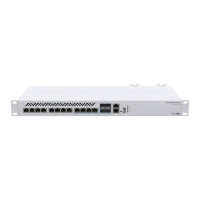
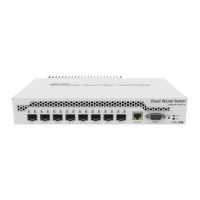
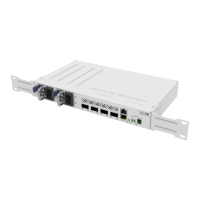
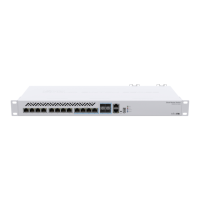
The MikroTik Cloud Router Switch CRS312-4C+8XG is a versatile 8-port Gigabit Ethernet switch designed for both routing and switching configurations. It features four 10 Gigabit Ethernet / SFP+ combo ports, offering flexible connectivity options. The device supports dual-boot functionality, allowing users to choose between RouterOS for comprehensive routing and switching capabilities or SwOS for dedicated switching functions. By default, it boots into RouterOS.
The CRS312-4C+8XG serves as a core network component, providing high-speed data transfer and network management. Its primary function is to act as a managed switch, facilitating efficient data flow within a network. With its 10 Gigabit Ethernet ports, it is suitable for environments requiring high bandwidth and low latency. The device can be configured for various network topologies and supports advanced routing and switching protocols through RouterOS. The combo ports enhance its flexibility, allowing the use of either copper Ethernet or fiber SFP+ modules, depending on the network infrastructure requirements.


 To Next Page
 General