a conscious effort to move the needle forward. When mastered, this
technique should greatly reduce anesthesia onset time and missed blocks.
Axial Rotation for insertion into palatal tissue (45º)
1
This needle movement has the effect of bringing the sharp edges of the mono
bevel needle into contact with the entire penetration site. It is particularly
effective in the dense connective tissue of the palate and should be used in
conjunction with the pre-puncture technique described on page 34. Axial
rotation (45º right and left) is performed by rotating the needle back and forth
between the thumb and forefinger.
The rotation is maintained along the axis of the needle path until bone is
reached. Gently rotate the needle and move forward about 1-2 mm, stop for 4
seconds then proceed forward. This allows the anesthetic pathway to form.
The rotation movement itself should be performed at a rate of about one
second in either direction. The operator will find that the rotational movement
will promote needle penetration without a conscious effort to move the needle
forward.
SPECIAL NOTE ON NEEDLE DEFLECTION AND ROTATIONAL TECHNIQUE
Needle deflection has long been recognized as altering the straight path of
needle insertion. This can negatively impact the accuracy and predictability of the
inferior alveolar block injection resulting in “missed blocks” and inadequate
mandibular anesthesia. This may be due to the fact that, when using a traditional
syringe, the insertion of the needle is linear, making it subject to deflection forces
(Diagram A).
New Bidirectional Rotational Insertion
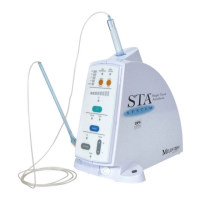
Since the STA Wand™ disposable handpiece is held in a pen-like grasp, it can
be rotated continuously during insertion. A recent investigation has demonstrated
that a bidirectional rotational insertion technique (Diagram B) will alter the vector
forces responsible for needle deflection, regardless of the needle gauge
. These
findings have numerous clinical implications, the most obvious of which is
accurate needle tracking to the target site.
Needle Rotation and Force Reduction
In vitro study of needle deflection: A linear insertion technique versus a bidirectional rotation insertion technique;
Hochman, Mark N., DDS; Friedman, Mark J., DDS; Quintessence Int. 2000:30:33-39


 To Next Page
 Loading...