The needle is advanced approximately 1 mm using active rotation, (see Rotation
Needle Insertion, Section 4), pause for anesthetic flow, and then continue
advancement. Rapid advancement of the needle will defeat the advantage of the
anesthetic pathway.
4. Hand Control and Rotational Needle Insertion Methods
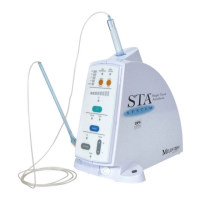
The most obvious difference between a syringe and the STA Wand™ handpiece
is the delicate manner in which the STA Wand™ can be held and manipulated.
Weighing only a few grams, the ultra-light handpiece promotes precise
movements and unsurpassed tactile feedback. Unlike a syringe, the STA needle
can be rotated between the thumb and fingers, making possible new insertion
methods. Always move the needle forward very slowly with the STA unit
activated on the slow flow rate to generate an anesthetic pathway. There are
three (3) distinct needle insertion methods:
Slight Rotation for insertion into mucosa
Insert the needle with a deliberate rotation at the moment it enters the
mucosa. This will enhance penetration by reducing the forward force
necessary for puncturing the tissue. With a mono bevel needle, rotation
brings the sharp needle surfaces into contact with a greater area of the tissue
during the puncture and initial penetration. Once the needle is through the
tissue surface, axial or bidirectional rotation can be performed to move the
needle forward. Insure that all forward movement is slow while ControlFlo™ is
activated.
Bidirectional rotation to prevent needle deflection (180º)
In certain injections, such as the inferior alveolar block, accurate targeting is
intimately related to clinical success. Needle insertion that penetrates greater
than 10 mm can cause needle deflection regardless of needle gauge. This is
due to the forces acting upon the mono-bevel needle. As the needle is
advanced through the tissue, the tip is deflected. A bidirectional rotation of
180º in either direction will cancel deflection and should markedly increase
accuracy. Bidirectional rotation (180º right and left) is performed by rotating
the needle back and forth between the thumb and forefinger. The rotation is
maintained along the axis of the needle path until the site is reached. Insure
that the STA Wand™ handpiece is not bent or distorted because this will
reduce the efficiency of rotation. The rotation movement itself should be
performed at a rate of about one second in either direction. The operator will
find that the rotational movement will also promote needle penetration without


 To Next Page
 Loading...