DYNAMICS OF THE INJECTION
1. COMPONENTS OF THE INJECTION
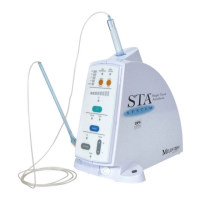
The STA System offers both physical and psychological advantages over
conventional syringe technology. There are three (3) physical components to
any injection which play a role in what the patient may experience during the
injection process; 1. The initial penetration of the needle into tissue. 2. The
advancement of the needle through the tissue, and 3. The deposition of
anesthetic fluid in the tissue. The delicate pen-like STA Wand™ handpiece
allows the operator to gently penetrate the mucosa and then direct the needle
with unparalleled accuracy and precision. This promotes the accurate placement
of the needle and deposition of anesthetic to achieve profound anesthesia. The
psychological advantage of the STA Wand™ handpiece is that it does not
resemble a syringe and is not threatening in appearance. If anticipatory anxiety is
reduced and patient confidence is increased, the entire injection experience is
likely to be a more positive one for the practitioner and the patient.
2. MICROPROCESSOR CONTROLLED FLOW RATES
Many patients believe that the needle insertion is what causes discomfort when,
in fact, most of the pain is caused by the flow of the anesthetic. When injected
too quickly, traditional anesthetics create a burning sensation. Experts in
anesthesia agree that a controlled slow rate of injection is ideal
. The STA unit,
when set on the normal mode, uses ControlFlo™ and RapidFlo™, which
automatically delivers optimal flow rates, regardless of tissue density. These
patented controlled flow rates result in an injection experience that is typically
below the threshold of pain.
3. SLOW NEEDLE ADVANCEMENT CREATES ANESTHETIC PATHWAY
It is speculated that during needle insertion, a continuous positive solution
pressure delivers an anesthetic drip that can precede the needle path. This
anesthetic pathway is believed to assist in virtually eliminating discomfort as the
needle penetrates through the tissue. STA injections often result in faster onset
of anesthesia and a much more comfortable experience due to the anesthetic
pathway. Advance the needle very slowly. To effectively create an anesthetic
path it is necessary to pause (approx. 4 beeps) every 2 mm of advancement.
Hochman M., Friedman M. Technique Article: Injection Dynamics for a Comfortable Palatal Injection.
In Review
Malamed SF, Handbook of Local Anesthesia. Fourth Edition, Mosby, St. Louis, MO. ppg. 140-141


 To Next Page
 Loading...