CLINICAL TECHNIQUES
INFERIOR ALVEOLAR
Inferior Alveolar (Mandibular) Nerve Block
The most common approach to mandibular anesthesia is the Inferior Alveolar
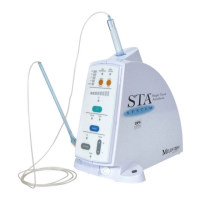
Nerve Block injection. The STA Wand™ handpiece enables the operator to
concentrate on accurate needle placement and provides unprecedented
control and tactile feel during this injection. The rotational insertion technique
described earlier reduces needle deflection and missed blocks and facilitates
more rapid onset of anesthesia.
The aspiration mode should be enabled prior to initiating the injection. Topical
anesthetic can be applied to the intended injection site. However, it may not be
required to achieve a comfortable penetration. ControlFlo™ is initiated prior to
needle penetration of the mucosa. Rotate the STA Wand™ handpiece slightly at
the commencement of the injection to reduce pressure required for needle
penetration. Advance the needle slowly using a continuous rotation technique to
reduce needle deflection to the intended target site. Initiate aspiration by
releasing the foot control. If positive, reposition the needle and resume the slow
flow rate and repeat aspiration. If aspiration is negative either RapidFlo™ or
TurboFlo™ rates can be initiated. For buccal anesthesia of the soft tissue and
periosteum of the mandibular molars, administer a long buccal nerve block.
Other mandibular injections can be performed in a similar manner (Mental,
Incisive, Gow Gates, Vazirani-Akinosi and Long Buccal.)
Review of Traditional Inferior Alveolar (Mandibular) Block Technique:
1. Perform an aspiration pretest (as described earlier).
2. Initiate the ControlFlo™ (first foot control position) flow rate.
3. Penetrate the mucosa with a slow, gentle advancement of the needle to
create an “anesthetic pathway”.
4. Slight needle rotation at the moment of mucosa puncture facilitates
penetration.
5. Use needle rotation technique during entire insertion to reduce needle
deflection.
6. When the needle reaches the target site, aspiration is initiated (release
foot control).
7. If blood is observed in handpiece tubing, reposition and repeat aspiration
8. When aspiration is negative, initiate the RapidFlo™ (second foot control
position) flow rate.
9. Monitor the LED panel to determine the volume of anesthetic delivered
10. When the cartridge is emptied (indicated by audio and visual signals),
reload, purge and continue as required.


 To Next Page
 Loading...