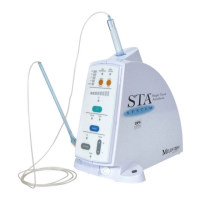
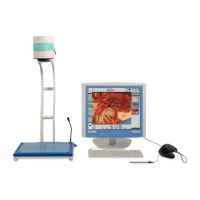
All traditional injections in the maxilla and the mandible are performed following
the steps outlined above. When not required, the aspiration mode can be
disabled by briefly depressing the aspirate mode button. Light will turn off.
Anterior Middle Superior Alveolar (AMSA) Injection Technique
The AMSA is an exciting addition to local anesthesia techniques. It will allow the
operator to achieve pulpal anesthesia from the maxillary central incisor through
the second premolar including the palatal tissue and mucoperiosteum from a
single needle penetration. The recommended dosage is from 3/4 to 1 cartridge of
anesthetic and the expected duration of anesthesia is approximately 60 minutes.
A bilateral AMSA anesthetizes 10 maxillary teeth extending from the second
premolar to the opposite second premolar and the associated palatal tissue from
just 1 1/2 to 2 cartridges of anesthetic. The lips, face and muscles of expression
are not anesthetized with the AMSA resulting in greater patient comfort
operatively and post operatively. In addition, esthetic smile-line assessments are
not hampered by facial distortion associated with traditional mucobuccal fold
injections. To enhance buccal soft tissue anesthesia a small volume of anesthetic
is administered within the surface mucosa of the mucobuccal fold.
The AMSA is easily administered, requiring up to 4 minutes to complete.
Anesthesia is achieved within approximately 5 - 7 minutes of injection. The
patient should be prepared for the extra time required to administer an AMSA
and advised they will likely experience only a minor sensation from the injection.
They will appreciate the lack of numbness to the face and lips.
A 30 gauge extra-short needle is recommended. It is inserted in a position that
bisects the premolars and is approximately halfway between the mid-palatine
suture and the free gingival margin. On patients with either a flat or excessively
high palatal vault, the landmark is adjusted closer to the mid-line. If desired,
topical anesthetic may be applied. The needle bevel is initially oriented parallel to
the palatal tissue. A sterile cotton tip applicator is employed to apply pressure on
the needle to “seal” the bevel to the tissue for the “pre-puncture” phase of the
insertion. (see pre-puncture section) The foot control is depressed slightly to
activate the slow flow rate for 4 - 6 beeps prior to slow needle insertion. The
cotton tip will help catch any anesthetic drips that occur before the bevel is
The AMSA injection: A new concept for local anesthesia of maxillary teeth using a computer-controlled injection system;
Friedman, Mark J., DDS; Hochman, Mark N., DDS; Quintessence Int. 1998: 29:297-303.


 To Next Page
 Loading...