EasyManua.ls Logo

Miller M-15 - User Manual

Miller M-15
12 pages
Print Icon
To Next Page IconTo Next Page
Loading...
OWNER’S MANUAL
1996 MILLER Electric Mfg. Co.
October 1996 FORM: OM-180 516A
Use above FORM number when ordering extra manuals.
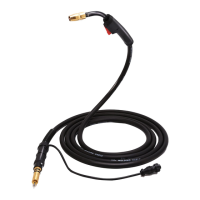
M-15, M-25, M-40, And M-40AL Guns (Euro-Connector)
1. Specifications
Air-Cooled Guns For GMAW And FCAW Welding
M-15 Rated At 150 Amperes Using CO
2
Shielding Gas. Feeds .023 To .035 in (0.6 To 0.9 mm) Hard Or
Flux Cored Wires.
M-25 Rated At 200 Amperes Using CO
2
Shielding Gas. Feeds .030 To .045 (0.8 To 1.1 mm) Hard Or Flu
x
M-25 Rated At 200 Amperes Using CO
2
Shielding Gas. Feeds .030 To .045 (0.8 To 1.1 mm) Hard Or Flux
Cored Wires (Also Feeds .023 in (0.6 mm) Wire – See Parts List)
M-40 Rated At 400 Amperes Using CO
2
Shielding Gas. Feeds .035 To 5/64 in (0.9 To 2.0 mm) Hard Or
Flux Cored Wires.
ST-801 727
M-40AL Rated At 275 Amperes Using Mixed Shielding Gas; Feeds .047 in (1.2 mm) Aluminium Wire
2. Safety Precautions For GMAW Guns
A. Symbol Usage
Means Warning! Watch Out! There are possible hazards with this
procedure! The possible hazards are shown in the adjoining symbols.
This group of symbols means Warning! Watch Out! Possible ELECTRIC SHOCK and HOT PARTS hazards.
Consult symbols and related instructions below for necessary actions to avoid the hazards.
Y Marks a special safety message.
. Means NOTE; not safety related.
B. GMAW Gun Hazards
WARNING
The symbols shown below are used throughout this manual to call attention to and identify possible
hazards. When you see the symbol, watch out, and follow the related instructions to avoid the hazard. The
safety information given below is only a summary of the more complete safety information found in wire
feeder and welding power source manuals. Read and follow all Safety Standards.

ELECTRIC SHOCK can kill.
1. Always wear dry insulating gloves.
2. Insulate yourself from work and ground.
3. Do not touch live electrode or electrical parts.
4. Repair or replace worn, damaged, or cracked gun
or cable insulation.
5. Turn off welding power source before changing
contact tip or gun parts.
6. Keep all covers and handle securely in place.
HOT SURFACES can burn skin.
1. Allow gun to cool before touching.
2. Do not touch hot metal.
3. Protect others from contact with hot metal.
FLYING PIECES OF METAL or DIRT can
injure eyes.
1. Wear safety glasses with side shields or face
shield.
WELDING WIRE can cause puncture
wounds.
1. Keep hands and body away from gun tip when
trigger is pressed.
OVERUSE can damage gun and void
warranty.
1. Follow rated duty cycle.
2. Allow cooling period.
3. Reduce current or reduce duty cycle before
starting to weld again.
1. Read and follow these instructions and all safety
blocks carefully.
2. Have only trained and qualified persons install
,
operate, or service this unit.
3. Call your distributor if you do not understand the
directions.
4. For WELDING SAFETY and EMF information
,
read wire feeder and welding power source
manuals.
Questions and Answers

Summary

Product Specifications

GMAW Gun Safety Precautions

Safety Symbol Usage

Explains the meaning of warning and note symbols used in the manual.

GMAW Gun Hazard Identification

Lists and describes potential hazards associated with GMAW guns and required precautions.

Gun Installation Procedure

Understanding Duty Cycle

Gun Maintenance: Nozzle, Liner, and Casing

Switch and Head Tube Replacement (M-15;M-25)

Head Tube Replacement (M-40)

Switch Component Replacement

Routine Maintenance Schedule

Troubleshooting Common Issues

Replacement Parts Identification

Summary

Product Specifications

GMAW Gun Safety Precautions

Safety Symbol Usage

Explains the meaning of warning and note symbols used in the manual.

GMAW Gun Hazard Identification

Lists and describes potential hazards associated with GMAW guns and required precautions.

Gun Installation Procedure

Understanding Duty Cycle

Gun Maintenance: Nozzle, Liner, and Casing

Switch and Head Tube Replacement (M-15;M-25)

Head Tube Replacement (M-40)

Switch Component Replacement

Routine Maintenance Schedule

Troubleshooting Common Issues

Replacement Parts Identification

Overview

This document is an owner's manual for M-15, M-25, M-40, and M-40AL GMAW (Gas Metal Arc Welding) and FCAW (Flux Cored Arc Welding) guns with Euro-connectors, published in October 1996. It provides specifications, safety precautions, installation instructions, duty cycle information, maintenance procedures, troubleshooting tips, and parts lists.

Function Description:

The devices described are air-cooled welding guns designed for GMAW and FCAW processes. They are used to deliver welding wire, shielding gas (if applicable), and electrical current to the weld puddle. The manual covers four models: M-15, M-25, M-40, and M-40AL, each with varying amperage ratings and wire feeding capabilities.

Important Technical Specifications:

  • M-15 Gun:

    • Rated Amperage: 150 Amperes using CO2 shielding gas.
    • Wire Feed Capability: .023 to .035 inch (0.6 to 0.9 mm) hard or flux cored wires.
    • Duty Cycle (100%): 150 Amperes with CO2, 120 Amperes with Mixed Gases.
    • Duty Cycle (60%): 200 Amperes with CO2, 150 Amperes with Mixed Gases.
  • M-25 Gun:

    • Rated Amperage: 200 Amperes using CO2 shielding gas.
    • Wire Feed Capability: .030 to .045 inch (0.8 to 1.1 mm) hard or flux cored wires (also feeds .023 inch (0.6 mm) wire – see parts list).
    • Duty Cycle (100%): 200 Amperes with CO2.
    • Duty Cycle (60%): 300 Amperes with CO2.
  • M-40 Gun:

    • Rated Amperage: 400 Amperes using CO2 shielding gas.
    • Wire Feed Capability: .035 to 5/64 inch (0.9 to 2.0 mm) hard or flux cored wires.
    • Duty Cycle (100%): 400 Amperes with CO2.
    • Duty Cycle (60%): 525 Amperes with CO2.
  • M-40AL Gun:

    • Rated Amperage: 275 Amperes using mixed shielding gas.
    • Wire Feed Capability: .047 inch (1.2 mm) aluminum wire.
    • Duty Cycle (100%): 275 Amperes with Mixed Gases.
    • Duty Cycle (60%): 400 Amperes with Mixed Gases.

Usage Features:

  • Installation: Guns are installed by inserting the gun end into the receptacle and tightening the gun securing collar. Specific threading procedures are referenced in the wire feeder manual.
  • Duty Cycle: The duty cycle is defined as the percentage of a 10-minute period that the gun can weld at its rated load without overheating. For example, a 60% duty cycle means 6 minutes of welding followed by 4 minutes of resting. Exceeding the rated duty cycle can damage the gun and void the warranty. Users are advised to follow the rated duty cycle, allow cooling periods, and reduce current or duty cycle if overheating occurs.
  • Consumables: The manual provides detailed parts lists for M-15, M-25, and M-40 Euro models, including nozzles, contact tips, adapters, O-rings, washers, head tubes, nuts, connectors, clamps, switches, handles, strain reliefs, set screws, collars, and liners. Specific consumables are noted as interchangeable between models (e.g., M-25 and M-25M, or M-40 and M-40AL).
  • Wire Size Matching: It is crucial to ensure that the wire size stamped on the contact tip matches the actual wire size being used.
  • Liner Stickout: When installing a new liner, a specific stickout of 3/4 inch (20 mm) is required, with a note for 3/8 inch (7/16 inch for M-25) for the gun cable.
  • Switch Replacement: The manual details the process of replacing the switch, including removing the switch housing, disconnecting leads, and ensuring switch leads lay parallel during reassembly.
  • Head Tube Replacement: Instructions are provided for replacing the head tube for M-15/M-25 and M-40 models, involving securing the head tube in a vice, removing shock washers, loosening jam nuts, and ensuring proper tightening and spacing during reassembly. It emphasizes not disturbing the cable connection between the cable connector and connector nut.

Maintenance Features:

  • Routine Maintenance:
    • Each Spool of Wire: Blow out the gun casing, and clean the nozzle and check the contact tip.
    • Every 3 Months: Replace cracked parts, check the control cord, gas hose, and gun cable.
  • Removing and Replacing Parts: The manual provides step-by-step instructions for removing and replacing the nozzle, contact tip, adapter, and changing the liner. This includes disconnecting the gun first, laying the gun cable straight before liner installation, and reassembling in reverse order.
  • Troubleshooting: A comprehensive troubleshooting guide is included, addressing common issues such as:
    • Wire does not feed: Check contact tip, kinks in gun cable, trigger plug connection, and trigger switch.
    • Wire is not energized: Check contact tip, trigger plug connection, and trigger switch.
    • Wire feeds unevenly: Check contact tip, kinks in gun cable, blow out liner and gun casing.
    • Weld porosity: Remove spatter buildup in nozzle, ensure inner support tube is tight, and check shielding gas flow/supply.
    • Wire feeding stops or does not feed properly: Straighten gun cable, replace damaged parts, adjust drive roll pressure, change drive roll groove, readjust hub tension, clean/replace wire inlet guide or liner, and replace worn/slipping drive roll or pressure bearing.

Safety Precautions:

The manual highlights several critical safety warnings using symbols:

  • ELECTRIC SHOCK can kill: Always wear dry insulating gloves, insulate yourself from work and ground, avoid touching live electrical parts, repair damaged insulation, turn off the welding power source before changing parts, and keep covers and handles secure.
  • HOT SURFACES can burn skin: Allow the gun to cool before touching, avoid hot metal, and protect others.
  • WELDING WIRE can cause puncture wounds: Keep hands and body away from the gun tip when the trigger is pressed.
  • OVERUSE can damage gun and void warranty: Follow the rated duty cycle, allow cooling periods, and reduce current or duty cycle if necessary.
  • FLYING PIECES OF METAL or DIRT can injure eyes: Wear safety glasses with side shields or a face shield.

General safety advice includes reading and following all instructions, ensuring only trained and qualified persons install/operate/service the unit, contacting the distributor for clarification, and consulting wire feeder and welding power source manuals for additional welding safety and EMF information. All maintenance and part replacements should be performed after disconnecting the gun from the power source.

Miller M-15 Specifications

General IconGeneral
BrandMiller
ModelM-15
CategoryPower Tool
LanguageEnglish