
 Need help?
Do you have a question about the Milwaukee HD18 AG115 and is the answer not in the manual?
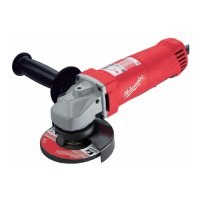
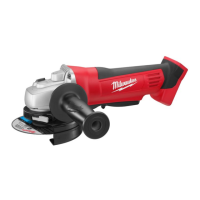
This document is an instruction manual for the Milwaukee HD18 AG115 and HD18 AG125 angle grinders.
The Milwaukee HD18 AG115 and HD18 AG125 are cordless angle grinders designed for various applications including grinding, sanding, wire brushing, and cutting metal, stone, and ceramic materials. They are intended for professional use and are part of the Milwaukee HEAVY DUTY® line of tools. The devices are battery-powered, offering portability and freedom from power cords.
Both models operate on an 18 V battery voltage. The HD18 AG115 has a rated speed of 10000 min⁻¹ and is designed for grinding disks with a maximum diameter of 115 mm and a hole diameter of 22.2 mm. Its grinding disk thickness can be up to 6 mm (1/4"), and cutting disk thickness ranges from 1.0 to 3 mm. The maximum grinding surface diameter is 115 mm, and the wire brush diameter is 75 mm. The thread of the work spindle is M14, and it weighs 2.4 kg according to EPTA-Procedure 01/2014. The HD18 AG125 also has a rated speed of 10000 min⁻¹ but accommodates larger grinding disks with a maximum diameter of 125 mm and a hole diameter of 22.2 mm. Its grinding disk thickness is also up to 6 mm (1/4"), and cutting disk thickness ranges from 1.0 to 3 mm. The maximum grinding surface diameter is 125 mm, and the wire brush diameter is 75 mm. The thread of the work spindle is M14, and it also weighs 2.4 kg.
Noise/Vibration Information (measured according to EN 60745): For both models, the sound pressure level is 74.5 dB(A) with an uncertainty K=3dB(A), and the sound power level is 85.5 dB(A) with an uncertainty K=3dB(A). Ear protectors are recommended. Vibration total values (triaxial vector sum) for surface grinding: vibration emission value aₕ,SG is 7.3 m/s² with an uncertainty K of 1.5 m/s². For sanding: vibration emission value aₕ,DS is 6.1 m/s² with an uncertainty K of 1.5 m/s². Other applications like abrasive cutting-off or wire brushing may result in different vibration values.
The angle grinders are designed for ease of use and safety. Battery System: The tools use Milwaukee LITHIUM-ION battery packs. The manual illustrates how to insert and remove the battery pack, which clicks into place. A battery charge indicator shows the remaining charge: 78-100%, 55-77%, 33-54%, 10-32%, and <10%. When the charge is low (<10%), the battery should be recharged using a Milwaukee charger. Safety Precautions: It is crucial to remove the battery pack before any work on the machine, such as changing accessories or making adjustments. Personal protective equipment, including face shield, safety goggles or glasses, dust mask, hearing protectors, gloves, and a shop apron, should be worn during operation. Bystanders should also wear personal protective equipment and maintain a safe distance. Auxiliary Handle: The auxiliary handle can be attached in multiple positions (left, right, or top) to provide maximum control and comfort during operation. The manual shows how to attach and adjust the handle. Guard Adjustment: The safety guard is adjustable to different angles (0°, 30°, 60°) to protect the operator from flying debris and sparks. The guard can be quickly adjusted by pressing a release button and rotating it. Specific guards are recommended for cutting operations. Accessory Installation: The manual details how to install and remove grinding disks and wire brushes. Only spindle nuts provided by the manufacturer should be used. Keyless nuts are not recommended. The spindle lock button must be pressed to secure the accessory during installation or removal. Starting and Stopping: The tool is started by pressing a trigger (1) and pushing a safety switch (2) forward. To stop, the trigger is released. Working Angle: For optimal performance and safety, the tool should be used at an angle of approximately 30° to the workpiece during grinding. Avoid "jamming" the cut-off wheel or applying excessive pressure, as this can lead to kickback or wheel breakage. Kickback Prevention: Maintain a firm grip on the power tool and position your body and arm to resist kickback forces. Always use the auxiliary handle. Never place your hand near the rotating accessory. Avoid working in areas where the tool might move if kickback occurs.
General Maintenance: The ventilation slots of the machine must be kept clear at all times to prevent overheating and electrical hazards. Accessory Inspection: Before each use, accessories such as abrasive wheels, backing pads, and wire brushes must be inspected for chips, cracks, tears, or excessive wear. Damaged accessories should not be used. If the power tool or accessory is dropped, it should be inspected for damage. Cleaning: Regularly clean the power tool's air vents to prevent accumulation of powdered metal, which can cause electrical hazards. Battery Care: Battery packs should be recharged before use if they haven't been used for some time. Avoid extended exposure to heat or sunshine. Keep contacts of chargers and battery packs clean. For optimum life, battery packs should be fully charged after use. For storage longer than 30 days, store battery packs below 27°C, away from moisture, and in a 30-50% charged condition. Recharge every six months. Ground Fault Interrupter: Under extreme conditions (e.g., smooth-grinding metals with a vulcanized fibre grinding disk), significant contamination may build up inside the angle grinder. For safety, a ground fault interrupter should be connected in series. If it trips, the machine must be sent for service. Service and Parts: Only Milwaukee accessories and spare parts should be used. For replacement components not described in the manual, contact a Milwaukee service agent. Exploded views of the tool can be ordered by providing the Article No. and machine type. Disposal: Do not dispose of used battery packs or electric tools with household refuse. They should be collected separately and returned to an environmentally compatible recycling facility. Milwaukee Distributors offer to retrieve old batteries.


 To Next Page
 General