
 Need help?
Do you have a question about the Milwaukee M12 2429-20 and is the answer not in the manual?
Maintain a clean, well-lit work area free from hazards and distractions.
Adhere to electrical safety, including proper grounding and avoiding wet conditions to prevent shock.
Remain alert, wear appropriate PPE, and prevent unintentional tool startup.
Use the correct tool, maintain it, avoid forcing, and disconnect power before adjustments.
Use specified chargers/batteries; handle damaged or modified batteries with caution.
Damaged battery packs require manufacturer or authorized service for safety.
Essential safety rules for band saw use, covering wiring, caution, and label upkeep.
Identifies key tool parts: lock-off button, trigger, handle, and pulleys.
Steps for safely removing and inserting the battery pack into the tool.
Select blade size and pitch based on material for optimal cutting performance.
Steps for safely replacing the blade, including battery removal and tensioning.
Correct blade alignment if it slips off pulleys to ensure proper tracking.
How to start, stop, and adjust the speed of the band saw during use.
Guidance on starting cuts, positioning guides, and finishing cuts effectively.
Regular inspection and maintenance to ensure tool longevity and safe operation.
How to clean the tool using mild soap and a damp cloth, avoiding harsh chemicals.
Instructions for returning the tool, battery, and charger to a service center for repairs.
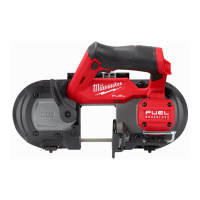
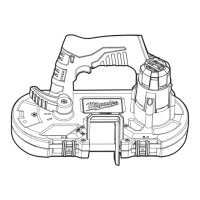
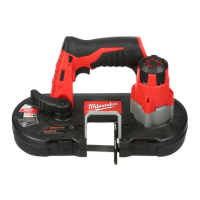
The Milwaukee M12™ Band Saw, model 2429-20, is a portable power tool designed for cutting various materials with precision and ease. This operator's manual provides essential information for safe and effective use, emphasizing the importance of understanding the tool's features, proper operation, and maintenance to minimize the risk of injury and ensure optimal performance.
The M12™ Band Saw operates by moving a continuous band blade around a set of pulleys, allowing for smooth and efficient cutting of materials. It is specifically designed for tasks requiring accurate cuts in round and rectangular stock. The tool is powered by an M12™ battery pack, offering cordless convenience and portability, making it suitable for a variety of job site applications where access to power outlets may be limited.
The core function of the band saw is to provide a clean and controlled cutting action. The blade, with its specific dimensions and tooth pitch, is guided through the material, making it ideal for cutting metal, plastic, and other common construction materials. The tool features a lock-off button and a variable speed trigger, allowing the user to control the blade speed for different materials and cutting requirements. The motor is designed to reach full speed before beginning a cut, ensuring optimal performance and preventing blade binding.
An integrated LED worklight automatically illuminates when the trigger is pulled, enhancing visibility of the workpiece and cut line, which is particularly useful in dimly lit environments. This feature improves accuracy and safety during operation. The design incorporates a handle for firm gripping, ensuring user control and stability during cutting tasks.
Before operating the M12™ Band Saw, users must ensure the battery pack is properly inserted and latched securely into place. The manual stresses the importance of using only the charger specified for the battery pack to prevent fire hazards.
Blade selection is a critical aspect of effective use. The manual outlines the required blade dimensions (.020" thickness, 1/2" width, and 27-1/16" length) and explains how to choose the correct tooth pitch based on the size, shape, and type of material being cut. Coarse pitch blades are recommended for thick work and soft materials, while fine pitch blades are suitable for thin work and hard materials. The general rule is to maintain at least three teeth in contact with the workpiece at all times for optimal cutting.
Changing blades involves a clear, step-by-step process that prioritizes safety. The battery pack must be removed before any blade changes. The tension lock handle is turned counterclockwise to release blade tension, and the pulley case latches are opened to access the blade. When installing a new blade, it must be pressed between the guides and fitted around the pulleys, ensuring the teeth face out. The tension lock handle is then turned clockwise to secure the blade, and the pulley case is closed and latched. It is crucial to ensure the blade lies freely within the guard channel and is properly seated on the pulleys before starting the tool.
The material guide can be adjusted to the desired position by loosening and tightening its retaining screws, allowing for precise control over the cutting depth and angle.
Blade tracking adjustment is a key feature for maintaining optimal performance. If the blade begins to slip off the pulleys after proper seating, a screwdriver can be used to tighten the blade tracking adjustment screw, ensuring the blade remains stable during operation.
When starting the tool, the user must firmly grasp the handle, push the lock-off button, and then pull the trigger. The motor should be allowed to reach full speed before initiating the cut. The variable speed trigger allows for precise control over the cutting speed, with greater pressure resulting in higher speeds. To stop the tool, the trigger is simply released, and the blade should come to a complete stop before removing it from a partial cut or laying the tool down.
For typical applications, the blade should be kept off the workpiece until the motor reaches full speed. Cutting should begin on a surface where the maximum number of teeth are in contact with the workpiece. The material guide is then placed against the workpiece, and the saw blade is lowered into the cut. Users are advised not to bear down excessively while cutting and to hold the tool firmly to prevent it from falling against the workpiece upon completing a cut.
Regular maintenance is essential for ensuring the longevity and safe operation of the M12™ Band Saw. The manual strongly advises removing the battery pack from the charger or tool before performing any maintenance tasks. Users are explicitly warned against disassembling the tool, battery pack, or charger, and are instructed to contact a MILWAUKEE service facility for all repairs.
A regular maintenance program should include inspecting the tool for issues such as undue noise, misalignment or binding of moving parts, breakage of parts, or any other condition that might affect its operation. If any such issues are identified, the tool, battery pack, and charger should be returned to a MILWAUKEE service facility for repair. Periodic inspections, typically every six months to a year depending on usage, are recommended.
If the tool does not start or operate at full power with a fully charged battery pack, the contacts on the battery pack should be cleaned. If the problem persists, the tool, charger, and battery pack should be returned for service.
Cleaning the tool is also crucial. Dust and debris should be regularly cleaned from the vents to prevent overheating and maintain proper airflow. Handles should be kept clean, dry, and free of oil or grease to ensure a secure grip. Only mild soap and a damp cloth should be used for cleaning, as certain cleaning agents and solvents can be harmful to plastics and other insulated parts of the tool. The manual specifically warns against using gasoline, turpentine, lacquer thinner, paint thinner, chlorinated cleaning solvents, ammonia, and household detergents, as these can damage the tool. Furthermore, users are cautioned against immersing the tool, battery pack, or charger in liquid or allowing liquid to flow inside them, as this can lead to personal injury and damage.
 General
| Voltage | 12V |
|---|---|
| No Load Speed | 0-3, 000 SPM |
| Blade Clamp | Tool-less |
| LED Light | Yes |
| Battery System | M12 |
| Type | Reciprocating Saw |

 To Next Page