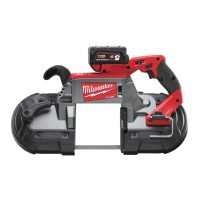
This document provides instructions and specifications for the Milwaukee M18 CBS125 Cordless Band Saw.
Function Description:
The Milwaukee M18 CBS125 is a cordless band saw designed for cutting various types of metal. It is suitable for cutting metal profiles (UniStrut), pipes, metal studs, channels, and aluminum profiles. The tool is intended for lengthways and accurate miter cuts.
Important Technical Specifications:
- Model: M18CBS125
- Production Code: 4770 22 02 ...000001-999999
- No-load speed: 0-116 m/min
- Blade size: 1139.8 x 12.7 x 0.5 mm
- Cutting capacity (rectangular stock): 125 x 125 mm
- Cutting capacity (pipe): Ø 125 mm
- Battery voltage: 18 V
- Weight (according EPTA-Procedure 01/2014 (4.0 Ah)): 7.3 kg
- Noise/Vibration Information (measured according to EN 60745):
- Sound pressure level (Uncertainty K=3dB(A)): 79.7 dB (A)
- Sound power level (Uncertainty K=3dB(A)): 90.7 dB (A)
- Wear ear protectors!
- Total vibration values (vector sum in the three axes) determined according to EN 60745:
- Sawing of metal vibration emission value a: 1.35 m/s²
- Uncertainty K: 1.5 m/s²
Usage Features:
The band saw is designed for safe and efficient operation. Before starting any work, it is crucial to remove the battery pack from the machine. The battery pack features an indicator to show the charge level (78-100%, 55-77%, 33-54%, 10-32%, <10%).
Blade installation and removal involve several steps:
- Blade Guide Adjustment: The blade guide can be adjusted by pressing a button and sliding it.
- Blade Tension Lever: A lever is used to release or apply tension to the blade.
- Blade Placement: The blade is guided around the wheels and through the blade guides. Ensure the teeth are oriented correctly.
- Blade Tensioning: Once the blade is in place, the tension lever is engaged to secure it.
- Blade Guide Repositioning: The blade guide is then moved back into its operational position.
The tool features a variable speed trigger (1 to 5 settings) for different cutting applications. It also includes an LED light that illuminates the work area. The light stays on for approximately 15 seconds after the trigger is released.
For safe operation, always hold the tool firmly with both hands. It is critical not to place hands on or around the guard/blade while the tool has a battery pack connected. The tool can be secured to a workpiece or support structure using a clamping mechanism, as shown in the illustrations.
The manual provides guidance on selecting the appropriate blade for different material thicknesses. The "TIP" section illustrates various blade tooth configurations and corresponding recommended cutting thicknesses (e.g., X = 2.5 mm for 8-13 mm, X = 1.8 mm for 5-8 mm, X = 1 mm for < 4 mm).
Safety Instructions:
- Always read all safety warnings and instructions to prevent electric shock, fire, and serious injury.
- Wear ear protectors to prevent hearing loss.
- Always place the guide shoe on the workpiece when sawing.
- Do not start the blade when in contact with the workpiece; wait for the blade to reach full speed.
- If the blade binds or a cut is interrupted, release the trigger and hold the cutter motionless until the blade stops completely. Do not restart the machine with the blade in contact with the workpiece.
- Do not use cracked or distorted saw blades.
- Use protective equipment, including safety glasses, dust mask, protective gloves, sturdy non-slip footwear, helmet, and ear defenders.
- Do not inhale dust; wear a suitable dust protection mask.
- Do not machine materials that present a danger to health (e.g., asbestos).
- If the insertion tool stalls, switch off the device immediately. Do not switch it on again while stalled, as this can cause a sudden recoil. Determine and rectify the cause of the stall.
- Possible causes of stalling include the tool being tilted in the workpiece, piercing through the material, or being overloaded.
- Do not reach into the machine while it is running.
- The insertion tool may become hot during use; beware of burns.
- Remove chips and splinters only when the machine is not running.
- When working in walls, ceilings, or floors, be careful to avoid electric cables, gas, or water pipes.
- Clamp your workpiece with a clamping device.
- Remove the battery pack before starting any work on the machine.
- Do not dispose of used battery packs in household refuse or by burning them. Milwaukee Distributors offer to retrieve old batteries.
- Do not store the battery pack with metal objects (short circuit risk).
- Use only System Milwaukee 18 V chargers for charging System Milwaukee 18 V battery packs.
- Never break open battery packs or chargers, and store them in dry rooms.
- Battery acid may leak from damaged batteries. In case of contact, wash with soap and water. For eye contact, rinse thoroughly for at least 10 minutes and seek medical attention.
- To reduce the risk of fire, personal injury, and product damage, never immerse the tool, battery pack, or charger in fluid, and do not allow fluid to flow inside them. Corrosive or conductive fluids can cause a short circuit.
- Do not carry the tool on your belt or use it on a ladder, as shown in the "Do not" illustrations.
Maintenance Features:
- Keep the ventilation slots of the machine clear at all times.
- Use only Milwaukee accessories and spare parts. For replacement components not described in the manual, contact a Milwaukee service agent.
- An exploded view of the tool can be ordered by stating the machine type and the six-digit number on the label.
- Recharge battery packs that have not been used for some time before use.
- Avoid temperatures in excess of 50°C (122°F) to prevent reduced performance and overheating.
- Keep contacts of chargers and battery packs clean.
- Remove the battery pack from the charger once fully charged to obtain the longest possible battery life.
- For storage longer than 30 days, store battery packs below 27°C, away from moisture, in a 30-50% charged condition. Charge the pack every six months during storage.
Battery Pack Protection:
- In high torque, binding, stalling, or short circuit situations, the tool will stop for about 2 seconds and then turn OFF. Release the trigger to reset.
- If the internal temperature of the battery becomes too high, the battery will shut down.
Transporting Lithium Batteries:
- Lithium-ion batteries are subject to Dangerous Goods Legislation requirements.
- Transportation must comply with local, national, and international provisions and regulations.
- Users can transport batteries by road without further requirements.
- Commercial transport by third parties is subject to Dangerous Goods regulations and must be carried out by appropriately trained persons.
- Ensure battery contact terminals are protected and insulated to prevent short circuit.
- Ensure the battery pack is secured against movement within packaging.
- Do not transport batteries that are cracked or leak.
- Check with the forwarding company for further advice.
Environmental Protection:
- Do not dispose of electric tools, batteries/rechargeable batteries with household waste.
- Electric tools and batteries that have reached the end of their life must be collected separately and returned to an environmentally compatible recycling facility.
- Check with your local authority or retailer for recycling advice and collection points.

 Need help?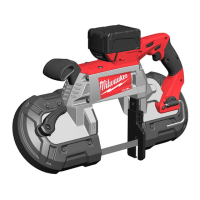


 To Next Page
 General