timer either before or after the shutter is cocked.
After setting the self-timer, if you decide not to use it, you simply have to return the
lever to its original position, and the self timer will be disconnected. The self-timer may
be used very conveniently in place of a cable release. It will release the shutter without
any vibration.
FLASH PHOTOGRAPHY
· For snapshots at night, in dark places, and in indoor shooting, flashbulbs or electronic flash can be used to
good
advantage. Flash units also provide auxiliary light for taking pictures of against-the-light subjects.
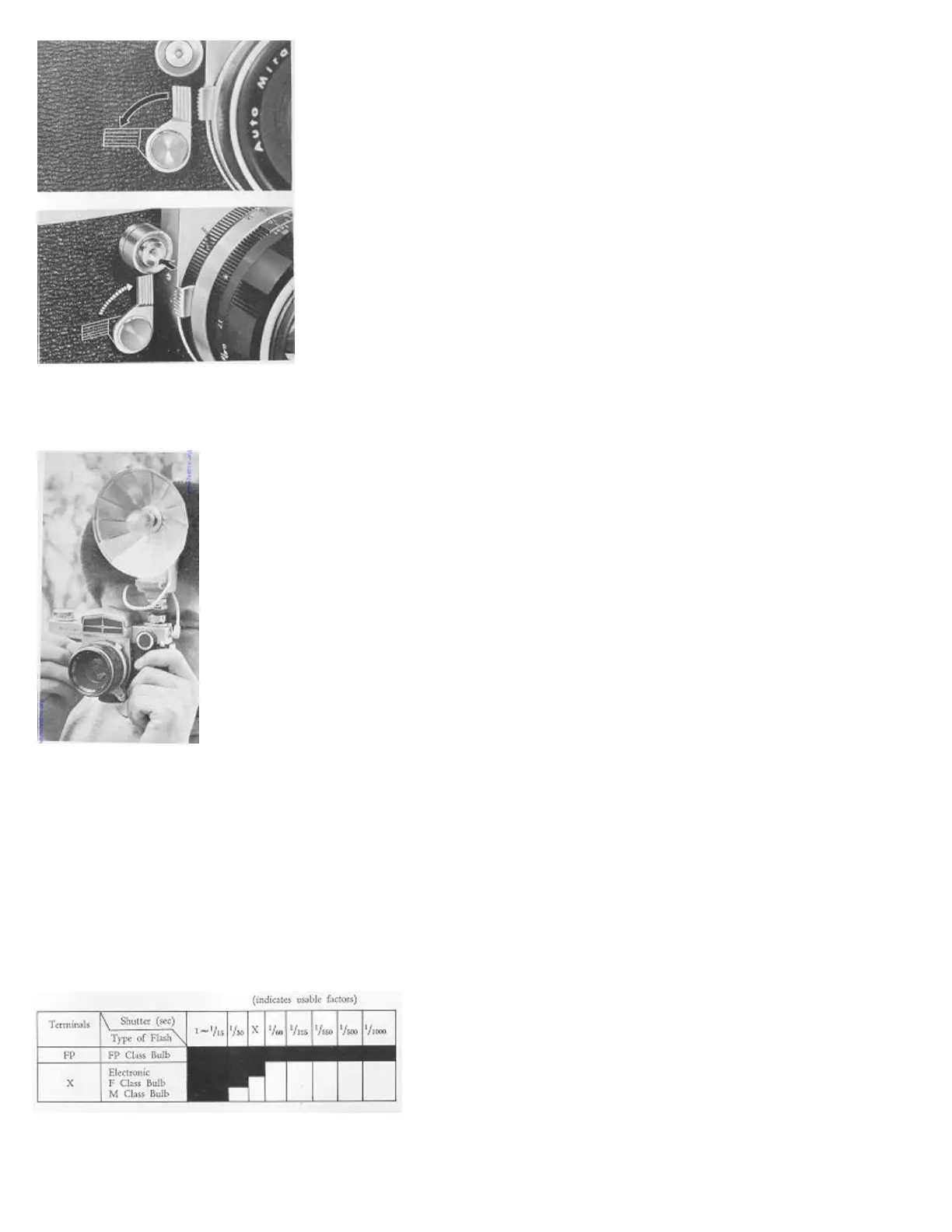
· For flash shooting, an exclusive flash Bracket is mounted to the bottom of the camera.
· The flash units is inserted from the rear of the flash bracket and secured by tightening its mount.
· Insert the plug of the flash unit into the camera's synchro terminal. For taking pictures with ordinary flash
bulbs, turn the selector dial to FP (focal plane).
· For taking pictures with electronic flash, turn the selector dial to X. When electronic flash is used the shutter
speed must be set at I/60 marked in red on the speed dial. For details, refer to the table on the next page.
· The F Class and M Class bulbs can also be used with slow shutter speeds (slower than l/30 see) but whenever
possible use the FP Class bulbs.
· Each type of flashbulb or electronic flash has a Guide Number to indicate its light output. Exposure should
be calculated from these guide numbers, The Guide Number is the product of "distance to subject" multiplied
by the lens aperture value. From this relationship, the correct lens aperture can be obtained by dividing the
Guide Number with the "distance to the subject".
-VARIOUS WAYS OF USING FLASH
As main light source
The flash unit is pointed towards to subject and exposure is determined by the exposure index attached to the flash unit.
Bounce light
This way of lighting diffuses the light evenly over the subject and surroundings is and obtained by flashing upwards, reflecting the light
from ceiling and walls. In this case the lens opening should be increased by 2 - 3 more Stops, due to a certain amount of loss of light.
Fill-in light
To be used for out door photography against the light, to avoid shadows in nearby subjects. No special precautions have to be taken as the
fill-in flash will not affect the exposure.
Combination Table for Flash Shooting
FILM REWINDING


 To Next Page
 Loading...


