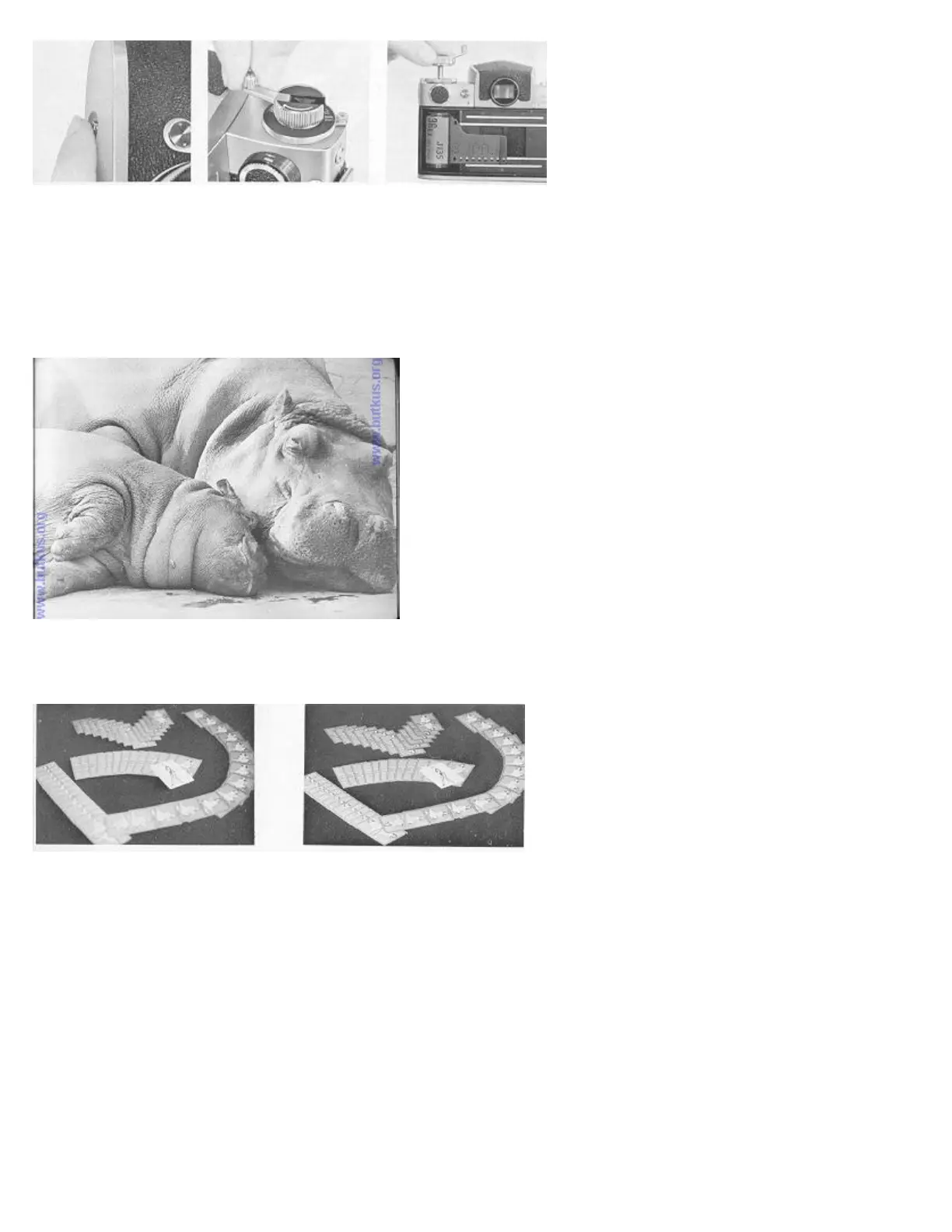
1. First, the film rewind release button on the base of the camera body is pushed in until a small click is heard. This button need not be
held during rewinding. The film is now free from the sprocket which has been advancing it, and is ready for rewinding.
2. Flip the rewind crank on the rewind knob and wind in the direction of the arrow. At the end of the roll you will feel the resistance
increase and then suddenly cease. Turn the rewind crank several more times to make certain the film has been entirely rewound.
3.Open the back cover by depressing the lock button and pulling up the cover clip at the same time. Pull up the rewind knob and take out
the film cartridge.
DEPTH OF FIELD.
no depth of field depth of field
This is. the range that appears in sharp focus for any particular distance and diaphragm setting. There is relatively very little depth of field
where close-up subjects are focused on, and a great deal of depth of field in the case of more distant subjects. Closing the diaphragm down
increases the depth of field and opening the diaphragm reduces it. The depth of field also varies with the lens used. Wide angle lenses
have great depth of field while telephoto lenses provide lesser depth of held. If your picture is such that you want both nearby and distant
objects to be in sharp focus, then the smallest possible diaphragm should be used. However, very frequently the composition of a picture
can be improved by having the principal subject in sharp focus while giving a soft, out-of-focus effect on other objects in the scene. This
will de-emphasize distracting background objects and concentrate the viewer's attention on the principal subject.
HOW TO ASCERTAIN THE DEPTH OF FIELD


 To Next Page
 Loading...


