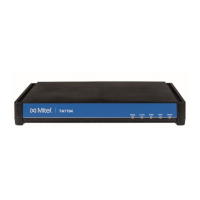
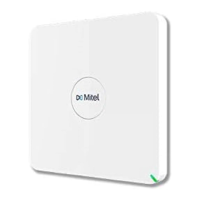
The Mitel TA7100 is a series of devices designed to handle voice and fax communications, specifically focusing on port and protocol settings. This document, "Mitel TA7100 Ports and Protocol Settings," with document number 58014901 REV00, dated May 2016, provides detailed information on the network ports and protocols utilized by the device, particularly in the context of a Digital Gateway (DGW) 2.0 environment.
Function Description:
The Mitel TA7100 series acts as a gateway for converting traditional analog voice and fax signals into IP-based communications. It supports various interfaces, including FXS (Foreign Exchange Subscriber) ports, which are used to connect analog telephones or fax machines, and potentially BRI (Basic Rate Interface) or PRI (Primary Rate Interface) channels for digital telephony connections. The primary function of the TA7100 is to enable these analog devices to communicate over an IP network by handling the necessary signaling and media protocols. This includes supporting Real-time Transport Protocol (RTP) for voice and T.38 for fax over IP. The device also integrates with various network management and security protocols to ensure reliable and secure operation.
Important Technical Specifications:
The document details the default ports used by DGW 2.0, which are crucial for network configuration and firewall rules. These include:
- Debug Signaling Log Host: UDP port 6000
- DHCP: UDP port 68
- FTP: TCP port 21
- HTTP: TCP port 80
- HTTPS: TCP port 443
- Persistent TLS Base Port: TCP port 6000
- Radius default port for accounting: TCP port 1813
- Radius default port for authentication: TCP port 1812
- RTCP (Real-time Transport Control Protocol): UDP port 5005
- RTP (Real-time Transport Protocol): UDP port 5004
- Secure SIP (Session Initiation Protocol): TCP port 5061
- SIP: UDP port 5060
- SNMP Listening (Simple Network Management Protocol): UDP port 161
- SNMP Trap: UDP port 162
- SNTP (Simple Network Time Protocol): UDP port 123
- SRTCP (Secure Real-time Transport Control Protocol): UDP port 5005
- SRTP (Secure Real-time Transport Protocol): UDP port 5004
- SSH (Secure Shell): TCP port 22
- Syslog: UDP port 514
- T.38 (Fax over IP): UDP port 6004
- Telnet: TCP port 23
- TFTP (Trivial File Transfer Protocol): UDP port 69
The document also provides specific port ranges for RTP (voice) and T.38 (fax) based on the model and number of FXS ports.
RTP Port Range for Voice:
The base RTP port for voice is 5004 (IpTransportRtpBasePort). The range is calculated as follows:
- RTP range min: IpTransportRtpBasePort (5004)
- RTP range max: IpTransportRtpBasePort + 4 * [Number of FXS ports] + 2 * [Number of FXO, BRI or PRI channels] - 1.
Alternatively, RTP range max = IpTransportRtpBasePort + 2 * [N] - 1, where N = 2 * nbr of FXS ports + 2 * nbr of BRI ports + nbr of FXO ports + 30 nbr of PRI E1 ports + 23 * nbr of PRI T1 ports + 24 * nbr of PRI T1 CAS ports.
When SRTP and RTP are activated:
- RTP with SRTP range min: IpTransportRtpBasePort (5004)
- RTP with SRTP range max: IpTransportRtpBasePort + 8 * [Number of FXS ports] + 4 * [Number of FXO, BRI or PRI channels] - 1.
Alternatively, RTP range max = IpTransportRtpBasePort + 4 * [N] - 1, where N = 2 * nbr of FXS ports + 2 * nbr of BRI ports + nbr of FXO ports + 30 nbr of PRI E1 ports + 23 * nbr of PRI T1 ports + 24 * nbr of PRI T1 CAS ports.
Specific Mitel TA7100 Series Port Ranges for Voice:
| Platform |
Interfaces |
# of FXS Ports |
Port Range (inclusively) |
SRTP and RTP activated Port Range (inclusively) |
| TA7102 |
2 FXS |
2 |
5004 to 5011 |
5004 to 5019 |
| TA7104 |
4 FXS |
4 |
5004 to 5019 |
5004 to 5035 |
| TA7108 |
8 FXS |
8 |
5004 to 6035 |
5004 to 5067 |
T.38 Port Range for Fax:
The base T.38 port for fax is 6004 (IpTransportT38BasePort). The range is calculated as follows:
- T.38 range min: IpTransportT38BasePort (6004)
- T.38 range max: IpTransportT38BasePort + [Number of channels] - 1.
Specific Mitel TA7100 Series Port Ranges for Fax:
| Platform |
Interfaces |
# of Channels |
Port Range (inclusively) |
| TA7102 |
2 FXS |
2 |
6004 to 6005 |
| TA7104 |
4 FXS |
4 |
6004 to 6007 |
| TA7108 |
8 FXS |
8 |
6004 to 6011 |
Usage Features:
The Mitel TA7100 series is designed for ease of integration into existing IP networks while supporting legacy analog devices. Key usage features include:
- Voice over IP (VoIP) Support: Enables standard analog phones to make and receive calls over an IP network using RTP.
- Fax over IP (FoIP) Support: Facilitates reliable fax transmission over IP networks using the T.38 protocol, which is specifically designed to handle the timing and packet loss sensitivities of fax data.
- Secure Communication: Supports Secure SIP (TCP 5061) for encrypted signaling and SRTP/SRTCP for secure media streams, enhancing the privacy and integrity of communications.
- Network Management: Utilizes SNMP (UDP 161, 162) for network monitoring and management, allowing administrators to oversee device status and performance. Syslog (UDP 514) is also supported for logging system events, aiding in troubleshooting and auditing.
- Configuration and Access: Provides various access methods for configuration and maintenance, including HTTP (TCP 80), HTTPS (TCP 443), SSH (TCP 22), and Telnet (TCP 23), offering both secure and less secure options depending on the network environment and security policies. TFTP (UDP 69) can be used for firmware upgrades or configuration file transfers.
- Dynamic Host Configuration: Supports DHCP (UDP 68) for automatic IP address assignment, simplifying network setup.
- Time Synchronization: Integrates SNTP (UDP 123) to synchronize the device's clock with network time servers, ensuring accurate timestamps for logs and call records.
- Radius Integration: Supports Radius for both authentication (TCP 1812) and accounting (TCP 1813), providing centralized user management and billing capabilities.
Maintenance Features:
The document implicitly highlights several maintenance features through the listed protocols:
- Remote Access: SSH and HTTPS provide secure remote access for configuration, troubleshooting, and software updates, reducing the need for physical presence.
- Logging and Monitoring: Syslog and SNMP are critical for monitoring the device's health, performance, and security events. Syslog messages can be sent to a central log server for analysis, while SNMP traps can alert administrators to critical issues.
- Firmware Updates: TFTP can be used for efficient and reliable firmware upgrades, ensuring the device runs the latest software with bug fixes and new features.
- Diagnostic Tools: The "Debug Signaling Log Host" (UDP 6000) suggests the capability to send detailed signaling logs to a specified host, which is invaluable for diagnosing complex call flow issues.
- Network Time Synchronization: SNTP ensures that all timestamps on the device are accurate, which is crucial for correlating events across different systems during troubleshooting.
In summary, the Mitel TA7100 series is a robust solution for integrating analog voice and fax services into modern IP networks, offering comprehensive support for various protocols, security features, and management tools to ensure reliable and efficient communication.

 Need help?
 General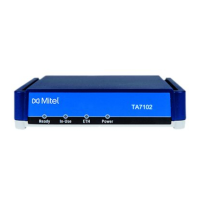

 To Next Page